
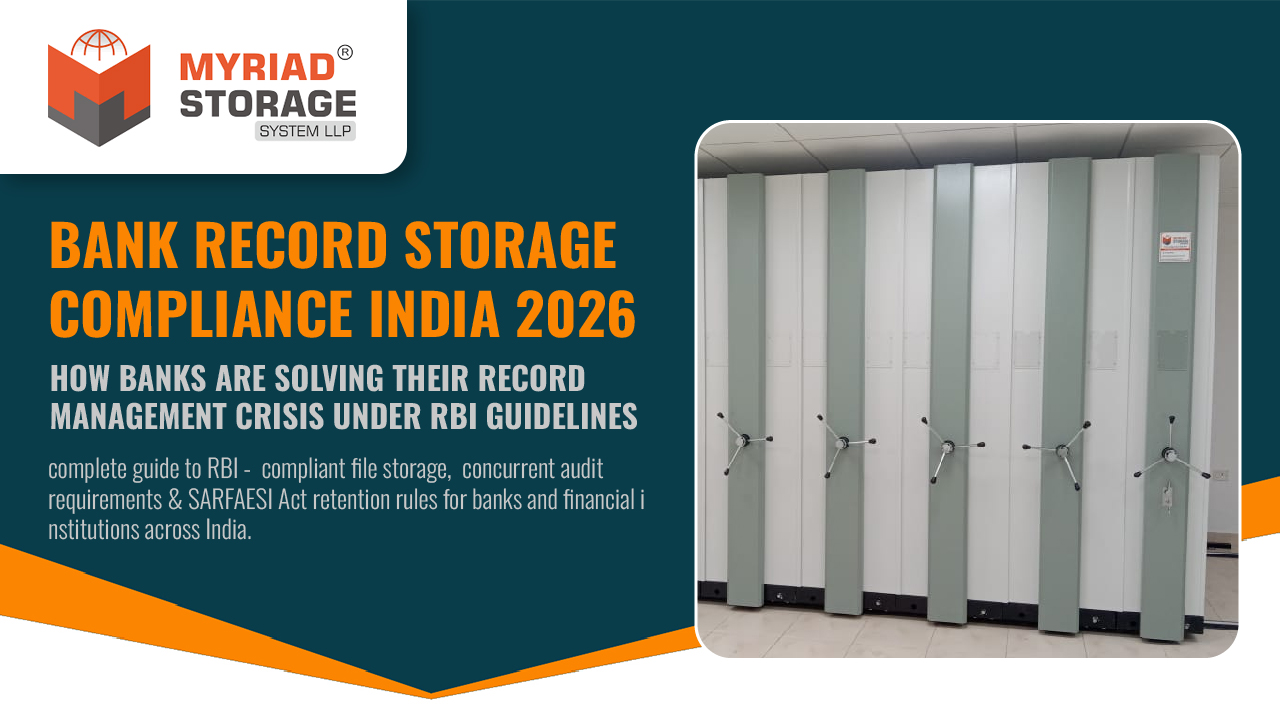
Banking & Finance Storage Compliance Guide: How Banks Are Solving Record Management Under RBI Guidelines in India 2026
Walk into the record room of almost any mid-sized bank in India today, and you’ll find the same scene — files stacked in corners, loan documents mixed with customer records, aging cabinets overflowing, and staff frantically digging through piles when an auditor asks for something specific.
Most branch managers will tell you it’s an operational problem. Something they’ll fix when there’s time.
There’s never time. And it’s not just an operational problem.
The RBI mandates that every bank maintain organized, accessible records under strict guidelines — covering customer KYC documents, loan files, regulatory compliance records, and statutory documentation. They don’t just ask for these to be in place. They verify. Multiple times a year. Unannounced.
These surprise visits are called concurrent audits. When an auditor walks into a record room and can’t find a requested file within 30 minutes, it becomes a documented finding. One finding is a note. A pattern of findings triggers escalation. Escalation leads to RBI enforcement action — which can mean restrictions on branch operations, limitations on loan origination, or increased supervisory scrutiny across the bank’s entire network.
This is why more and more banks across India are realizing that their record rooms aren’t just disorganized. They’re regulatory liabilities.
The RBI Regulations You Must Know (And Why They Matter)
Banks in India operate under a complex web of regulatory requirements. Unlike most industries where poor organization is just inefficient, in banking it can be a compliance violation.
Master Circular on Know Your Customer (KYC) Norms
The RBI’s Master Circular on KYC Norms is the foundational regulation governing customer identification and verification. Here’s what it requires:
Document Retention: All customer KYC documents — identity proof, address proof, PAN, passport, Aadhaar verification records — must be maintained for the entire duration of the customer relationship, plus 5 years after account closure. A customer who has been with the bank for 20 years and then closes their account means 25 years of retention requirements.
Accessibility Requirement: The circular requires records to be “readily available” for inspection. In practice, RBI’s concurrent auditors interpret this as: retrievable within 30 minutes of request, without staff spending excessive time searching.
What this means in practice: a bank with 50,000 active customer accounts needs to maintain organized, accessible records for potentially 100,000+ accounts — including closed ones — spanning decades. Most branches store these files across multiple locations (main branch vault, satellite record rooms, off-site storage), managed by different staff members, with no centralized index. Finding a specific account’s KYC file often takes 30–60 minutes as a result.
The SARFAESI Act, 2002 — Loan File Requirements
The Securitization and Reconstruction of Financial Assets and Enforcement of Security Interest (SARFAESI) Act governs how banks handle secured loans and recovery proceedings.
Every loan file must include:
- Original loan application signed by the customer
- Credit approval memo with sanctioning authority signature
- KYC documentation
- Income proofs (salary slips, IT returns, bank statements)
- Property valuation report (for mortgages)
- Legal opinion on security documents
- Mortgage deed or pledge agreement
- All disbursement vouchers showing release of loan amount
- Repayment statements and transaction history
- Correspondence with the customer (notices, amendments, etc.)
Retention Period: Loan files must be kept for a minimum of 7 years after loan closure. For a 20-year mortgage that closes, that’s 27 years of retention. For banks with thousands of loans, that’s tens of thousands of files spanning several decades.
Why this matters beyond compliance: if the bank ever needs to pursue legal action against a defaulted borrower — even 5 years after loan closure — the entire file must be retrievable. A single missing document can weaken or invalidate the bank’s legal position in court.
Most banks don’t have a systematic way to track which loan files are still required vs. which have cleared their retention period. Files pile up indefinitely.
RBI Concurrent Audit Requirements
Concurrent audits are unannounced visits by independent auditors — mandated for banks above a certain size — that happen 2–4 times per year. During these audits, the auditor can request any customer file or loan file at any time.
What’s expected: Active files should be produced within 15–30 minutes. Files in off-site archival storage get a little more leeway — 48–72 hours is generally acceptable. But if an active file is sitting somewhere in the branch and can’t be found, that’s a finding.
How findings escalate: One finding per audit gets noted. Two in the same audit suggests a pattern. Three across consecutive audits triggers escalation to RBI headquarters, and the bank receives a directive to remediate within a specific timeframe. Many branches are currently taking 45–60 minutes to locate a file when auditors ask — and that’s being documented every single cycle.
Statutory Retention Periods (Across Multiple Acts)
Beyond RBI guidelines, Indian law requires banks to retain:
- Customer account records: 10 years minimum (Income Tax Act)
- Loan files: 7 years after closure (SARFAESI Act)
- Currency Transaction Reports (CTR): 10 years (Prevention of Money Laundering Act)
- Suspicious Transaction Reports (STR): Indefinitely (mandatory reporting requirement)
- Audit reports and financial statements: 10 years (Companies Act)
- Income tax related documents: 7 years minimum (Income Tax Act)
Put it all together: a mid-sized bank with 20,000 active accounts, 15,000 closed accounts spanning 15 years, and 10,000 loan files is managing upwards of 200,000 documents that must be organized, accessible, and secure at any given time.
initely.
The Hidden Costs of Disorganized Records (That Most Banks Don't Track)
When a bank discovers its records are in poor shape, the instinct is to quickly reorganize and move on. But the real cost of poor record management goes much further than a messy room.
Direct Costs
Audit Findings and Regulatory Response
Each concurrent audit finding requires the bank to submit an “Audit Observation Reply” explaining the root cause, plus a “Remedial Action Plan” (RAP) showing how the issue will be fixed. For a branch with persistent record management problems, this typically means:
- 8–10 hours of internal staff time preparing the response
- ₹10,000–25,000 in external consultant fees (if outside help is brought in)
- Implementation of remedial measures
- A follow-up verification audit to confirm the fixes
If the same issue appears across consecutive audits, RBI escalates. The branch faces heightened scrutiny in future inspections — sometimes moving from the standard 18–24 month inspection cycle to one every 12 months, which is a significant operational burden on its own.
The Biggest Hidden Cost: Staff Time
This is the one most banks don’t measure — but it adds up fast.
Based on what we’ve seen across client implementations, the difference between a disorganized record room and an organized one typically looks like this:
- Disorganized system: 30–45 minutes to locate a specific file
- Organized system: 5 minutes or less
For a 50-branch bank averaging even 10 file requests per branch per day, that difference — roughly 35 minutes per search — compounds into hundreds of staff hours every week. When you factor in salary costs, the annual figure runs into crores for larger banks. That’s not a one-time cost. It happens every working day.
This doesn’t include the secondary impact: loan processing delays. When document retrieval is slow, loan disbursement is slow. Customers complain. Processing bottlenecks form. In a competitive market, that has a real revenue impact.
The “Audit Season Scramble” Problem
Many bank branches have an unspoken ritual: in the weeks before a concurrent audit, staff frantically reorganize files to look compliant. After the audit passes, things gradually slide back. Normal work resumes, files pile up, and the cycle repeats.
This recurring pattern has two costs: the actual overtime and stress during the scramble, and the fact that it never actually solves the underlying problem. The next audit finds the same issues.
Total Cost Estimate
For a mid-sized bank with 25–50 branches, the combined cost of poor record management — staff time, audit compliance costs, processing delays, and regulatory overhead — conservatively runs into several crores per year. The exact number varies by branch count and loan volume, but in nearly every assessment we’ve conducted, the figure surprises the management team that sees it for the first time.
The Hidden Costs of Disorganized Records (That Most Banks Don't Calculate)
When a bank discovers its records are disorganized, the instinct is to quickly reorganize and move on. But the costs of poor record management extend far beyond the inconvenience of a messy file room.
Direct Costs
Audit Findings and Regulatory Response
Each concurrent audit finding requires the bank to submit an “Audit Observation Reply” explaining the root cause and a “Remedial Action Plan” (RAP) showing how the bank will fix the issue. For a branch with poor record management, this might mean:
- 8–10 hours of staff time preparing the response
- ₹10,000–25,000 in external consultant fees (if the bank hires help)
- Implementation of remedial measures
- Follow-up verification audit to confirm remediation
If the findings are persistent (same issue in consecutive audits), RBI escalates. The bank’s supervisory category increases. The branch faces heightened scrutiny in future RBI inspections.
Regulatory Capital Impact
While a single record management finding does not directly impact capital requirements, it contributes to the RBI’s overall risk assessment. Multiple findings → higher risk category → potential requirement for additional reserves or restrictions on operations.
Increased Inspection Frequency
Branches with poor audit history get inspected more frequently by the RBI. Instead of the standard 18–24 month inspection cycle, a branch might face inspections every 12 months. Each inspection requires:
- 5–10 days of RBI team on-site
- Significant staff time responding to requests
- Potential operational disruption
Indirect Costs
Staff Time Searching for Records
This is the largest hidden cost most banks do not track.
Average file search time in a disorganized record room: 30–45 minutes
Average file search time in an organized system: 5 minutes
A typical 50-branch bank with 10 file searches per branch per day:
- 500 searches × 40 minutes per search = 333 hours per day
- Staff cost (salary + overhead): ₹500/hour average
- Daily cost: ₹1,66,500
- Annual cost: ₹4.6 crores (250 working days)
This is not one-time cost. This happens every single day, year after year.
Loan Processing Delays
Slow document retrieval delays loan disbursement. Customers complain. Processing bottlenecks form. Loan origination drops. The bank loses competitive advantage to competitors with faster processes.
Estimated impact: 5–10% reduction in loan origination volume = significant revenue loss
Audit Season Stress
In the weeks before a concurrent audit, banks pre-organize their files frantically to look compliant. Staff works overtime. After the audit passes, organization collapses again as daily work resumes and files pile up. This recurring stress affects employee morale and retention.
Compliance Risk and Enforcement Action
Repeated findings can trigger RBI enforcement action, which might include:
- Restrictions on new branch openings (cannot expand)
- Limitations on loan origination (can only renew existing loans)
- Requirement for RBI approval on major decisions (slows operations)
- In extreme cases, restrictions on banking license scope
Total Annual Cost of Poor Bank Record Management
For a mid-sized bank with 25–50 branches:
- Staff time searching: ₹2–4 crores/year
- Loan processing delays: ₹1–2 crores/year potential
- Audit compliance costs: ₹20–50 lakhs/year
- Regulatory capital impact: Variable
- Total: ₹3.5–7 crores per year
This does not include the intangible cost of regulatory restriction or the risk of enforcement action.
What Actually Happens During a Concurrent Audit
To understand why banks are acting on record management now, it helps to walk through what a realistic concurrent audit actually looks like.
The Auditor Arrives
Time: 10:30 AM (unannounced) Branch: Mid-sized urban branch with 3,500 active customer accounts Auditor: Concurrent auditor — independent, appointed through the RBI framework
The auditor walks into the branch manager’s office:
“Good morning. I’m here for the concurrent audit. I need to verify some records.”
The Audit Request
The auditor asks for two files:
- Loan Account #LN-2018-4521 — A home loan for ₹25 lakhs, approved in March 2018. Borrower: Rajesh Sharma.
- Savings Account #SA-2019-3847 — Opened in June 2019. Account holder: Priya Patel.
The branch manager calls Meera, the person responsible for records.
Meera starts searching. She checks the main filing cabinet — not there. She checks the secondary record room — not there. She calls the customer service desk to ask if they have a copy. They’re not sure.
It’s now 11:00 AM. Thirty minutes have passed.
The auditor makes a note: “Requested files not immediately available.”
Meera finally locates both files at 11:15 AM — 45 minutes after the original request.
The auditor checks Loan File #LN-2018-4521 and finds everything in order:
- ✓ Loan application — signed
- ✓ Credit approval memo — signed by sanctioning authority
- ✓ KYC documents — PAN, Aadhaar, address proof
- ✓ Income proof — salary slips, IT returns
- ✓ Property valuation report — signed
- ✓ Mortgage deed — complete
- ✓ Disbursement vouchers — all present
- ✓ Repayment statements — in chronological order
- ✓ Correspondence — filed properly
The documents are all there. But the 45-minute retrieval time is documented as a finding regardless.
The Audit Outcome
Audit Observation: Records not readily available. File retrieval took 45 minutes. RBI guidelines require immediate accessibility. Remedial Action Plan Required By: Within 15 days.
The branch manager must now submit a RAP. The most common remediation paths:
- Reorganize files by account number
- Hire additional staff to manage records
- Implement a new record management system
- Move to digital or scanned records
- Implement mobile compactor storage
Most banks choose option 1 or 5 — they’re the fastest to implement and most cost-effective at scale.
(This is right after the list: “Reorganize files / Hire staff / New record system / Move to digital / Implement file compactor storage“)
Why Filing Cabinets Don't Actually Solve the Problem
After going through an audit experience like the one above, the first thing most branches do is order more filing cabinets. It seems like the obvious fix. It usually isn’t.
Space Inefficiency
Traditional metal filing cabinets require fixed aisle space between each unit. In a 400 sq ft record room with 10 cabinets arranged in two rows:
- Each row of cabinets + required aisle space eats up floor area fast
- A typical setup holds around 10,000–15,000 files in 400 sq ft
The same 400 sq ft with a mobile compactor storage system — where racks slide on floor rails and share a single movable aisle — can hold 50,000+ files. That’s not a marginal improvement. It’s a completely different storage density.For bank record rooms specifically, a file compactor storage system with central locking and adjustable shelves is the most compliant and space-efficient solution available.
The Organization Mismatch
Filing cabinets are typically organized alphabetically or chronologically. But RBI auditors request files by account number.
Auditor asks for: “Loan Account #4521” Filing system organized by: “Last name — Sharma” Staff has to think: “Which Sharma is #4521?”
That’s where retrieval time disappears — in the translation between how files are stored and how they’re requested. A well-configured mobile compactor system labels each shelf section by account number range (“Accounts #4000–4500 on Row 3, Shelf 2”), so any staff member can walk to the exact location in under a minute.
Scalability
Every time a bank needs to add more files, it adds more cabinets — until there’s no floor space left. Then files overflow into auxiliary rooms, or off-site storage, or stacked boxes in a corner. Staff loses track of what’s where. The problem that looked manageable at 5,000 files becomes unmanageable at 20,000.
With a compactor system on a rail, new racks are added to the existing setup. Everything stays in one organized location.
How Banks Are Actually Organizing Records: The Four-Level System
Banks that have successfully improved their concurrent audit results typically follow a consistent four-level organization structure:
Level 1: By Account Number (Primary)
Everything is organized by account number range — not alphabetically, not by date.
- Shelf Row 1: Accounts #1000–1999
- Shelf Row 2: Accounts #2000–2999
- Shelf Row 3: Accounts #3000–3999
- …and so on
When the auditor asks for “Account #4521,” any staff member immediately knows to go to Row 4. No searching. No guessing.
Level 2: By Account Status (Secondary)
Within each number range, files are physically separated by status:
- Active accounts — front racks, easily accessible
- Closed / dormant accounts — back racks, less frequent access acceptable
This matters because RBI expects active files to be immediately retrievable. Archived files can take longer — so physically separating them allows staff to respond accordingly without slowing down active file retrieval.
Level 3: Loan Files vs. Account Records (Tertiary)
Loan files are kept separate from savings account records. This isn’t just for organization — it reflects the different retention schedules the law requires (7 years for loan files post-closure, 10 years for account records). Keeping them physically separate prevents confusion and makes it much easier to manage which files are due for destruction and which still need to be kept.
Level 4: Document Order Within the File (Quaternary)
Within each account folder, documents follow a standard sequence that every staff member knows:
Loan Account Files:
- Original loan application + approval memo
- KYC documents
- Income proof documents
- Property valuation (for mortgages)
- Security documents (mortgage deed, pledge agreement)
- Disbursement vouchers — in chronological order
- Repayment statements — in chronological order
- Correspondence — in chronological order
- Any amendments or loan restructuring documents
Savings Account Files:
- Account opening form
- KYC documents
- Account modification forms
- Correspondence
The reason this standardization matters: any staff member — not just the designated record keeper — can locate and verify a document quickly. That matters most when an auditor arrives on a day when the usual person isn’t in.
Colour Coding by Status
Many banks add a visual layer with colour-coded dividers:
- Green: Active accounts (frequently accessed)
- Yellow: Accounts pending closure
- Blue: Closed accounts (archived)
- Red: Suspended or dormant accounts
It’s a small addition that lets anyone scanning a shelf section identify file status at a glance — especially useful during audit reviews.

A Real-World Example: How a Cooperative Bank Improved Its Audit Results
Here’s a composite picture based on implementations we’ve worked on — the details are representative of the kind of transformation we see, though specifics vary across clients.
The Starting Situation
A 25-branch cooperative bank based in Maharashtra. Around 50,000 active customer accounts, 8,000 active loans. Consistent concurrent audit findings around record accessibility.
Record management was distributed across branches with no central system. Each branch had developed its own filing approach over time — some alphabetical, some chronological, some essentially random. Files were stored across:
- Main branch vault (~2,000 sq ft)
- Satellite record room at headquarters (~1,500 sq ft)
- An off-site storage facility in Thane (monthly rental: ₹8,000)
- Overflow boxes stacked in corners throughout various branches
Average file retrieval time: 45–60 minutes. Concurrent audit findings related to records: 6–8 per audit cycle, with two cycles annually.
A concurrent audit observation put the situation plainly: “Records management does not meet RBI standards for immediate accessibility.”
What They Changed
The bank’s management centralized record management at headquarters using a mobile compactor system in an 800 sq ft dedicated room.
The setup:
- 12 mobile compactor racks on floor rails
- Files organized by account number range across the system
- Colour-coded dividers separating active, closed, and dormant accounts
- Standard document arrangement within each folder
- Central locking with 3 authorized staff members
- Access log maintained (who accessed which section, date, time)
- A monthly internal spot-check process established
Installation happened over a weekend. File migration from all locations took the following two weeks.
The Results (6 Months Later)
File retrieval time: Down from 45–60 minutes to 5–7 minutes for active files — roughly 85% faster.
Concurrent audit findings for records: Zero in the first audit after implementation. The branch moved from “Areas for improvement” to “Fully compliant” in the auditor’s assessment.
Space and cost savings:
- Off-site storage eliminated: ₹8,000/month saved
- Vault space reduced by ~500 sq ft: ₹5,000/month saved
- Annual saving: approximately ₹1,56,000
Investment: Mobile compactor storage system, installation, and staff training came to approximately 8-15 lakhs total depends on how we customized according to our need.
Staff feedback: The record keeper who previously spent 30–40% of her time searching for files reported spending less than 5% of her time on retrieval after the change. That freed time went back into productive work.
The payback period purely from space savings is several years — but the compliance confidence and elimination of audit findings are what drove the decision. Those are harder to put a number on, but every branch manager who’s sat through an escalated audit review understands the value.
Compliance Checklist: Is Your Bank Ready for the Next Concurrent Audit?
Use this before your next audit. If you answer “No” to more than 3 items, your record room needs attention.
Record Organization (5 items)
- ☐ Files are organized by account number — not alphabetically or randomly
- ☐ Active and closed accounts are physically separated
- ☐ Each shelf section is clearly labelled with account number ranges
- ☐ Colour-coded dividers or clear markers separate active / closed / dormant files
- ☐ Within each account file, documents follow a standard, consistent order
Document Completeness (4 items)
- ☐ All KYC documents are present and verified (PAN, Aadhaar, address proof)
- ☐ All required loan documents are present (application, approval, security deed, disbursement vouchers)
- ☐ Repayment statements are filed in chronological order
- ☐ All customer correspondence and notices are properly filed
Physical Condition (3 items)
- ☐ Documents show no water damage, mould, or deterioration
- ☐ All documents are legible — not faded or obscured
- ☐ Files are stored neatly, not loose or stacked in unstructured piles
Compliance Documentation (4 items)
- ☐ A complete file inventory is maintained and updated
- ☐ A documented retention schedule is in place and being followed
- ☐ It’s clear who has authorized access to the record room and keys
- ☐ An access log is maintained (who accessed which files, when)
Staff Readiness (4 items)
- ☐ The designated record keeper is trained on the current organization system
- ☐ All staff know the file retrieval procedure and which section holds what
- ☐ A written procedures manual exists for file organization and retrieval
- ☐ Monthly or quarterly spot-checks are being done to verify system integrity
File Accessibility (2 items)
- ☐ Any active file can be retrieved within 15–30 minutes
- ☐ All active files are stored on-site — not in off-site or auxiliary storage
Scoring Guide
- 20–22 (Yes to nearly all): You’re in good shape. Your record room should pass concurrent audit without issues.
- 17–19 (Missed 3–5): Some gaps. You’ll likely pass audit but may receive one or two observations. Address before the next cycle.
- 13–16 (Missed 6–9): Significant gaps. Start remediation now — don’t wait for the audit to flag these.
- Below 13 (Missed 10+): High risk of multiple audit findings. Treat this as urgent.
FAQ About Banking Record Compliance
Does RBI explicitly require a mobile compactor storage system?
No. The RBI requires the outcome (organized, accessible, secure records), not the specific system. A mobile compactor system is one way to achieve this. Digital storage is another. Traditional filing cabinets are a third, but they are harder to maintain compliance with. The choice is yours, but the outcome is mandatory.
What is the statutory retention period for loan files?
Loan files must be retained for a minimum of 7 years after loan closure under the SARFAESI Act. For mortgages and secured loans, some banks retain indefinitely due to potential legal disputes. After the statutory period, files can be destroyed via authorized shredding service.
Can we use digital/cloud storage instead of maintaining physical files?
Digital storage is acceptable and increasingly common. However, many banks use a hybrid approach: Digital copies for quick reference, physical originals for legal compliance. RBI’s KYC Master Circular mentions “original documents” should be maintained. Digital copies are acceptable for speed, but originals provide the strongest legal standing in court disputes.
What happens if we cannot find a file during a concurrent audit?
This is a critical finding. It gets escalated immediately. If it is a recurring issue (found in multiple concurrent audits), RBI triggers enforcement action, which could include: limitations on branch expansion, restrictions on loan origination, or heightened supervisory scrutiny.
How do we organize files by account number if customers' last names are different?
Account numbers are assigned sequentially by the bank’s system, independent of customer name. When you open an account, the bank assigns “Account #4521” to “Rajesh Sharma.” That account number remains the same for the customer’s entire relationship. Files are organized by account number, making them findable regardless of customer name.
Can we archive closed loan files to off-site storage?
Yes, after 7 years post-closure. However, if an auditor requests an archived file, the bank has 48–72 hours to retrieve it. This is acceptable for archived files, but not for active files. Active files must be on-site and immediately accessible.
What if we digitize all our records? Can we destroy the originals?
Banks typically maintain both digital and physical originals for compliance and legal reasons. Courts in India give more weight to original signed documents in contract disputes. Digital files are acceptable for operational efficiency, but originals should be retained per statute (7–10 years). Many banks maintain digital copies for quick reference but keep originals for legal compliance.
How often should we audit our record management system?
Monthly spot-checks are recommended. Randomly select 10–20 files and verify: (1) they are correctly located, (2) all required documents are present, (3) documents are in the correct order. This monthly verification ensures the system remains compliant and catches issues before the concurrent audit.
Key Regulations & References
1. Master Circular on Know Your Customer (KYC) Norms Issued by: Reserve Bank of India rbi.org.in — Search “Master Circular KYC” Key requirement: Customer KYC documents must be maintained for the entire relationship plus 5 years after closure, and must be readily available for inspection.
2. SARFAESI Act, 2002 Issued by: Ministry of Finance rbi.org.in — Search “SARFAESI Act Guidelines” Key requirement: Loan documents must be retained for 7 years post-closure, properly filed to support enforcement of security interests.
3. RBI Guidelines on Concurrent Audit Issued by: Reserve Bank of India rbi.org.in — Search “Concurrent Audit Guidelines” Key requirement: Records must be readily available — generally interpreted as 15–30 minute retrieval — during unannounced audit visits.
4. Prevention of Money Laundering Act (PMLA), 2002 Issued by: Ministry of Finance Key requirement: Currency Transaction Reports (CTR) must be retained for 10 years.
5. Income Tax Act, 1961 Issued by: Central Board of Direct Taxation Key requirement: Bank account records and income-related documents must be retained for a minimum of 7 years.
Conclusion
After spending years working with banks across India on record management, the pattern is consistent: the branches that come to us after an audit finding are always reacting. The ones that come before — because a manager recognized the risk early — are the ones that pass every subsequent audit cleanly and without stress.
Record management doesn’t have to be a recurring problem. Set up the right system, train your people properly, and run monthly checks. After that, an unannounced concurrent audit should feel routine — not like a fire drill.
The investment pays off in space savings and recovered staff time. The compliance confidence that comes with it is harder to quantify, but ask any branch manager who’s been through an escalation and they’ll tell you exactly what it’s worth.
Ready to Get Your Bank Audit-Ready?
If your bank is facing concurrent audit pressure, has already received a record management finding, or simply wants to get ahead of the issue, we’re happy to take a look.
At Myriad Storage System LLP, we’ve worked with banks, co-operative societies, and financial institutions across India. We understand what concurrent auditors are looking for and how to design a system that holds up — not just for the next audit, but consistently.
How we work:
We start with a free compliance assessment of your current record room — file volume, retrieval time, organization gaps, and space constraints. From there, we design a system tailored to your specific situation, install it, train your staff, and support you through your next concurrent audit verification.
There’s no template solution here. Every bank’s record room is different.
Contact us for a free assessment →
Your next concurrent audit may be closer than you think. Getting organized now is always easier than explaining a finding later.
Last updated: May 2026 Based on RBI Master Circular on KYC Norms, SARFAESI Act guidelines, concurrent audit requirements, and statutory retention periods under Indian law. Prepared by: Myriad Storage System LLP — Storage Solutions for Banking & Finance




The point about concurrent audits exposing disorganized record rooms really drives home the urgency; waiting until an auditor arrives to find files is a risky strategy that can lead to serious compliance findings. Transitioning from reactive ‘fix it when there’s time’ mentalities to proactive, RBI-aligned systems seems to be the only way to actually survive those unannounced inspections without penalties.
This post really highlights that managing bank records isn’t just about storage—it’s about accessibility and staying compliant. Ensuring that files can be retrieved quickly seems crucial for avoiding repeated audit findings, especially under RBI’s stringent guidelines.