Bangalore's Fintechs Think They're Paperless — RBI Disagrees. Here's What You Actually Need to Store.
Your lending app processes 10,000 loan applications per month. Your KYC is eKYC — Aadhaar-based, video-verified, completely digital. Your loan agreements are e-signed. Your repayment tracking is automated. Your entire stack lives on AWS.
And somewhere in your 1,500 square foot Koramangala office, there is a metal almirah crammed with paper that nobody wants to talk about.
That almirah contains the physical records that the Reserve Bank of India requires every NBFC — which is what your fintech legally is — to maintain. Not as a backup. Not as a nice-to-have. As a regulatory requirement with penalties for non-compliance.
Bangalore has over 400 fintech companies. Most of them are registered as NBFCs or work with NBFC partners. Almost none of them have a physical document storage strategy. They are building billion-dollar lending platforms on cloud infrastructure while their compliance records sit in an unlocked cabinet that any intern can open.
This is the gap that gets flagged during an RBI inspection. And this is exactly what a file compactor storage system solves — without consuming the floor space that your engineering team needs.
What Physical Records Does RBI Expect Your Fintech to Maintain?
If your company holds an NBFC licence — or operates as a Digital Lending App (DLA) for a licensed NBFC — these records must exist in physical form or as verified physical copies. The RBI’s NBFC KYC Directions, 2025 and the Prevention of Money Laundering Act lay out the requirements.
Customer KYC records. Even when onboarding is fully digital via eKYC, the underlying identity verification records — Aadhaar authentication logs, PAN verification responses, video KYC recordings, and the customer consent records — must be maintained. For customers onboarded through physical KYC (still common for high-value loans), original identity and address proof copies must be retained for 5 years after the relationship ends.
Loan agreements and sanction letters. E-signed loan agreements are legally valid under the IT Act. But the RBI’s Digital Lending Guidelines require that the NBFC (not the lending app) retain the executed agreement. Many NBFCs maintain physical printouts of e-signed agreements as backup evidence — because in a courtroom dispute over a defaulted loan, a printed, stamped agreement carries more weight than a PDF on a server.
Board resolutions and corporate governance records. Every NBFC must maintain physical board meeting minutes, shareholder resolutions, statutory filings, RBI correspondence, and compliance certificates. The Companies Act requires these for 8 years. Most fintech founders store these in a folder in someone’s desk drawer.
PMLA records. Currency Transaction Reports (CTRs) and Suspicious Transaction Reports (STRs) filed with FIU-IND must be retained for 10 years. Physical copies of these filings — plus the supporting transaction evidence — are required during PMLA inspections.
Employee and vendor records. HR files for every employee (offer letters, identity proofs, NDAs, ESOP agreements), vendor contracts, and partnership agreements with co-lending NBFCs or banking partners — all require physical retention under various statutes.
Funding documentation. Shareholder agreements, term sheets, cap table records, investor consent letters, and board resolutions for each funding round. These are physical originals that must be retrievable for legal due diligence during subsequent rounds or exits.
For a Series B fintech with 300 employees, 50,000 borrowers, and 3 funding rounds — the physical document volume easily crosses 100,000 pages. That is not a folder-in-a-drawer situation. That is a storage infrastructure problem.
Why This Problem Is Uniquely Bangalore's
Bangalore has the highest concentration of fintech companies in India. Koramangala alone has more NBFC-registered lending startups per square kilometre than any other neighbourhood in the country. HSR Layout, Indiranagar, and Whitefield are close behind.
These companies share three characteristics that make the physical storage problem acute:
Small office footprints. A typical Series A fintech operates from 1,500 to 3,000 square feet in Koramangala or HSR Layout. Every square foot is allocated to engineering desks, product teams, sales pods, and a small meeting room. There is no “records room” in the floor plan. Physical documents get stuffed into whatever space is left — a corner almirah, a shelf under the staircase, a cupboard in the server room.
Rapid growth in headcount and borrowers. A lending fintech that grows from 10,000 to 100,000 borrowers in 18 months generates 10x the compliance documentation in the same period. The almirah that was half-empty at launch is overflowing before the second funding round closes. Nobody planned for this because “we’re a digital company.”
Compliance awareness gap. Most fintech founders come from technology backgrounds, not banking. They understand API integration and cloud security intuitively. They do not intuitively understand that RBI expects physical access control for documents containing Aadhaar numbers. The compliance team knows, but the facilities budget rarely reflects it.
This is not a Mumbai problem or a Delhi problem — because those cities do not have this density of early-stage, high-growth fintechs operating from tiny offices. This is a Bangalore problem.
What Happens When RBI Inspects Your Fintech
NBFC inspections are not like startup pitch meetings. The RBI inspection team arrives — sometimes with advance notice, sometimes without — and asks to see specific records.
The inspection covers:
Asset classification files. The inspector asks for the loan file of a specific borrower — identified by loan account number. The compliance officer has to produce the KYC documents, sanction letter, agreement, disbursement proof, and repayment history. If the company’s physical records are in an unlocked almirah sorted by “whenever we printed it,” this retrieval takes 30 to 60 minutes. The inspector notes it.
Governance documentation. Board minutes for the last 4 meetings. Compliance officer appointment letter. Audit committee composition. RBI annual return filing copies. If these are in a desk drawer mixed with old visiting cards and headphone cables, the impression is not good.
PMLA compliance. STR filing records, CTR submissions, customer risk categorisation documentation. These are serious regulatory records. They should not be in the same shelf as the office stationery.
A single inspection with multiple “records not immediately available” findings triggers increased supervisory attention. For a fintech that depends on its NBFC licence to operate, this attention is not just inconvenient — it is existential.
For a detailed walkthrough of what happens during banking audits, including the four-level filing system that makes retrieval instant, see our complete banking compliance guide.
How a File Compactor Fits Into a 1,500 Sq Ft Fintech Office
This is where most fintech founders assume the solution does not apply to them. “File compactors are for banks and government offices. We’re a startup.”
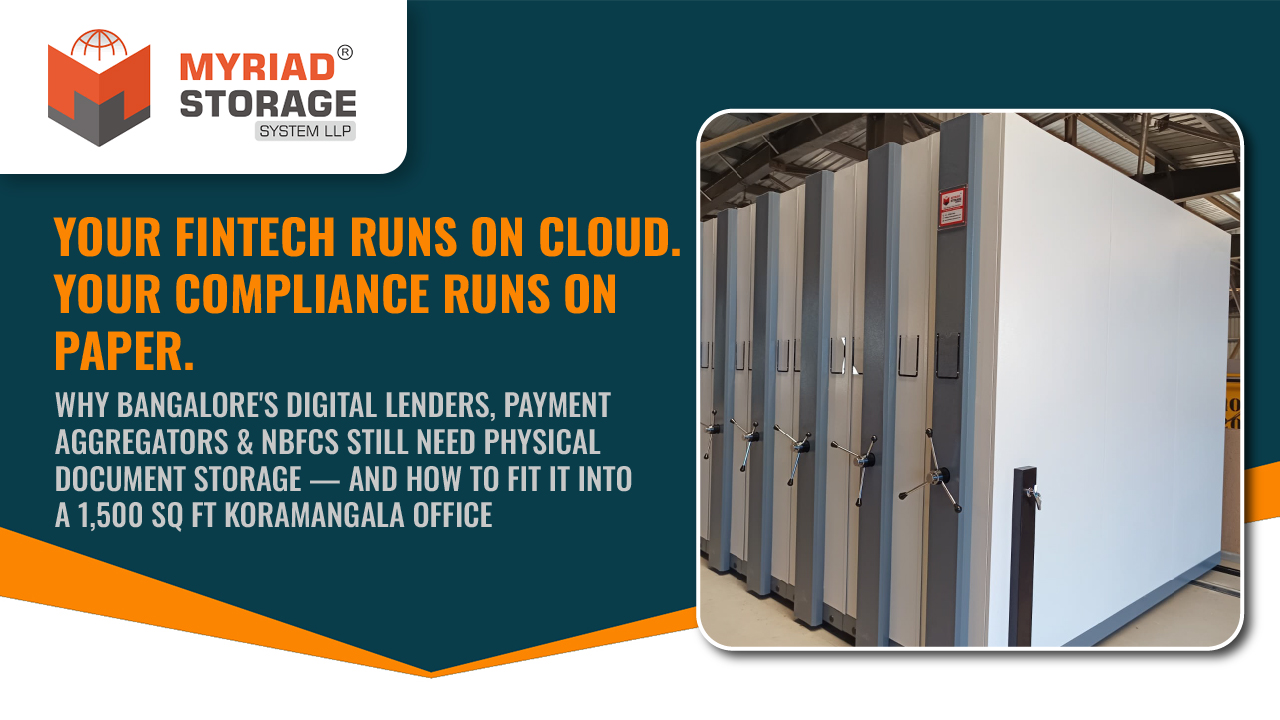
A file compactor is not a room-sized installation by default. It is a modular system that scales from 4 bays (fitting into a 6 foot × 3 foot floor space) to 40+ bays for large archives. For a fintech office, the small-format configuration is what works.
A 4 to 6 bay file compactor for a fintech:
- Floor footprint: approximately 1.8 metres × 0.9 metres (6 feet × 3 feet) — smaller than two side-by-side almirahs
- Storage capacity: 1,000 to 2,100 files — equivalent to replacing 4 to 6 standard almirahs
- Central locking: one key secures all compliance records — Aadhaar data, loan agreements, PMLA filings
- Adjustable shelves: configure for thin KYC folders, thick loan files, and box files within the same unit
- Material: CRCA steel with electrostatic powder coating — built to last 15+ years in Bangalore’s climate
Where it fits in a small office:
It replaces the corner almirah, the under-staircase cupboard, and the server-room shelf — consolidating all physical compliance records into one locked, organised unit that takes less floor space than what you are currently using across scattered locations.
The filing method for a fintech is simpler than a bank branch. Three sections:
- Section 1: Customer/borrower records — sorted by loan account number
- Section 2: Corporate governance — board minutes, RBI correspondence, statutory filings, funding documents
- Section 3: Employee records — HR files sorted alphabetically
Central locking ensures that borrower data containing Aadhaar and PAN is not accessible to every employee — which is what the DPDPA requires for organisations processing personal data.
What Smart Bangalore Fintechs Are Doing Differently
The fintechs that get this right do not treat physical record storage as an afterthought. They build it into their office setup from day one — the same way they plan their server infrastructure, their engineering tooling, and their compliance framework.
They appoint a records custodian. Not a full-time role — but a designated person (usually the compliance officer or executive assistant) who is responsible for maintaining the compactor, managing key access, and ensuring new documents are filed in the correct section within 48 hours of generation.
They create a filing SOP. A one-page document that every team knows: where borrower KYC goes, where board minutes go, where HR files go, who has the key, and what the retrieval process is. This SOP survives employee turnover — which in Bangalore fintechs happens frequently.
They separate digital access from physical access. Digital copies on Google Drive for daily operational use. Physical originals in the locked compactor for compliance and legal purposes. The two systems serve different needs and neither replaces the other.
They plan for scale. A 4-bay compactor handles the first 1,000 borrowers. When the company crosses 10,000 borrowers, additional bays are added to the existing rail system without replacing anything. The compactor grows with the company — just like the engineering team and the cloud infrastructure.
Your cloud stack is enterprise-grade. Your compliance storage shouldn't be an unlocked almirah.
Compliance Infrastructure That Matches Your Tech Stack
A 4 to 6 bay file compactor takes less space than two almirahs, stores 3× the documents, locks with a single key, and lasts 15+ years. We'll visit your Bangalore office and design a compact setup that fits your floor plan.
SBI, ISRO, Tata clients
500+ installations
ISO 9001:2015
Myriad Storage System LLP · ISO 9001:2015 · Factory in Vasai, Mumbai · Pan-India delivery & installation
Frequently Asked Questions
Does RBI require fintechs to maintain physical records?
If your fintech holds an NBFC licence or operates as a Digital Lending App for a licensed NBFC, yes. RBI’s NBFC KYC Directions require customer identification records to be maintained for 5 years after the relationship ends. PMLA requires transaction records and suspicious transaction reports for 10 years. Loan agreements, board resolutions, and statutory filings must also be retained in physical form.
Can we just keep everything digital and skip physical storage?
Digital copies are acceptable for operational use, but physical originals or verified copies carry stronger legal standing in court disputes. Many NBFCs maintain a hybrid approach — digital for daily access, physical for compliance and legal protection. Board minutes, shareholder agreements, and signed regulatory filings typically require physical retention under the Companies Act.
How much space does a file compactor need in a small fintech office?
A 4 to 6 bay file compactor fits in approximately 1.8 metres × 0.9 metres of floor space — smaller than two standard almirahs side by side. This compact configuration stores 1,000 to 2,100 files, which covers the compliance needs of most early to mid-stage fintechs with up to 50,000 borrowers.
What should a fintech store in a file compactor?
Three categories: borrower/customer records (KYC documents, loan agreements, sanction letters), corporate governance records (board minutes, RBI correspondence, funding documents, statutory filings), and employee records (HR files, NDAs, ESOP agreements). Central locking ensures Aadhaar and PAN data is accessible only to authorised personnel.
Can we add more storage as our fintech grows?
File compactor systems are modular — additional bays can be added to the existing rail system without replacing the original installation. A company that starts with 4 bays at Series A can expand to 10 bays by Series C on the same rail track.
Does Myriad install file compactors in Bangalore fintech offices?
Yes. Myriad delivers and installs pan-India with a dedicated project team for Bangalore. We assess your office space, design a compact configuration that fits your floor plan, and handle complete installation. Myriad is ISO 9001:2015 certified with 500+ installations for clients including SBI, ISRO, Tata, and L&T.