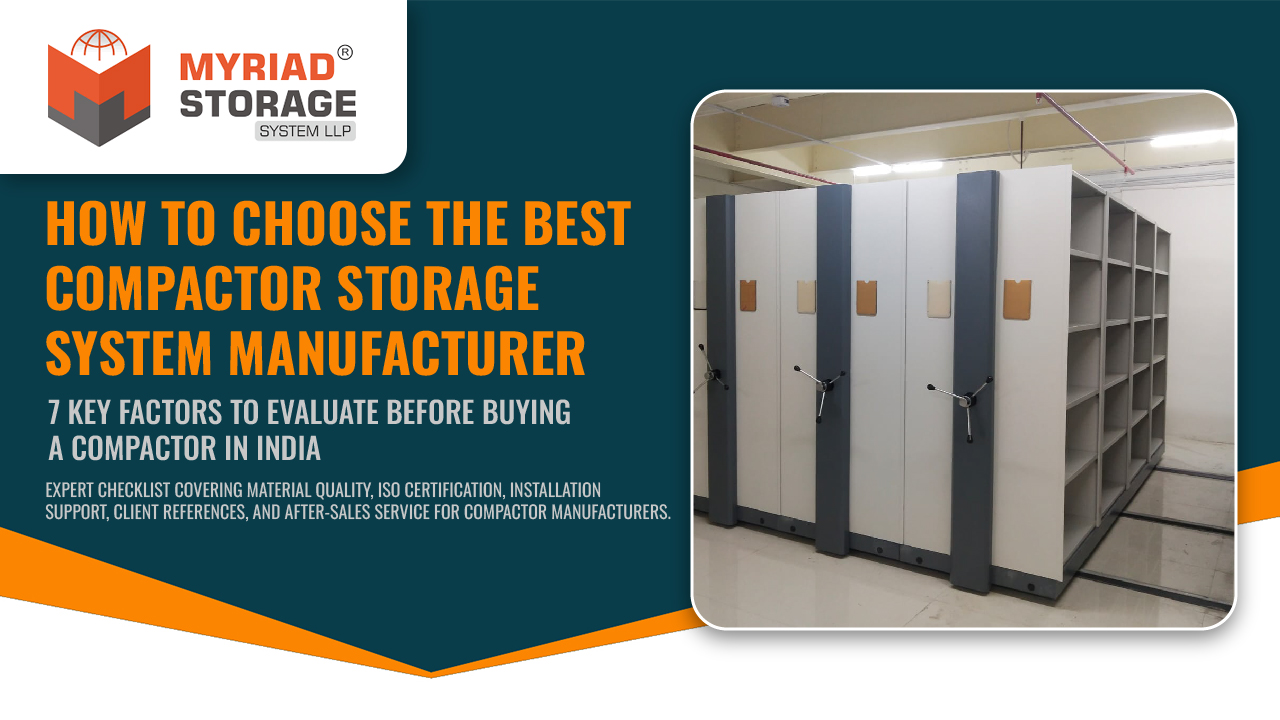
How to Choose the Best Compactor Storage System Manufacturer in India
Here is a fact most buyers learn the hard way: more than half the companies listing themselves as compactor storage system manufacturers on IndiaMART, TradeIndia, and Google are not manufacturers at all. They are trading companies or dealers who take your order, outsource production to a third-party fabricator, add their margin, and deliver a product they had no role in designing or quality-controlling.
The result? Compactor systems where the rails jam within six months. Powder coating that chips and rusts after one monsoon. Shelves that buckle under normal file loads. And when you call for service, the trader has moved on to his next order and has no technical team to send.
Choosing the wrong compactor storage system manufacturer does not just waste money. It creates a storage system you cannot trust, in a room you cannot use, for the next 10 to 15 years.
This guide is not a generic list of “factors to consider.” It is a practical, ground-level checklist built from real buyer mistakes — the kind of mistakes that organisations from small offices to large institutions make when they do not know what to look for.
The Real Problem: Traders Disguised as Manufacturers
Before we discuss how to choose the right manufacturer, you need to understand the landscape of the compactor storage industry in India.
The Indian market has roughly three types of companies selling compactor storage systems.
Actual manufacturers own a factory, employ fabrication and welding staff, purchase raw CRCA steel coils, and produce finished compactor systems in-house. They control quality at every stage — from steel cutting and bending to powder coating, rail fitting, and final assembly. There are perhaps 15 to 20 genuine compactor manufacturers across India.
Trading companies have a registered business, a website, and sometimes even a showroom — but no factory. When you place an order, they forward your specifications to a fabricator (often a small workshop in an industrial area) who builds the system. The trader handles sales and logistics but has no involvement in manufacturing quality. There are hundreds of these on B2B portals.
Fabricators and local workshops are small-scale metalworking shops that can build basic compactor frames but lack the precision engineering, powder coating facilities, and quality control systems that commercial-grade compactor storage requires. Their products work initially but deteriorate rapidly.
The challenge for buyers is that all three types present themselves identically online. The same product photos (often copied from actual manufacturers), similar website language, and comparable pricing. Without knowing what to look for, you cannot tell them apart until the product arrives and problems begin.
9 Red Flags That Expose a Bad Compactor Storage System Manufacturer
9 red flags when choosing a compactor manufacturer
Check these before signing any purchase order
No factory address on website
Check GST certificate — registered as Manufacturer or Trader?
Factory visit not offered or avoided
Insist on visiting. Look for raw steel coils, CNC machines, powder coating oven
Cannot explain steel grade or thickness
Should answer: CRCA steel, 0.8-1.2mm standard, 1.5-2.0mm heavy duty
Suspiciously low pricing (30-40% below market)
Get 3-4 quotes. Ask how the low price is achieved — check bill of materials
No ISO or quality certification
Verify ISO 9001:2015 certificate online. Check NABCB accreditation of certifier
No named client references provided
Ask for 3-5 recent clients with contact details. Call them. Visit one site
Quotes without conducting site survey
A real manufacturer will never quote without measuring your room first
Vague warranty and service terms
Get warranty in writing: 5-10 years structure, 1-2 years moving parts, service SLA
No product testing or demonstration offered
Ask for demo at factory or existing site. Check smooth movement, safety features
Rule of thumb: If a company cannot show you their factory, explain their steel grade, name their clients, and demonstrate their product — they are likely a trader reselling someone else's product, not a manufacturer.
Red Flag 1: No Factory Address on the Website
A genuine compactor storage system manufacturer is proud of their factory. They list the full factory address on their website, invite clients for factory visits, and showcase production photos. If the website only lists a registered office address (typically a residential or commercial office) with no mention of a manufacturing facility, that is your first warning sign.
What to do: Search for the company name on the Ministry of Corporate Affairs website (mca.gov.in) to verify their registration. Check the GST registration certificate — it shows whether the business is registered as a “Manufacturer” or “Trader/Dealer” under the business activity field. This single document tells you more than any website ever will.
Red Flag 2: No Factory Visit Offered
Ask to visit the factory before placing your order. A real manufacturer will welcome this — it is a selling point for them. A trader will make excuses: the factory is in another state, it is under renovation, visits require prior scheduling that somehow never gets confirmed.
What to do: Insist on a factory visit. When you visit, look for raw material inventory (CRCA steel coils), cutting and bending machines (CNC or hydraulic press brakes), a welding station, a powder coating booth with an oven, and an assembly area with finished or in-progress compactor units. If the factory only has finished products and no production equipment, it is a warehouse and not a factory.
Red Flag 3: They Cannot Explain the Steel Grade
Ask any compactor storage system manufacturer one question: what grade of steel do you use and what is the sheet thickness? A genuine manufacturer will answer without hesitation — CRCA (Cold Rolled Close Annealed) steel, typically 0.8 mm to 1.2 mm thickness for standard office compactors and 1.5 mm to 2.0 mm for heavy duty industrial compactors.
A trader will give vague answers: “high quality steel,” “premium grade material,” or “industry standard thickness.” They do not know because they do not manufacture.
What to do: Ask for a material test certificate from the steel supplier. Real manufacturers receive these with every steel coil they purchase and can produce them on request. Also ask to see a cross-section of the steel panel — you can verify thickness with a simple vernier caliper measurement during a factory visit.
Red Flag 4: Suspiciously Low Pricing
Compactor storage systems involve significant raw material (steel), skilled labour (welding, assembly), and overhead (powder coating, quality control). There is a floor price below which a quality system cannot be produced.
When a company quotes 30 to 40 percent below the market average, they are cutting corners somewhere — thinner steel, inferior powder coating, cheaper wheels and rails, or no quality checks. The savings you gain today become repair and replacement costs within 2 to 3 years.
What to do: Get quotes from at least 3 to 4 manufacturers. If one quote is dramatically lower than the others, ask them specifically how they achieve the lower price. If they cannot explain it with a clear bill of materials, walk away.
Red Flag 5: No ISO or Quality Certification
An ISO 9001:2015 certification does not automatically guarantee quality, but its absence in 2026 is a definite red flag. The certification process requires documented quality management systems, standard operating procedures, and regular audits. Most legitimate manufacturers have obtained this by now.
What to do: Ask for the ISO certificate and verify it online. Check the certification body name — it should be accredited by NABCB (National Accreditation Board for Certification Bodies). Some companies display fake or expired certificates, so always verify.
Red Flag 6: No Named Client References
A genuine compactor storage system manufacturer with years of experience will have a portfolio of named clients that you can independently verify. Banks, government departments, hospitals, corporate offices — these are not confidential clients. Their compactor installations are visible and verifiable.
A trader or new entrant will claim “100+ installations” but will not name specific organisations or provide contact details for references.
What to do: Ask for 3 to 5 recent client references with contact details. Call those clients. Ask them about product quality, installation experience, and after-sales service. Visit one installation site if possible — seeing a system that has been in daily use for 2 to 3 years tells you more about quality than any brochure.
Red Flag 7: No Site Survey Before Quoting
A reputable compactor storage system manufacturer will never quote without conducting a site survey first. They need to measure the room dimensions, check floor load capacity, assess ceiling height, note column and beam positions, check door widths for delivery access, and verify electrical points if motorised systems are being considered.
A company that sends you a quotation based on a phone conversation or a room photo is guessing — and guessing leads to systems that do not fit, rails that cannot be installed due to floor conditions, or racks that block fire exits.
What to do: If a manufacturer quotes without visiting your site, that is a red flag. Insist on a physical site survey. It should be free of charge — any manufacturer investing in a relationship will absorb this cost.
Red Flag 8: Vague Warranty and Service Terms
Ask about warranty and after-sales service in specific terms. What exactly is covered? For how long? What is the response time for service calls? Is there a service team in your city?
Genuine manufacturers provide clear warranty terms — typically 5 to 10 years on the structure and 1 to 2 years on moving parts like wheels and locking mechanisms. They have trained service technicians who can be on-site within 24 to 72 hours.
Trading companies offer vague “lifetime warranty” claims that mean nothing because they have no service infrastructure. When something goes wrong, they ask you to find a local welder.
What to do: Get warranty and service terms in writing as part of the purchase agreement. Ask what happens if the manufacturer cannot resolve a service issue within a specified timeframe.
Red Flag 9: No Product Testing or Demonstration
A confident manufacturer will demonstrate their product’s performance. They will show you how smoothly the racks move on the rails, how the locking mechanism works, how much weight a shelf can handle, and how the anti-tilt safety feature prevents accidents.
A trader selling someone else’s product cannot demonstrate these features because they do not fully understand the engineering behind them.
What to do: Ask for a product demonstration — either at the factory, at an existing installation site, or through a detailed video showing the system under load. Pay attention to how smoothly the racks move, whether there is any wobbling, and how the safety mechanisms function.
What a Proper Quotation Should Include
When you receive a quotation from a compactor storage system manufacturer, it should include all of the following. If any item is missing, ask for it before proceeding.
The quotation should clearly state the number of bays and overall dimensions of the system including height, width, and depth per bay. It should specify the steel grade and sheet thickness used for panels, shelves, and base frames. The type of powder coating and its thickness in microns should be mentioned — standard is 60 to 80 microns.
Rail specifications including material, length, and floor-mounting method should be included. The type and brand of wheels or rollers should be specified since these determine how smoothly the system operates over years of daily use.
The quotation should state the total load capacity per bay and per shelf. It should describe the locking mechanism type and the anti-tilt safety system. Installation charges, delivery charges, and any civil work required for floor preparation should be itemised separately.
Payment terms, delivery timeline, warranty coverage, and after-sales service terms should all be explicitly stated. If any of these elements are missing from a quotation, the manufacturer is either hiding something or has not thought through the project properly — neither is a good sign.
What a proper compactor quotation should include
Good quotes vs bad quotes — know the difference before you pay
| Item | Proper quotation states | Bad quotation hides |
|---|---|---|
| Dimensions | Exact H × W × D per bay, number of bays, total system dimensions | Just says "compactor system" with no measurements |
| Steel grade | CRCA steel, sheet thickness 0.8-1.2mm for panels, shelves, base frames | Says "high quality steel" or "premium material" with no specs |
| Powder coating | Electrostatic powder coating, 60-80 microns, with pre-treatment wash | Just says "powder coated" — no micron spec, may skip pre-treatment |
| Rail specs | Rail material, length, floor-mounting method, and wheel type specified | Rails and wheels not mentioned — these determine long-term performance |
| Load capacity | Load per bay and per shelf in kg clearly stated | No load capacity mentioned — shelves may buckle under normal use |
| Safety features | Locking mechanism type and anti-tilt safety system described | Not mentioned — system may have no safety features at all |
| Installation | Installation charges, delivery charges, civil work itemised separately | "Installation extra" with no figure — surprise charges after purchase |
| Timeline | Manufacturing time, delivery date, installation schedule specified | No timeline — delivery may take months with no accountability |
| Warranty | 5-10 years structure, 1-2 years moving parts, service response time | Verbal "lifetime warranty" promise with nothing documented |
Questions to Ask During a Factory Visit
If you visit a compactor storage system manufacturer’s factory, here are the specific questions and observations that will tell you everything you need to know about their capability.
Walk the production floor and observe whether the factory is organised and clean or cluttered and chaotic. A well-maintained factory reflects a well-maintained quality system.
Ask to see the raw material storage area. Check if CRCA steel coils are properly stored (off the ground, covered from moisture) and whether material test certificates are available.
Look at the cutting and bending process. Are they using CNC or precision machines, or manual cutting with grinders? Precision cutting ensures panels fit together accurately without gaps.
Check the welding quality on in-production units. Welds should be clean, consistent, and free of splatter. Ask whether they use MIG welding (preferred for steel furniture) or basic stick welding.
Visit the powder coating booth. A proper setup includes a pre-treatment wash (to ensure adhesion), an electrostatic spray booth, and a curing oven. Ask what temperature and duration they cure at — standard is 180 to 200 degrees Celsius for 15 to 20 minutes. Companies that skip pre-treatment or under-cure will produce coating that chips and peels.
Ask how many compactor systems they produce per month. This gives you a sense of their capacity and whether your order timeline is realistic.
Industry-Specific Requirements You Should Know
Different industries need different compactor specifications. A manufacturer who understands these differences is more likely to deliver a system that actually works for your specific application.
Banking and financial services require compactors with individual bay locking, fire-resistant construction, and the ability to organise files by date for RBI-mandated retention periods. The system must accommodate lever arch files, flat files, and bound ledgers — each with different shelf spacing requirements.
Hospitals and healthcare need compactors that can handle a mix of patient files, X-ray film storage, and medical supply storage. NABH accreditation standards require documented access control for patient records, making individual bay locks essential. Some bays may need wider spacing for bulky medical equipment or pharmaceutical inventory.
Government departments handle massive volumes of land records, citizen applications, and policy files — often dating back decades. The compactor system must be designed for very high density with strong load-bearing shelves. Floor load capacity verification is especially important in older government buildings.
Warehouses and industrial facilities require heavy duty mobile compactors with reinforced steel, higher load capacity per shelf, and mechanical or motorised operation for smooth movement under heavy loads. Anti-corrosion treatment is critical in humid or coastal warehouse environments.
Libraries and universities need library compactor systems with quiet operation (noise control matters in academic settings), adjustable shelf spacing for different book sizes, and smooth rail movement that does not damage flooring.
Why the Cheapest Quote Is Almost Always the Most Expensive Decision
In compactor storage, you get exactly what you pay for. The difference between a well-built system and a cheaply built one is not visible on day one — both look identical when freshly powder-coated and newly installed. The difference shows up at month six, year two, and year five.
Cheap systems use thinner steel (0.5 to 0.6 mm instead of 0.8 to 1.2 mm) that dents and buckles under normal loading. The powder coating is thinner (30 to 40 microns instead of 60 to 80), chips within months, and exposes bare steel to rust. The wheels and rails are lower grade, causing the racks to jam, require excessive force to move, and eventually seize.
At that point, you face a choice: pay to repair a system that was poorly built from the start, or pay again for a new system from a better manufacturer. Either way, the cheap quote has now cost you more than the quality quote would have.
Every year, Myriad Storage System receives enquiries from organisations asking us to replace compactor systems that were installed just 2 to 3 years ago by another vendor. The replacement cost, plus the disruption of removing the old system and installing a new one, always exceeds what a quality system would have cost originally.
How Myriad Storage System Approaches Every Project
At Myriad Storage System LLP, our process starts with a free site survey where our technical team visits your location, takes precise measurements, assesses floor conditions, and discusses your specific storage requirements.
We design a custom mobile compactor storage system tailored to your space using CAD drawings that you approve before manufacturing begins. Every system is manufactured at our own facility in Vasai, Palghar — using CRCA steel with electrostatic powder coating cured in our own oven.
Our installation team handles complete on-site assembly including floor rail fitting, rack assembly, levelling, and load testing. We do not use third-party contractors for installation because the quality of installation directly affects how the system performs for the next 15 to 20 years.
Ready to optimise your storage space?
Get a free site survey and customised quotation within 48 hours
myriadstoragesystem.com
FAQ — Choosing a Compactor Storage System Manufacturer
How can I verify if a company is a real compactor storage system manufacturer or a trader?
Check the GST registration certificate — it shows whether the business is registered as a Manufacturer or Trader under the business activity field. Also visit mca.gov.in to verify company registration. A genuine manufacturer will have a factory address, invite factory visits, and be able to show raw material inventory and production equipment on-site.
What steel grade should a quality compactor storage system use?
A quality compactor should use CRCA (Cold Rolled Close Annealed) steel with sheet thickness of 0.8 to 1.2 mm for standard office compactors and 1.5 to 2.0 mm for heavy duty industrial compactors. Ask the manufacturer for material test certificates from their steel supplier to verify the grade and thickness.
Why should I avoid the cheapest compactor storage quote?
The cheapest quote usually means thinner steel, inferior powder coating, lower grade wheels and rails, and no quality checks. These systems develop problems within 6 to 24 months including jamming rails, chipping coating, rusting panels, and buckling shelves. Replacing a failed system costs more than choosing quality in the first place.
What should a proper compactor storage quotation include?
A complete quotation should specify number of bays, dimensions, steel grade and thickness, powder coating thickness in microns, rail specifications, wheel type, load capacity per bay and shelf, locking mechanism details, anti-tilt safety system, installation charges, delivery timeline, warranty terms, and after-sales service commitment.
How long does a quality compactor storage system last?
A properly manufactured compactor system built from CRCA steel with 60 to 80 micron powder coating lasts 15 to 20 years with minimal maintenance. The main maintenance requirement is annual lubrication of the rail and wheel system. Moving parts like wheels may need replacement after 8 to 10 years depending on usage frequency.