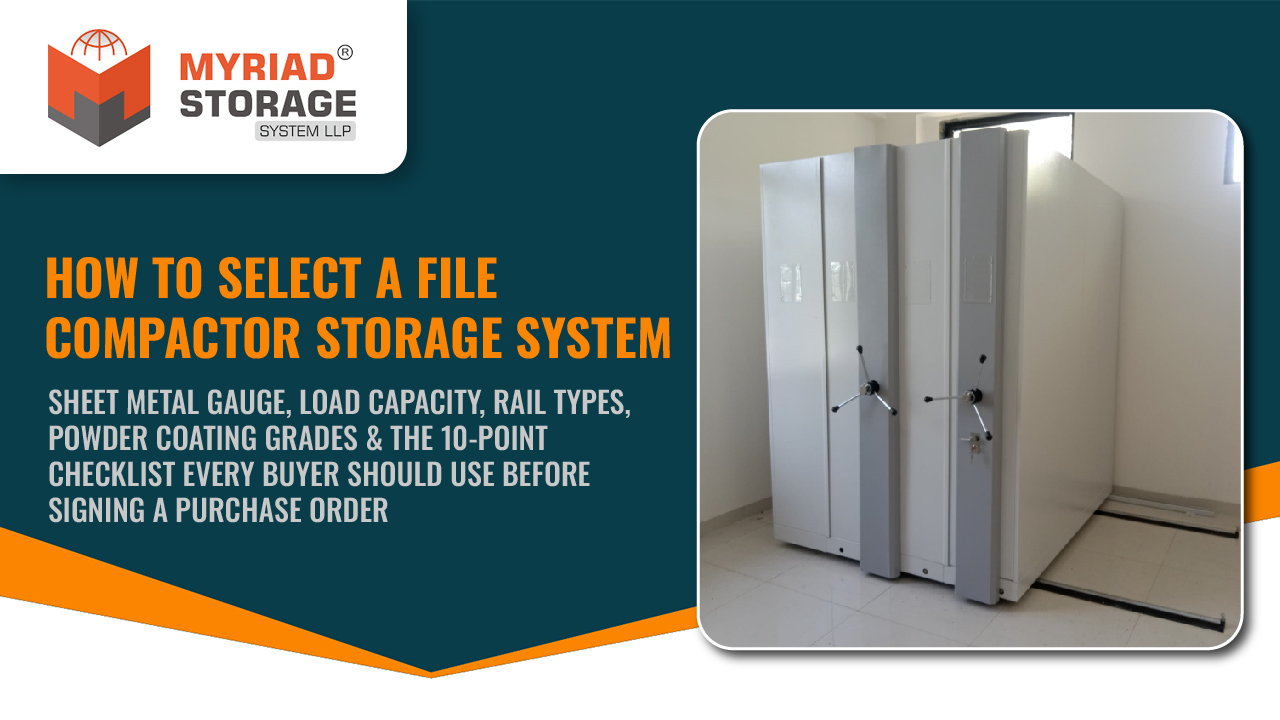
How to Select a File Compactor Storage System — A Technical Specification Guide for Buyers Who Want to Compare Quotations Like a Manufacturer
Every file compactor manufacturer in India will tell you their product is “heavy duty,” “smooth operating,” and “long lasting.” These words appear on every brochure, every website, and every quotation. But when you place two quotations side by side, how do you actually tell which compactor is better built?
The answer is in the technical specifications — and most buyers have never been taught how to read them.
This guide teaches you to evaluate a file compactor storage system the way a manufacturer would — by looking at the numbers that determine whether a compactor will last 15 years or start showing problems in 3. No generic advice. Just the specific technical details you need to compare any two quotations and know which one is offering real quality.
Sheet Metal Gauge — The Number That Determines Everything
The single most important specification in any file compactor quotation is the sheet metal gauge. This number tells you the thickness of the steel used to build the panels, shelves, and structural components. Everything else — load capacity, rigidity, lifespan — flows from this.
What the numbers mean:
In India, file compactor manufacturers use CRCA (Cold Rolled Close Annealed) sheet steel. The gauge system works inversely — a lower gauge number means thicker steel.
- 18 gauge (1.2 mm) — Heavy duty. Used for shelves and structural panels in quality compactors. This is what you want for any installation that will carry full file loads for 10+ years.
- 20 gauge (0.9 mm) — Medium duty. Acceptable for side panels and non-load-bearing components, but not ideal for shelves that carry file weight directly.
- 22 gauge (0.7 mm) — Light duty. Sometimes used in budget compactors to reduce cost. Shelves at this gauge will deflect under heavy file loads within 2 to 3 years.
What to check in a quotation:
A quality manufacturer will specify gauge for each component separately — “shelves: 18 gauge CRCA, side panels: 20 gauge CRCA, back panels: 22 gauge CRCA.” If the quotation says only “made from CRCA sheet” without specifying gauge, ask. If the answer is a single gauge for the entire unit, the manufacturer is likely using the same thin sheet everywhere to save cost.
The real-world difference: An 18-gauge shelf supports 60 to 80 kg per shelf span without deflection. A 22-gauge shelf at the same span starts bowing visibly at 30 to 40 kg. Over 10 years of daily use, that bowing becomes permanent — and the shelf eventually needs replacement.
Panel Construction — Why the Number of Folds Matters
Look at any file compactor panel from the side. You will see that the edges are folded — bent back on themselves one or more times. This is not decoration. Each fold adds structural rigidity to what would otherwise be a flat, flexible sheet of steel.
Fold count and what it means:
- 4-fold construction — The minimum for any commercial compactor. Each panel edge is folded twice on each side, creating a box-like profile that resists bending. Found in standard-quality compactors.
- 6-fold construction — Additional folds on the top and bottom edges. Significantly increases vertical rigidity. Recommended for compactors taller than 7 feet or those carrying heavy loads.
- 8-fold construction — The highest grade. Every edge — top, bottom, left, right — is double-folded. Found in heavy-duty industrial compactors and premium office systems. The panels feel noticeably stiffer when you press them.
How to check: Ask the manufacturer for the fold count on shelves and on vertical panels separately. Shelves need the most rigidity because they carry the load. A compactor with 8-fold shelves and 6-fold side panels is well-engineered. A compactor with 4-fold everything is cutting corners.
Why it matters practically: A shelf with more folds distributes weight across a wider structural profile. This prevents the “taco effect” — where a flat or poorly folded shelf bows in the middle when loaded, causing files to slide toward the centre and making retrieval difficult.
Load Capacity — How to Read the Numbers and Spot Exaggeration
Every compactor quotation mentions load capacity. But the way this number is presented varies dramatically — and manufacturers who want to impress use tricks to make their numbers look bigger.
Three types of load capacity you will see:
- Per-shelf capacity — The weight each individual shelf can hold. This is the most useful number for a buyer. A well-built file compactor shelf should support 60 to 80 kg per shelf span.
- Per-bay capacity — The total weight one bay (one vertical section with multiple shelves) can hold. This is simply per-shelf capacity multiplied by the number of shelves. A bay with 7 shelves at 70 kg each = 490 kg per bay.
- Total system capacity — The weight the entire compactor can hold. This is per-bay capacity multiplied by the number of bays. A 10-bay system at 490 kg per bay = 4,900 kg total.
How to spot exaggeration: Some quotations state “load capacity: 5,000 kg” without specifying whether this is per shelf, per bay, or total system. Always ask for per-shelf capacity — this is the number that tells you whether the individual shelf will hold your files without deflecting.
A practical test: Standard A4 box files weigh approximately 3 to 4 kg each when full. A shelf span of 900 mm can hold roughly 15 to 18 box files. That is 45 to 72 kg. If the per-shelf capacity is 70 kg, you are within safe limits. If it is 40 kg, you are overloading every shelf from day one.
Rail Types — Flush-Mount vs Surface-Mount and When to Use Each
The rail system is the foundation of every file compactor. It determines how smoothly the bays move, how long the system lasts, and what floor preparation is needed.
Surface-mount rails are fixed on top of the existing floor. The rails sit 15 to 25 mm above floor level, creating a slight step at the entry point.
- Advantages: Faster installation, no floor cutting, easier to remove or relocate later, keeps files elevated above floor level (helpful in ground-floor offices or areas with minor water ingress risk).
- Disadvantages: Creates a small step that users must step over when entering the aisle. Not ideal for wheelchair accessibility. Requires a ramp at the entry point for trolley access.
- Best for: Most office and commercial installations where speed and flexibility matter.
Flush-mount (recessed) rails are installed into channels cut into the floor. The rail top sits level with the finished floor surface.
- Advantages: No step, no trip hazard, clean visual appearance, fully accessible for wheelchairs and trolleys.
- Disadvantages: Requires floor cutting during installation, which adds cost and time. Difficult to relocate. Not suitable for floors with embedded electrical or plumbing conduits.
- Best for: Government buildings with accessibility requirements, hospitals, premium corporate offices, and any space where a flush finish is mandatory.
What to check: Ask the manufacturer which rail type they recommend for your floor and why. If they only offer one type, ask what happens if your floor is not suitable — a good manufacturer adapts the rail system to the floor, not the other way around.
Powder Coating — The Specification That Determines Whether Your Compactor Rusts in 3 Years or Lasts 15
Powder coating is the protective finish applied to every external surface of the compactor. In theory, it prevents rust, resists scratches, and maintains appearance. In practice, the quality varies enormously between manufacturers — and the difference shows up within 2 to 3 years.
Three specifications to ask for:
1. Coating thickness (microns). Measured in microns (µm), this tells you how thick the protective layer is. Industry standard for office furniture is 40 to 50 microns. A quality file compactor should have 60 to 80 microns. Budget compactors often use 30 to 40 microns — enough to look good on delivery but too thin to resist daily wear and humidity.
2. Application method. The two common methods are electrostatic spray and dip coating. Electrostatic powder coating uses an electric charge to attract powder particles evenly across the entire surface, including edges and corners. Dip coating (liquid paint) is cheaper but produces uneven coverage — especially on internal corners and folded edges where rust typically starts first.
3. Baking temperature. After application, the coated panels are baked in an oven to cure the coating. Standard curing requires 180 to 220 degrees Celsius. Under-curing (below 180°C) produces a coating that looks fine but chips easily and does not bond properly to the steel surface.
A simple test for any buyer: Ask the manufacturer: “What is your powder coating thickness in microns, and what baking temperature do you use?” If they cannot answer with specific numbers, the coating process is not controlled — and the finish will deteriorate unpredictably.
Wheels and Bearings — What Moves Your Compactor for the Next 15 Years
A file compactor bay loaded with files can weigh 300 to 500 kg. This entire weight sits on wheels that must roll smoothly along rails thousands of times over the system’s life. The wheel and bearing quality determines whether the compactor moves with a light push in year 10 or becomes stiff and difficult after year 3.
Wheel material:
- Nylon wheels — The standard for most office file compactors. Nylon is lightweight, quiet, does not scratch steel rails, and handles loads up to 100 kg per wheel comfortably. Suitable for most installations with 6 to 15 bays.
- Steel wheels with nylon coating — Used in heavy-duty installations. The steel core handles higher loads while the nylon coating protects the rail surface. Suitable for large installations with 15+ bays or compactors carrying heavy materials beyond standard files.
Bearing type:
- Sealed ball bearings — The best option. Sealed bearings prevent dust and debris from entering the mechanism, maintaining smooth operation without maintenance. A compactor with sealed ball bearings should roll smoothly for 15+ years with zero lubrication.
- Bush bearings — A cheaper alternative. Bush bearings require periodic lubrication and wear faster, especially under heavy loads. If the manufacturer offers only bush bearings, expect higher maintenance effort and gradually increasing friction over time.
How to test during a factory visit or showroom demo: Push a fully loaded bay with one hand. A well-engineered compactor with sealed ball bearings on nylon wheels should move smoothly with minimal effort. If it requires both hands or feels jerky, the bearing quality is inadequate.
File Compactor Spec Comparison — Quality vs Budget
What to look for in a quotation: the specs that separate a 15-year compactor from a 3-year one
How to use this: Print this table and compare it against any quotation you receive. A manufacturer who specifies each number clearly is one who controls their process. Vague specs = unknown quality.
Technical reference by Myriad Storage System LLP · ISO 9001:2015 Certified · Factory in Vasai, Mumbai
Request a Detailed Technical Quotation →
How to Measure Your Room Before Requesting a Quotation
Getting accurate room measurements before you contact any manufacturer saves time and prevents costly errors. Here is exactly what to measure and how.
Step 1: Wall-to-wall distance. Measure the clear distance between the two walls where the compactor will sit, at three heights — floor level, waist height, and near the ceiling. Old buildings often have walls that are not perfectly parallel. Use the smallest measurement as your working width.
Step 2: Room depth. Measure the perpendicular distance — this determines how many bays you can fit. Each bay is typically 900 to 1,000 mm deep, plus 600 to 900 mm for the operating aisle.
Step 3: Ceiling height. Compactors are typically 7 to 8 feet tall. Ensure you have at least 150 mm clearance between the top of the compactor and the ceiling for air circulation and overhead lighting.
Step 4: Door dimensions. Measure the door width and height of the room AND the building entrance, lift, and corridor. Compactor components must physically fit through every access point between the delivery truck and the record room. Narrow lifts (common in Mumbai buildings) may require components to be transported in sections.
Step 5: Floor level check. Place a long straight edge (a 2-metre aluminium ruler works) on the floor where the rails will go. Check for dips or humps. If the gap between the straight edge and the floor exceeds 5 mm at any point, floor levelling will be needed before installation.
Step 6: Obstructions. Note the position of electrical outlets, switches, fire extinguishers, air conditioning units, columns, and pipes. These cannot be behind or under the compactor. Mark them on a rough sketch of the room.
Bring these six measurements to any manufacturer, and they can produce an accurate layout drawing without a site visit. A responsible manufacturer will still insist on a site survey to verify, but your measurements dramatically speed up the quotation process.
The 10-Point Pre-Purchase Checklist — Ask Every Manufacturer These Questions
Before signing a purchase order with any file compactor manufacturer, ask these ten questions. The answers will tell you more about the product quality than any brochure.
1. What is the sheet metal gauge for shelves vs side panels vs back panels? (Look for 18 gauge shelves, 20 gauge sides.)
2. What is the fold count on shelves and panels? (Look for minimum 6-fold shelves.)
3. What is the per-shelf load capacity in kilograms? (Look for 60 to 80 kg per shelf span.)
4. What type of rails do you use — surface-mount or flush-mount? (Either is acceptable, but the manufacturer should explain why they recommend one for your space.)
5. What is the powder coating thickness in microns and the baking temperature? (Look for 60 to 80 microns, 200 to 220°C.)
6. What type of wheel bearings are used — sealed ball bearings or bush bearings? (Sealed ball bearings are superior.)
7. Do you provide a warranty, and what does it cover? (Look for minimum 5-year warranty on structure, 1 year on moving parts.)
8. Who handles installation — your team or a third-party contractor? (Manufacturer-direct installation is always better for accountability.)
9. What is your post-installation support process? (Look for a specific contact, not “call our customer care number.”)
10. Can I visit your factory or see a completed installation? (Any manufacturer confident in their product will say yes immediately.)
A manufacturer who answers all ten questions with specific numbers — not vague assurances — is one who controls their manufacturing process and stands behind their product.
Now you know what to look for — ask us for the exact numbers
Get a Detailed Technical Quotation With Every Spec Listed
Our quotation specifies sheet metal gauge per component, fold count, per-shelf load capacity, powder coating microns, baking temperature, and bearing type. No vague claims — just numbers you can verify.
500+ installations
ISO 9001:2015
ISRO, SBI, Tata, L&T
Myriad Storage System LLP · Manufacturer since 2018 · Factory in Vasai, Mumbai · Pan-India delivery & installation