Mobile Compactor Features & Trends in India 2026 — What's New
India’s offices, hospitals, banks, and warehouses are all facing the same pressure: more to store, less room to store it, and rising expectations for organisation, security, and access speed. Conventional fixed shelving — with its permanent aisles consuming 40 to 60 percent of available floor space — is increasingly unable to meet these demands.
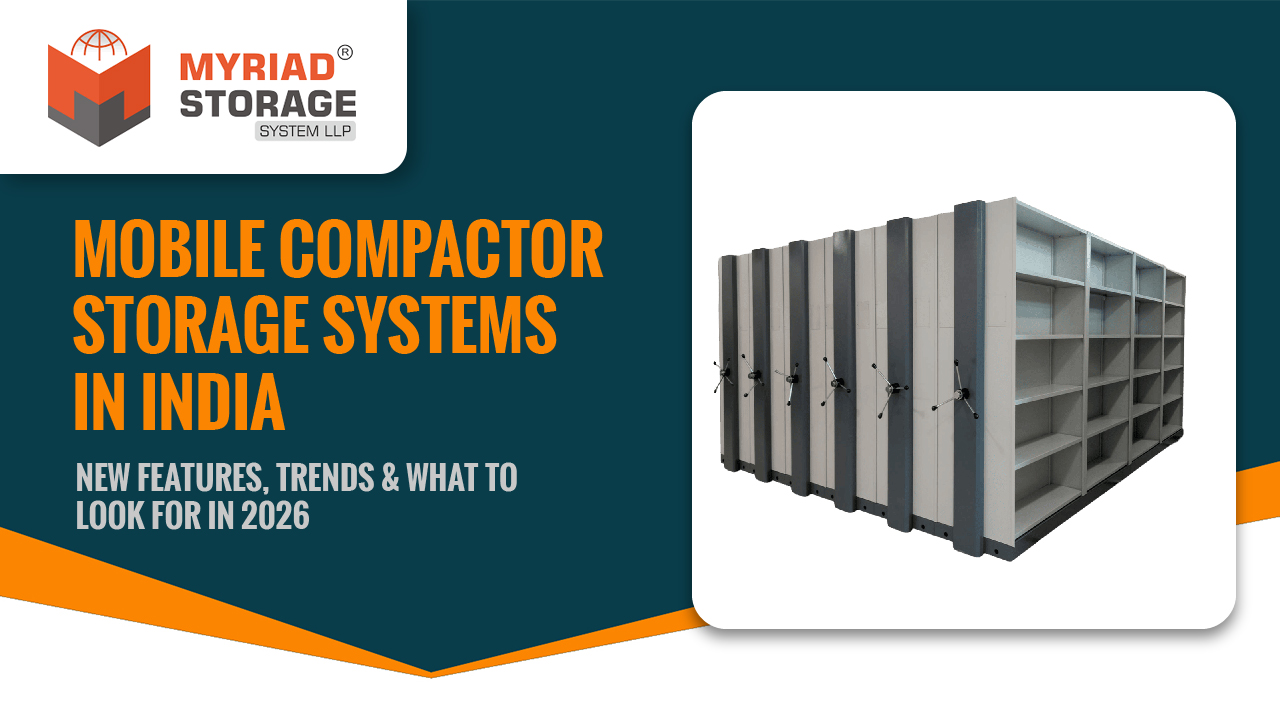
The mobile compactor storage system solves this at the root. By mounting shelving units on wheeled carriages that travel along fixed floor rails, a compactor eliminates all but one movable aisle — the one currently in use. The remaining rows stay compacted together, unlocking far more storage within the same footprint.
The gains are significant. Organisations routinely recover 50 to 70 percent more usable storage capacity from an identical floor area after switching from fixed shelving to a compactor system. For space-constrained facilities in Mumbai, Delhi, Bangalore, or Chennai, this is a meaningful infrastructure shift — not a minor upgrade.
More storage from
same floor space
Organizations supplied by Myriad across India
Purpose-built compactor types for every use case
Year Myriad was established in Mumba
Demand has grown considerably over the last three years. Government digital transformation is paradoxically increasing the need for organised physical archiving during transition periods. Healthcare expansion is creating new storage demand in tier-2 cities. And businesses are increasingly treating storage infrastructure as a long-term capital investment — not a stop-gap fix..
The Biggest Trends Shaping Compactor Storage in 2026
The mobile compactor market in India has evolved substantially. Here are the trends actively reshaping how organisations across India think about, specify, and invest in compactor storage systems today.
6 Trends Reshaping Compactor Storage in India
Tap any trend to see who it impacts most
Latest Features You Should Now Expect
If you last specified a mobile compactor system a few years ago, the feature baseline has moved considerably. Here is what modern systems now offer as standard — and what you should insist on from any manufacturer you evaluate in 2026.
Is Your Compactor Manufacturer Meeting the 2026 Standard?
Tap each feature to check — see how your shortlist compares
🛡️ Three-Layer Safety: Anti-Tip, Load Balancing, and Aisle Interlock
Safety engineering has seen the most impactful improvement of any feature area in recent compactor generations. Older models were vulnerable to tilting under uneven loads and lacked meaningful user protection. Modern systems include three distinct safety layers:
The shift from mild steel to CRCA (Cold Rolled Close Annealed) steel as the baseline material represents one of the most meaningful quality improvements in the market. CRCA steel is denser, more dimensionally consistent, and significantly more resistant to rust and surface degradation than mild steel alternatives that many lower-cost manufacturers still use.
Paired with an electrostatic powder coat finish — where the coating is bonded to the metal surface under heat rather than sprayed on — the result is a system that resists humidity, coastal salt air, and industrial environments far better than older designs. This matters especially for facilities in Mumbai, Chennai, Kochi, or any environment with significant moisture exposure. A system that looks and performs well a decade from now is determined largely by these two material choices.
Standard solid steel shelves block airflow around stored items — which is fine for files and documents but a compliance problem for pharmaceutical products, electronic components, laboratory samples, and food items. The 2026 market now offers perforated shelf compactor variants as a standard product option rather than a special-order exception.
Perforated shelves maintain full structural load capacity while allowing 360-degree air circulation around stored goods — reducing moisture buildup, preventing temperature stratification, and keeping stored items within storage compliance standards for regulated industries. Myriad’s Perforated Compactor Storage System is designed specifically for pharmaceutical, laboratory, and electronics storage environments
Document security requirements have raised the bar on locking configurations across almost every sector. Modern compactors now support:
- Central locking bars that secure an entire row of shelving with a single key turn — ideal for end-of-day lockdown in shared access environments
- Individual compartment locks for systems where different teams or departments share the same unit but need segregated access control
- Lock configurations compatible with internal compliance audits and data protection requirements increasingly expected by banking, legal, and healthcare clients
One of the clearest market shifts in 2026 is the move away from fixed catalogue sizes. Leading manufacturers now configure every system to exact client requirements:
- Custom heights — from standard office ceiling heights up to 10 feet or beyond for high-bay warehouse installations
- Custom colours — to match office interiors, corporate identity, or department-specific colour coding systems
- Adjustable shelf pitch — configured precisely for A4 binders, legal files, library books, engineering drawings, or medical equipment depending on the application
- Combination frame configurations — integrating open shelves, lockable drawers, and display panels within a single compactor frame for multi-use environments
Older compactor systems required full disassembly and reinstallation to add capacity — expensive, time-consuming, and disruptive. The 2026 standard has shifted to genuinely modular designs where new rows slot into an existing rail system without disturbing the installed setup. This applies across all variants — from a compact manual push-pull compactor in a small office to a large heavy duty installation in a warehouse.
For growing organisations, this changes the nature of the purchase from a one-time capital decision into a long-term infrastructure asset that scales with the business. It also makes relocation to a new office significantly less disruptive — the system can be disassembled and reassembled without specialist tools or a full reinstallation project.
Which Sectors Are Adopting Compactors — and Why
Mobile compactor adoption in India has expanded well beyond traditional government record room applications. The breadth of sectors investing in modern compactor systems has grown considerably, each with distinct storage challenges that purpose-built variants now address effectively.
Banking & Finance
Healthcare
Manufacturing
Libraries & Education
Government & Defence
Pharmaceuticals
Research & Labs
Legal & Compliance
KYC records, loan files, and compliance archives are growing faster than branch floor space in Indian banking. File compactor systems — with A4-optimised shelf configurations, integrated label holders, and centralised locking — are the dominant specification in this sector. Major institutions including SBI are established users. Smaller branches and sub-offices also widely deploy manual push-pull compactors for everyday record room management.
Hospital expansion across India — in both metro and tier-2 cities — is generating significant new compactor demand. Patient records, lab results, and imaging archives require organised, space-efficient, and access-controlled storage. For pharmaceutical departments and sample storage areas, perforated compactor systems are increasingly specified to meet airflow compliance standards for medicines and biological samples.
Government record rooms, district courts, defence establishments, and public sector undertakings remain among the largest buyers of compactor systems in India. The combination of high load capacity, centralised security, and decades-long durability makes heavy duty compactor systems the dominant specification in this sector. Myriad has supplied installations to organisations including ISRO and Bharat Electronics Limited.
University libraries, school archives, and public library networks are investing in library-specific compactor systems designed for book and archival storage. Adjustable shelf spacing accommodates everything from slim paperbacks to oversized reference atlases and archival map folders — while a compactor layout allows significantly larger collections to be housed in the same physical space.
Engineering drawings, spare parts catalogues, quality control records, and component inventories require storage that handles both the physical weight of industrial materials and the retrieval speed demands of active production environments. Heavy duty compactor systems — built to higher structural specifications with reinforced carriages and elevated per-shelf load ratings — address exactly these requirements.
What to Ask Before You Buy in 2026
The Indian compactor market includes many manufacturers across a wide quality and price range. These are the questions that separate a system that performs reliably for 15 years from one that becomes a maintenance problem in three.
Rate Your Compactor Manufacturer
Score each factor — see if they pass the 2026 benchmark
Why Organisations Across India Choose Myriad
Myriad Storage System LLP has been manufacturing mobile compactor storage systems in Mumbai since 2018. With over 500 client organisations across India — including ISRO, SBI, TATA, L&T, and Bharat Electronics — Myriad has built a track record across some of the country’s most demanding storage environments.
Every system is manufactured from CRCA steel with electrostatic powder coat finishing, configured to exact client specifications, and installed by Myriad’s own professional team with pan-India coverage — not outsourced to contractors.
Myriad manufactures five compactor variants built for specific industry requirements:
- Manual Push-Pull Compactor — zero-electricity operation for offices, bank branches, clinics, and record rooms
- File Compactor Storage — A4-optimised shelving with label holders and central locking for document-heavy departments
- Perforated Compactor Storage — ventilated shelf panels for pharmaceutical, laboratory, and electronics storage
- Library Compactor Storage — adjustable shelf spacing for book collections from school libraries to university archives
- Heavy Duty Compactor Storage — reinforced CRCA construction for industrial, warehouse, and defence-grade requirements
All five types come with complete dimensional and colour customisation, and pan-India installation and support by Myriad’s own professional team.
Frequently Asked Questions
What are the latest features in mobile compactor storage systems in India in 2026?
The most significant 2026 upgrades include aisle interlock safety systems that prevent user entrapment, CRCA steel with electrostatic powder coat finishing for long-term durability, perforated shelf variants for ventilation-critical storage, centralised locking for compliance-ready security, and fully modular designs that allow capacity expansion without full reinstallation. Customisation on dimensions, colour, and configuration is now offered as standard by leading manufacturers like Myriad Storage System.
How much space can a mobile compactor storage system save?
Modern mobile compactor systems typically recover 50 to 70 percent more usable storage capacity from the same floor area compared to fixed shelving. This is because compactors eliminate all permanent aisles except one movable aisle — which opens only where access is currently needed, keeping the rest of the rows compacted together.
Which type of compactor is right for my industry?
Myriad manufactures five purpose-built variants: the Manual Push-Pull Compactor for general office and record room use; the File Compactor for document-intensive environments like banks and legal firms; the Perforated Compactor for pharmaceutical, laboratory, and electronics storage requiring airflow compliance; the Library Compactor for book and archival collections; and the Heavy Duty Compactor for industrial, warehouse, and defence applications.
Which industries use mobile compactor storage systems in India?
Mobile compactors are widely adopted in banking and financial services, healthcare and hospitals, government offices and defence establishments, manufacturing and warehousing, libraries and educational institutions, pharmaceutical storage, research laboratories, and legal and compliance departments. Each sector typically specifies a different variant — perforated shelving for pharmaceuticals, file-specific configurations for banks, and heavy duty builds for industrial warehouses.
Can I expand an existing compactor system later without replacing it?
Yes — Myriad’s modular compactor designs allow new rows to be added to an existing floor rail without removing or disrupting the installed setup. This protects your initial investment and allows the system to scale as your organisation’s storage needs grow. Always confirm modular expansion capability with any manufacturer before purchasing.
What warranty does Myriad offer on mobile compactor systems?
Myriad provides a 1-year warranty covering material defects on every system. Steel grade, coating quality, and rail precision are the primary determinants of long-term performance. Contact Myriad for a free site assessment and customised quote.
Conclusion
The mobile compactor storage system market in India in 2026 is defined by two clear shifts: meaningfully better safety engineering as standard, and a decisive move toward purpose-built, fully customised solutions over generic catalogue products. For Indian organisations navigating space pressure and compliance requirements, this is the right moment to invest in a modern compactor specified correctly for your industry. Whether you need a manual push-pull system for a small office, a perforated variant for pharmaceutical compliance, a library configuration for a growing collection, or a heavy duty installation for a warehouse — Myriad has the right system and the pan-India capability to deliver and install it.
Ready to Transform Your Storage?
Get a Free Quote Today
Connect with Our Experts for Customized, Space-Saving Storage Solutions