Chennai's Cyclone Season Destroyed Thousands of Office Records — Were Yours Protected?
On 4 December 2023, Cyclone Michaung dumped 40 centimetres of rain on Chennai in 36 hours. The airport shut down. Roads became rivers. Office buildings across T. Nagar, Velachery, Guindy, and Nungambakkam flooded to knee and waist level. The economic damage exceeded ₹11,000 crore.
That was the headline damage. The damage nobody reported was quieter — and for many businesses, more permanent.
Across hundreds of ground-floor offices, record rooms flooded. Metal almirahs standing on the floor absorbed water from the bottom up. Files in the lowest shelves — often the oldest and most legally critical records — were soaked. KYC documents swelled and stuck together. Ink on signed contracts bled into illegibility. Tax records for ongoing assessments turned into pulp. HR files containing employee identity proofs were ruined beyond recovery.
You cannot re-create a signed contract. You cannot reprint someone’s original Aadhaar copy. You cannot ask a court to accept a water-damaged lease agreement. When these documents are gone, they are gone — and the compliance obligations attached to them remain.
Chennai is not a city where flooding is an anomaly. It is a city where flooding is a recurring certainty — 2004 (Tsunami), 2015 (catastrophic floods, 200+ deaths), 2021 (record rainfall), 2023 (Cyclone Michaung). The question for every Chennai office is not whether the next flood will come. It is whether your records will survive it.
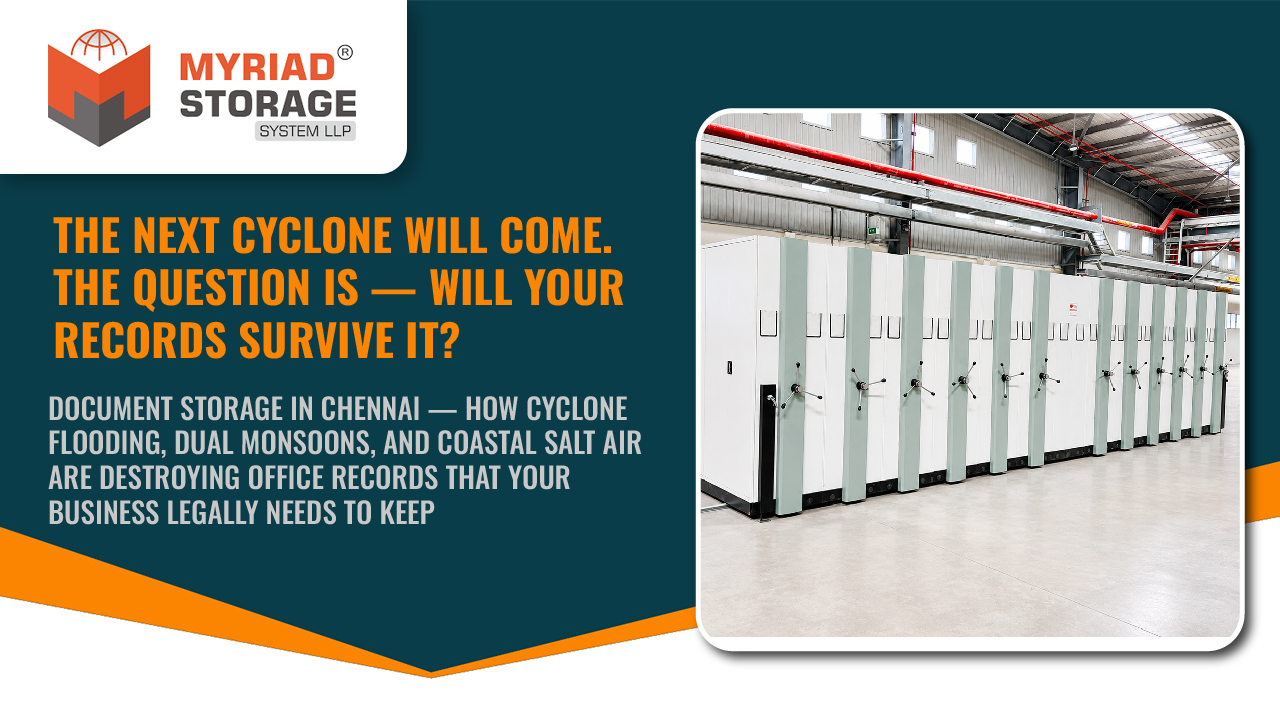
A file compactor storage system does not make your office flood-proof. But it does something no almirah or filing cabinet can — it elevates your documents 100 to 150 mm above floor level on a raised rail system, seals bays together to block water ingress from the sides, and creates a protected storage environment that gives your most critical records a fighting chance when the water rises.
Chennai's Triple Threat — Why No Other Indian City Attacks Documents This Aggressively
Chennai's Triple Threat to Office Documents
Three simultaneous environmental dangers that no other Indian city combines — and why standard almirahs fail against all three
How a File Compactor Fights All Three
Flood data: IMD, Wikipedia (2023 Chennai floods), BBC · Climate data: weather-atlas.com, climate-data.org
See Myriad's File Compactor Range → · Get a Free Site Survey in Chennai →
Most Indian cities face one or two environmental threats to paper documents. Chennai faces three simultaneously, year-round, with no relief season.
Threat 1: Cyclone flooding
Chennai sits on the Bay of Bengal cyclone belt. The Bay of Bengal generates more cyclones than any other basin in the Indian Ocean — and Chennai’s flat, low-lying geography means even moderate cyclones cause urban flooding. The city has experienced major flooding events in 2004, 2005, 2010, 2015, 2021, and 2023.
During these events, ground-floor offices flood within hours. Record rooms in basements and ground floors are the first spaces to take water. Metal almirahs standing directly on the floor offer zero water protection — the gap under the almirah door allows water to enter and soak documents from the bottom shelf upward. By the time the water recedes, the damage is irreversible.
The flooding is not limited to low-lying slums. In 2023, premium office areas including T. Nagar, Nungambakkam, Adyar, and Velachery were submerged. No Chennai neighbourhood is immune.
Threat 2: Dual monsoon humidity
Unlike most Indian cities that face one monsoon season, Chennai faces two — the southwest monsoon from June to September and the northeast monsoon from October to December. This means Chennai experiences elevated humidity for 7 months of the year, not 4.
Average humidity stays above 70 per cent for most of the year, peaking at 80 per cent during November. This sustained moisture exposure causes paper fibres to swell, pages to stick together, ink to bleed, and fungal growth to establish on documents stored in poorly ventilated almirahs.
The double monsoon means Chennai documents get twice the humidity exposure of documents stored in Delhi or Bangalore — cities with a single monsoon season and a prolonged dry period for recovery.
Threat 3: Coastal salt air
Chennai’s eastern boundary is the Bay of Bengal shoreline. Salt-laden sea air penetrates several kilometres inland, affecting offices across the city — not just those on Marina Beach. This salt aerosol corrodes unprotected metal surfaces (including almirah hinges, locks, and shelving) and deposits chloride compounds on paper that accelerate chemical degradation.
The combination of salt air and humidity is particularly destructive. Salt crystals absorb moisture from the air (a process called deliquescence), creating microscopic pools of salt solution on paper surfaces. These tiny pools cause localised fibre breakdown, producing the brown spots and edge deterioration visible on documents stored in Chennai offices for more than 2 to 3 years.
No other major Indian city faces all three threats simultaneously. Mumbai has coastal humidity but rarely floods to Chennai’s extent. Delhi has extreme pollution but no coastal salt or cyclones. Bangalore has moderate humidity but no flooding or salt air. Chennai gets all three — cyclone flooding, dual-monsoon humidity, and coastal salt air — every single year.
What Flooding Actually Does to Paper Documents — The Damage Sequence
When floodwater enters a record room, the destruction follows a predictable sequence — and most of it happens within the first 48 hours.
Hours 0 to 6 — Water contact. Paper absorbs water rapidly. A standard 80 GSM office paper sheet reaches full saturation within 30 to 60 minutes of submersion. Ink — especially from inkjet printers and ballpoint pens — begins bleeding immediately. Carbon copies (still used in many government and banking offices) become completely illegible when wet.
Hours 6 to 24 — Structural breakdown. Saturated paper loses 90 per cent of its tensile strength. Pages that are stacked together (as in a file folder) bond to each other as fibres swell and interlock. Attempting to separate bonded wet pages tears them. Files stored in box files or ring binders trap water inside, making natural drying nearly impossible without disassembly.
Hours 24 to 48 — Biological contamination. In Chennai’s tropical temperatures (28 to 35°C year-round), mould growth begins on wet paper within 24 to 48 hours. Once mould establishes, it spreads rapidly through an entire file — and from file to file within a closed almirah. Mould-damaged documents are not just unsightly — they become a health hazard and in many cases are unrecoverable.
Days 3 to 7 — Permanent damage. Documents that remain wet for more than 72 hours undergo irreversible changes — permanent warping, colour transfer between pages, adhesion of printed text to adjacent pages, and structural weakness that makes handling impossible without further damage.
After drying — residual damage. Even documents that are successfully dried after flooding retain permanent water stains, warped shapes, reduced legibility, and weakened fibres. They may satisfy visual inspection but often fail the handling requirements of legal proceedings, audits, or regulatory submissions.
The critical point: flood damage to documents is not a cleaning problem. It is a loss event. Documents that survive physically may not survive legally — a water-stained, partially illegible contract may not hold up in court, regardless of whether the original intent is still visible.
How a File Compactor Provides Physical Protection That Almirahs Cannot
A file compactor storage system is not waterproof. No storage system is. But it provides three layers of physical protection that standard almirahs completely lack.
Layer 1: Raised rail elevation.
A file compactor sits on steel rails that elevate the entire unit 100 to 150 mm (4 to 6 inches) above the floor surface. In a minor to moderate flooding event — where water rises 50 to 100 mm (2 to 4 inches) before receding — the compactor’s lowest shelf remains above the water line.
Compare this to a standard metal almirah that sits directly on the floor with a 5 to 10 mm gap under the door. At 50 mm of water ingress — common even in heavy rainfall without cyclone conditions — the bottom shelf of an almirah is already underwater.
This 100 to 150 mm elevation does not protect against catastrophic flooding (waist-deep water). But it protects against the far more common scenario — moderate water ingress during heavy rains, backing up drains, overflowing building sumps, and minor leaks from walls and windows during monsoon months.
Layer 2: Sealed bay-to-bay construction.
When compactor bays are in their default closed position (pressed together), the steel panel-to-panel contact creates a semi-sealed enclosure around the documents. Water approaching from the sides must penetrate through the contact points between panels — which significantly slows lateral water ingress compared to an almirah with ventilation slats that actively channel water inside.
In a flooding scenario, this sealed construction buys time — potentially hours — before water reaches the documents. In many Chennai flooding events, water rises and recedes within 6 to 12 hours. Those extra hours of protection can be the difference between salvageable and destroyed records.
Layer 3: Anti-corrosion powder coating.
Chennai’s salt air corrodes standard almirah hardware — locks, hinges, and shelving — within 3 to 5 years. A file compactor with 60 to 80 micron electrostatic powder coating applied over CRCA steel creates a sealed, non-porous surface that resists both salt corrosion and moisture penetration for 15+ years. The mechanical handle mechanisms and locking systems are also coated to withstand coastal conditions.
Chennai's Business Zones — Where the Risk Is Highest
T. Nagar and Nungambakkam
Chennai’s primary commercial hub — jewellery showrooms, wholesale textile traders, banks, insurance offices, and professional services firms. Both areas were severely flooded during Cyclone Michaung. Ground-floor offices and basement-level record rooms were submerged. These zones have the highest concentration of paper-heavy businesses — retail, trading, and financial services — and the highest flood exposure.
Guindy and SIDCO Industrial Estate
Industrial and IT zone. Guindy is home to factories, small manufacturers, and IT companies. The area’s proximity to the Adyar river estuary makes it vulnerable to riverine flooding during heavy rains. Industrial record rooms here store production logs, quality records, and statutory compliance documentation.
OMR (Old Mahabalipuram Road)
Chennai’s IT corridor — TCS, Cognizant, Infosys, and hundreds of mid-size IT companies. Modern glass-facade offices with centralised HVAC — but the HVAC serves employee comfort, not the record room in the utility floor. OMR’s low-lying stretches flood regularly during northeast monsoon, disrupting operations and damaging ground-floor storage.
Anna Salai (Mount Road)
Chennai’s historic business spine — banks, insurance headquarters, government offices, and trading companies. Indian Bank and Indian Overseas Bank are headquartered here. Decades of accumulated records in legacy buildings with minimal flood protection infrastructure.
Mylapore and Triplicane
Coastal neighbourhoods with dense commercial activity. The closest business zones to the Bay of Bengal — maximum salt air exposure and maximum flood risk during cyclones and storm surges. During Cyclone Michaung, Mylapore recorded over 200 mm of rainfall.
Which Chennai Industries Have the Most to Lose
Banking and Financial Services. Indian Bank and Indian Overseas Bank are headquartered in Chennai. Under RBI mandates, branches must retain KYC records, transaction documents, and loan files for 5+ years. A single flood event destroying 3 years of branch records creates an immediate compliance crisis. Controlled access storage with flood elevation protects both the documents and the compliance position.
Automobile Manufacturing. Chennai is India’s automobile capital — Hyundai, Renault-Nissan, BMW, Ashok Leyland, TVS, Royal Enfield all manufacture here. Production records, quality inspection reports, supplier documentation, and warranty files are retained for years. Water damage to quality records during IATF 16949 audits is a certification-level risk.
Healthcare. Apollo Hospitals (headquartered in Chennai), MIOT, Kauvery, and Sri Ramachandra maintain thousands of patient files. Medico-legal records must be retained for decades. Loss of patient records due to flooding creates both legal liability and patient safety risks.
Legal and Professional Services. Chennai High Court (Madras High Court) is one of India’s oldest and busiest. Law firms across the city retain case files for 10+ years. Signed court orders, original affidavits, and executed agreements are irreplaceable if destroyed by water.
Government and State Administration. The Tamil Nadu Secretariat at Fort St. George, municipal offices, and district administration buildings maintain permanent archives. RTI Act compliance requires record retrieval within 30 days — impossible if the records were destroyed in the last flood.
What to Do Before the Next Cyclone Season
Chennai’s northeast monsoon — the primary cyclone and flooding risk period — runs from October to December. Any protective measures taken after the rains start are too late. Here is what Chennai offices should do before October:
Assess your current risk. Walk into your record room right now. Are files stored on the floor or on the bottom shelf of almirahs standing at floor level? If yes, those documents will be the first casualties in any water ingress event.
Elevate critical records. At minimum, move the most irreplaceable documents — signed contracts, original KYC files, court orders, board resolutions, tax assessment records — to upper shelves. This buys some protection, though it does not solve the long-term problem.
Install a file compactor before monsoon. A file compactor system with raised rail installation elevates ALL your records above floor level — not just the ones you remember to move to the top shelf. The sealed bay construction adds lateral protection. The central locking prevents unauthorised access to wet records during and after flooding (a real problem when record rooms are open during emergency response).
Create digital backups of critical documents. Scan the most important records and store digital copies in cloud storage. The physical originals remain legally necessary — but at least the information survives even if the paper does not.
Check your powder coating. If your current almirahs or storage systems already show rust or corrosion, they will not survive another monsoon in Chennai’s salt air. A system with 60 to 80 micron electrostatic powder coating is the minimum specification for Chennai’s coastal environment.
Chennai's cyclone season starts October — is your record room ready?
The Next Cyclone Will Come. Will Your Records Survive It?
Request a free site survey for your Chennai office. We'll assess flood vulnerability, measure your space, and design a file compactor layout with raised-rail installation that protects your documents from the ground up.
SBI, ISRO, Tata, TVS
500+ installations
ISO 9001:2015
Myriad Storage System LLP · ISO 9001:2015 · Factory in Vasai, Mumbai · Pan-India delivery & installation