Compactor Storage for Small Spaces — How to Maximise Limited Areas
A 200 sq ft record room in a Mumbai office costs ₹33,600 per month in rent. A 500 sq ft warehouse storage zone in Bhiwandi costs around ₹20,000 per month. In both cases, nearly half that space is wasted — eaten up by fixed aisles between static racks that nobody walks through 90% of the time.
This is the storage problem that Indian offices and warehouses face every day in 2026. Files keep coming in, inventory keeps growing, and the room stays the same size. Renting additional space means ₹4–5 lakh per year in Mumbai alone. Relocating is even more expensive.
Compactor storage solves this without adding a single square foot. Rail-mounted units slide together to eliminate dead aisle space, recovering 50–70% more usable storage from the same room. Whether it is an office record room stuffed with compliance files or a warehouse zone overflowing with spare parts, the solution is the same — store more in less.
This guide covers compactor storage solutions designed specifically for small offices and compact warehouses across India — what works, what to avoid, and what it actually costs.
Part 1: Compactor Storage for Small Offices
The office storage crisis in India
Indian offices are getting smaller. With commercial rents hitting ₹168 per sq ft in Mumbai, ₹110 in Bengaluru, and ₹95+ in Delhi-NCR, companies are leasing tighter spaces and expecting more from every square foot.
But paper is not going away. Despite digitisation drives, most Indian businesses still maintain physical records — GST invoices (mandatory 6-year retention), employee files, contracts, client documents, audit papers, and legal correspondence. A mid-size office generating 2,000–3,000 files per year runs out of cupboard space within 18 months.
The typical office response is to stack files on top of cupboards, stuff boxes under desks, or rent a separate storage unit. None of these are real solutions. They are symptoms of a storage system that was never designed for the space it occupies.
How compactors solve office storage
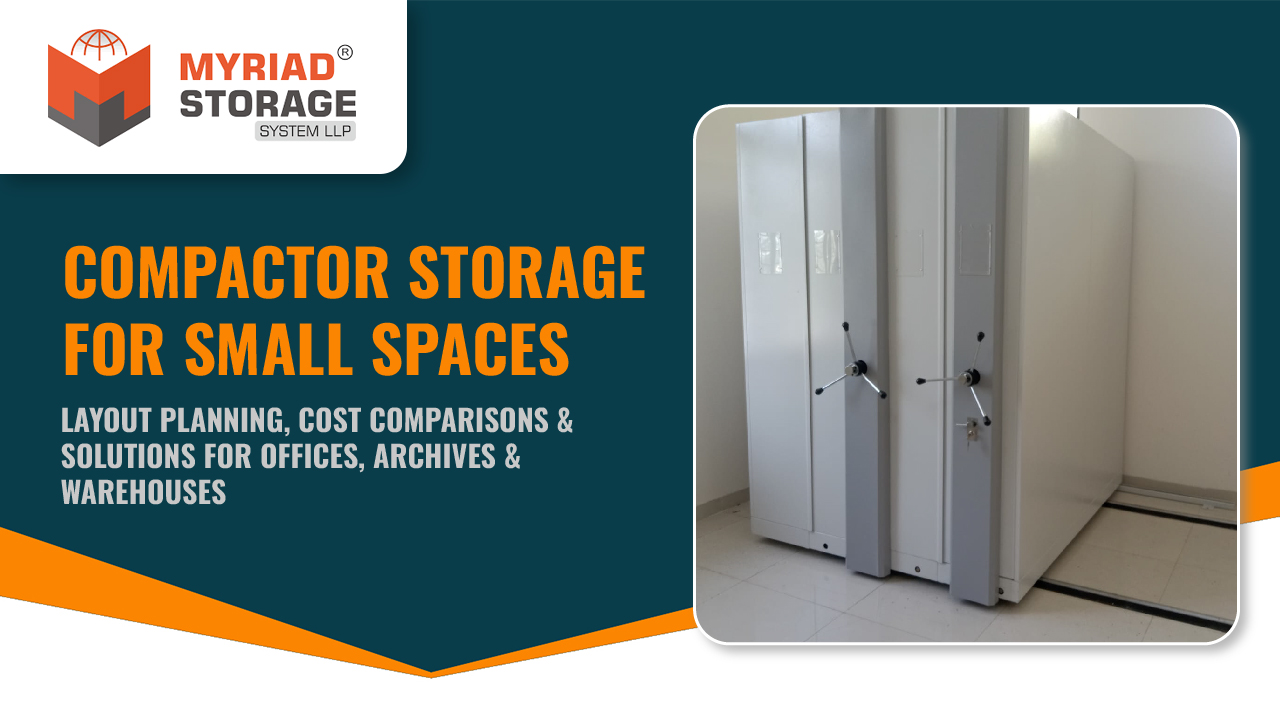
A mobile compactor storage system replaces your fixed racks and cupboards with units that sit on floor rails. When you need a file, you slide the units apart to open one aisle. When you are done, everything compacts back together — no wasted space.
In practical terms, a 150 sq ft office record room fitted with fixed shelving holds approximately 4,000–5,000 standard files. The same room with a mechanical compactor system holds 8,000–10,000 files. That is double the capacity, zero extra rent.
Best compactor types for offices
How Much Space Can You Save?
Enter your room size — see the difference instantly
Push-pull compactors — For rooms under 200 sq ft with light file loads. Manually slide units along rails. Lowest cost (₹35,000–₹65,000 per bay), zero electricity needed. Ideal for CA firms, legal chambers, and small business offices.
Mechanical (hand-wheel) compactors — For rooms between 200–600 sq ft with moderate to heavy file volumes. A crank mechanism makes movement effortless even with full loads. The most popular choice for Indian offices (₹55,000–₹90,000 per bay).
File compactor systems — Purpose-built for documents. Narrower depth, optimised shelf spacing for A4 and legal files, maximum filing density per sq ft. Ideal for offices where 90%+ of storage is paper files.
Office-specific layout considerations
Door clearance comes first. In small offices, the compactor is often installed in the same room as the entrance. Ensure the nearest unit does not block the door when closed — maintain at least 900 mm between the door swing arc and the first compactor face.
Think about access frequency. Place the files you access daily (current year records, active client files) in the outermost bays. Archive files (3+ years old) go in the innermost bays that you rarely open.
Air conditioning matters. Compacted units trap heat and moisture between closed bays. In Mumbai’s humid climate, this can cause paper degradation over time. If your record room is not air-conditioned, choose perforated panel compactors that allow airflow even when closed.
Electrical points. If you are planning motorised compactors, you need a power outlet near the installation point. Plan this during the survey — not after the compactor is installed and you are breaking walls for wiring.
Office compactor cost vs renting more space
Let us compare the numbers for a Mumbai office:
Your 200 sq ft record room is full. You need roughly 100 sq ft more storage.
Option A — Rent extra space: 100 sq ft × ₹168/sq ft = ₹16,800/month = ₹2,01,600/year. Over 5 years: ₹10,08,000.
Option B — Install compactors: A 4-bay mechanical compactor system costs approximately ₹3,00,000–₹3,60,000 installed. It unlocks 55% more capacity from the existing room — you do not need additional space.
Payback period: Under 18 months. After that, every month is pure savings. The system lasts 15–20 years.
Part 2: Compactor Storage for Small Warehouses
Why warehouse storage zones run out of space
Warehouses face a different version of the same problem. The issue is not paper files — it is spare parts, tooling, maintenance inventory, packaging materials, samples, and archived stock.
Most small Indian warehouses (1,000–5,000 sq ft) are not designed with optimised storage layouts. They use standard slotted angle racks or pallet racking with fixed aisles wide enough for forklifts — even in zones where everything is picked by hand.
A spare parts zone with 10 rows of static racks has 9 permanent aisles. Each aisle is typically 1,000–1,200 mm wide. In a 500 sq ft zone, those aisles consume 250+ sq ft — over half the total area. You are paying rent on floor space that holds nothing but air.
How compactors work in warehouse environments
Warehouse compactors are heavier-duty versions of office compactors. They use reinforced rails, thicker shelving, and higher load ratings — designed for storing metal parts, tools, boxes, and industrial materials instead of paper files.
The principle is identical: units slide on rails, aisles are created only when needed, and total storage capacity increases by 50–70%.
Which Compactor Is Right for You?
Answer 3 questions — get a personalised recommendation
The key difference is the type of compactor used:
Heavy-duty mechanical compactors — Hand-wheel operated, with load capacities of 500–1,000 kg per shelf level. Steel construction with powder coating for durability in industrial environments. Best for spare parts, tooling, and maintenance inventory.
Approximate cost: ₹70,000–₹1,20,000 per bay.
Motorised heavy-duty compactors — Electric-powered movement for runs longer than 4 metres or very heavy loads. Some systems include safety sensors that stop movement if an obstruction (or a person) is detected in the aisle.
Approximate cost: ₹1,50,000–₹3,00,000 per bay.
Multi-tier compactors — Two-level systems with an upper walkway for warehouses with high ceilings (4+ metres). This effectively doubles the storage zone without expanding the floor footprint.
Warehouse-specific layout considerations
Floor strength is critical. A fully loaded warehouse compactor run can weigh 8,000–15,000 kg. Most warehouse floors (RCC with standard thickness) can handle this, but older facilities and mezzanine floors may not. Always get a structural check.
Rail embedding vs surface mounting. In warehouses, rails can be embedded flush into the concrete floor — creating a smooth surface for pallet jacks and trolleys to cross. Surface-mounted rails work but create a small trip hazard and limit trolley movement.
Keep forklift zones separate. Compactors and forklifts do not mix. Design the layout so that forklift-accessible pallet racking stays in the main warehouse area, and compactors are used in hand-pick zones — spare parts stores, maintenance inventory, sample libraries, and archive sections.
Dust and environment protection. Warehouses are dustier than offices. Choose compactors with sealed panels and rubber gaskets if you are storing sensitive items — electronics, precision tools, or pharmaceutical materials
Part 3: Planning Guide — Office or Warehouse
5-step process for any small-space compactor installation
Step 1 — Audit your current storage. Before shopping for compactors, count what you actually store. How many files? How many boxes of parts? What are the dimensions? What is accessed daily vs yearly? This determines the compactor type, bay count, and shelf configuration.
Step 2 — Measure the room precisely. Length, width, ceiling height, door positions (including swing direction), pillars, electrical boards, fire equipment, windows, and pipe runs. In small rooms, 100 mm matters.
Step 3 — Plan for growth. Design for 25–30% more than your current volume. If you have 5,000 files or 200 boxes of parts today, plan for 6,500 files or 260 boxes. Compactors are a long-term investment — do not outgrow them in 2 years.
Step 4 — Choose the right system. Match the compactor type to your actual needs:
- Files only, small room → File compactor or push-pull
- Files + some materials, medium room → Mechanical hand-wheel
- Heavy parts, industrial environment → Heavy-duty mechanical or motorised
- Very large or heavy loads → Motorised with safety sensors
Step 5 — Professional site survey. This is non-negotiable. A 15-minute site visit catches problems that hours of floor-plan analysis will miss — uneven floors, hidden conduits, load-bearing limits, ventilation gaps. Myriad provides free site surveys across India.
Industries That Need This Most in 2026
Banking: RBI mandates require 7–10+ year document retention. Every branch needs compactor storage — it is a compliance necessity, not a choice. Read our complete Banking & Finance Storage Compliance Guide.
Healthcare: NABH-accredited hospitals must retain patient records for defined periods. OPD record rooms are almost always undersized. Compactors double the capacity.
Manufacturing: Spare parts rooms, quality sample archives, maintenance tool stores — every factory has small zones bursting at the seams. Heavy-duty compactors solve this permanently.
Government: District offices, courts, and municipal corporations across India face chronic storage shortages. DPDPA 2025 adds new retention requirements during the digital transition period.
Legal and Accounting: Practising offices in commercial hubs (Fort, Connaught Place, MG Road) are 300–600 sq ft. Client files grow every year. Compactors are often the only alternative to a much more expensive office move.
E-commerce and 3PL: Small fulfilment centres storing high-SKU, low-volume items — cosmetics, electronics accessories, stationery — benefit enormously from compactor storage in their slow-moving inventory zones.
5 Costly Mistakes to Avoid
1. Overloading without structural checks. A 6-bay office compactor with files weighs 3,000–5,000 kg. A warehouse compactor with parts can exceed 10,000 kg. Upper floors and mezzanines may not handle this. Get a structural assessment — it costs very little and prevents very expensive problems.
2. Blocking fire exits. Never sacrifice safety clearance for one extra bay. Maintain minimum 600 mm exit path at all times. This is not optional — it is a fire safety code requirement.
3. Choosing manual for long runs. Push-pull compactors work for runs under 3 metres. Beyond that, fully loaded units become very hard to move. The extra ₹20,000–₹30,000 per bay for a mechanical system saves daily frustration.
4. Ignoring humidity control (offices). In coastal cities like Mumbai and Chennai, closed compactor bays trap moisture. Without ventilation or AC, paper degrades within 2–3 years. Choose perforated panels or ensure the room has dehumidification.
5. Installing without a site survey. The most expensive compactor mistake is discovering on installation day that the floor is uneven, the door does not clear, or there is a conduit run exactly where the rails need to go. A free site survey prevents all of this.
Compactor vs Renting More Space
See your payback period and 5-year savings
Why Myriad for Your Small-Space Project
Myriad Storage System LLP has manufactured and installed compactor systems from our Mumbai facility since 2018. With 500+ installations across India — from 80 sq ft bank record rooms to 10,000 sq ft warehouse storage zones — we have solved small-space storage problems for organisations of every size.
Custom-built systems. Every compactor is manufactured to your exact room dimensions at our Vasai factory. No standard sizes forced into non-standard spaces. 2–3 week manufacturing turnaround.
Office and warehouse expertise. We do not sell one-size-fits-all solutions. Our team designs layouts specific to your environment — whether it is a climate-controlled office archive or a dusty industrial parts store.
Trusted by India’s biggest organisations. ISRO, State Bank of India, Tata, L&T, and UNIFAB Engineering — when storage failure is not an option, they choose Myriad.
Pan-India installation. Mumbai, Pune, Delhi-NCR, Bengaluru, Chennai, Hyderabad, Kolkata, and 50+ cities. Site survey, manufacturing, delivery, installation, and training — all handled end to end.
Still Stacking Files on Top of Cupboards?
You should not need a ladder to find last year’s GST records. And your warehouse team should not spend 20 minutes searching for one spare part in an overcrowded rack.
We will visit your site — office or warehouse — measure the space, design a compactor layout, and show you exactly how many more files or parts you can fit. Free. No strings attached.
Ready to Transform Your Storage?
Get a Free Quote Today
Connect with Our Experts for Customized, Space-Saving Storage Solutions