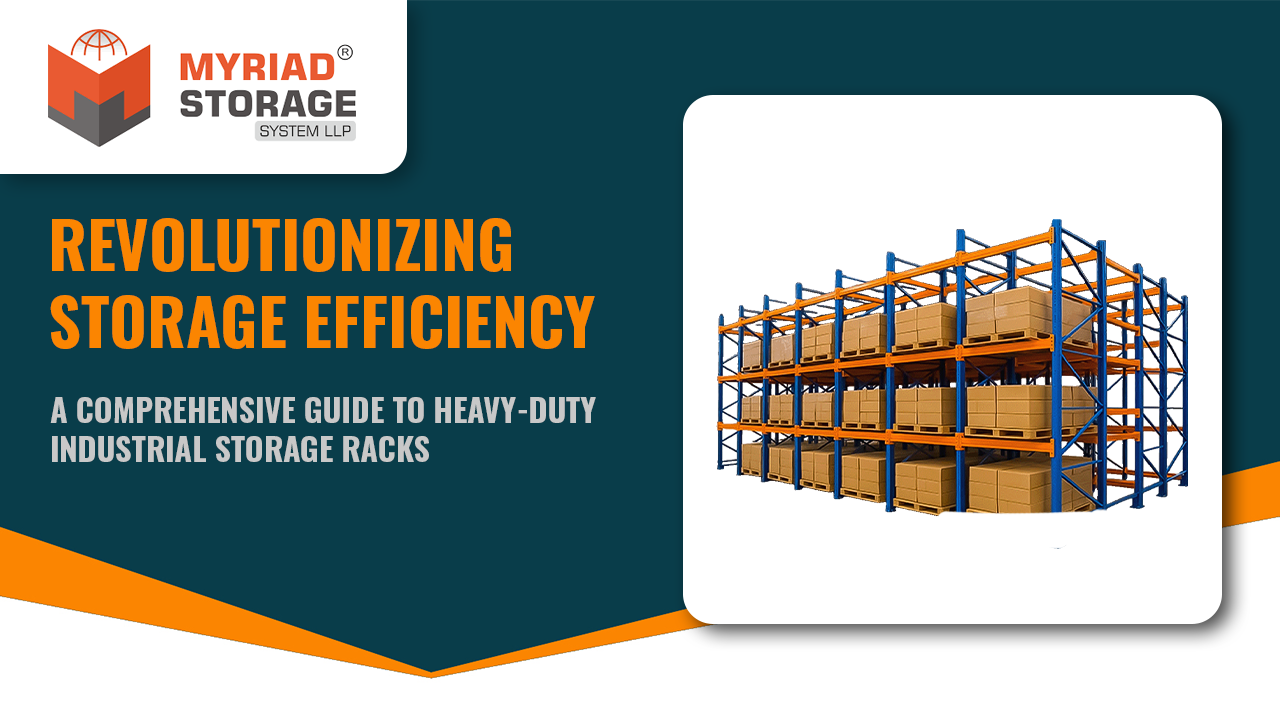
Heavy Duty Industrial Storage Racks in India: A Practical 2026 Guide
A rack is only as good as the load it was designed for. Buy one that is too light and it bends. Buy one that is too heavy and you pay for steel you never use.
This guide explains how heavy duty industrial storage racks work, which type suits which job, and what to check before you buy. We build these racks ourselves at our factory in Vasai, Palghar, so the numbers below are the ones we actually work with.
What does a heavy duty rack carry, and how high can it go?
These are the ranges we build to. Every rack is sized to your actual load.
Made at our Vasai factory and installed by our own team.
What is a heavy duty industrial storage rack?
A heavy duty rack is a steel storage structure built to carry far more than office or retail shelving. It has four main parts:
- Uprights (frames): the tall vertical posts that carry the weight down to the floor.
- Beams: the horizontal bars that hold each level.
- Decking or shelves: the surface your goods actually sit on.
- Bracing and safety parts: cross braces, beam locks and floor fixings that keep the rack straight and stop beams from lifting out.
Our racks are made of powder-coated steel. The coating protects against rust and wear, so the rack keeps its strength through years of daily use in a warehouse or factory.
The key idea is that a rack is designed, not simply bought off a shelf. The number of levels, the beam size and the steel thickness are all chosen from the load you plan to store.
Heavy duty racks, pallet racking or mezzanine: which one do you need?
These three systems solve different problems. The table below shows the difference at a glance.
| Heavy duty racks | Pallet racking | Mezzanine floor | |
|---|---|---|---|
| Load | 500 to 1,000 kg per level | 500 kg to 4 tonnes per level | Designed to your floor load |
| Best for | Cartons, spare parts, tools, loose goods | Full pallets and bulk stock | Adding a second working level |
| Handled with | By hand, trolley or pallet truck | Forklift or pallet truck | Staircase with handrails |
| Height | 2 to 10 m, set by your ceiling | 2 to 10 m, set by your ceiling | Needs clear height for two usable levels |
| Finish | Powder-coated steel | Powder-coated steel | Galvanized decking panels |
| Learn more | Heavy duty storage racks | Pallet racking systems | Mezzanine storage systems |
A simple way to decide:
- If you store goods on pallets and move them with a forklift, you need pallet racking.
- If you store cartons, parts or tools and pick by hand, heavy duty racks are usually the better fit.
- If your floor is full but your ceiling has room, a mezzanine floor gives you a second level.
Many sites use more than one. For the full picture, see our industrial racking system page or our warehouse racking system guide.
Load capacity: what the numbers really mean
Most buying mistakes begin with a misunderstood load figure. Keep these points in mind:
- Capacity is per level, not per rack. A rack rated at 1,000 kg per level does not mean 1,000 kg in total.
- Plan for your heaviest item. Use the heaviest pallet or box you will ever store on a level, not the average. Then add a safety margin of about 20 percent.
- Even weight is not the same as one heavy point. A load spread across the whole beam is easier on a rack than one dense item sitting in the middle.
- The upright carries the total. The taller the rack and the more levels it has, the more weight each upright must carry, so the frame is chosen together with the beams.
- Your floor matters too. All that weight ends up on your slab, so floor strength has to be checked before installation.
India does not have one dedicated racking safety code, so the responsibility for getting the load rating right sits with whoever designs and installs your system. That is why we always give the rated load in writing. Our racking safety guide explains this in more detail.
How high can industrial racks go?
Most buying mistakes begin with a misunderstood load figure. Keep these points in mind:
- Capacity is per level, not per rack. A rack rated at 1,000 kg per level does not mean 1,000 kg in total.
- Plan for your heaviest item. Use the heaviest pallet or box you will ever store on a level, not the average. Then add a safety margin of about 20 percent.
- Even weight is not the same as one heavy point. A load spread across the whole beam is easier on a rack than one dense item sitting in the middle.
- The upright carries the total. The taller the rack and the more levels it has, the more weight each upright must carry, so the frame is chosen together with the beams.
- Your floor matters too. All that weight ends up on your slab, so floor strength has to be checked before installation.
India does not have one dedicated racking safety code, so the responsibility for getting the load rating right sits with whoever designs and installs your system. That is why we always give the rated load in writing. Our racking safety guide explains this in more detail.
Where heavy duty racks are used
Heavy duty racks serve almost every business that stores goods at scale:
- Automotive and engineering: parts, assemblies, dies and tools in workshops and factory stores.
- Pharma and healthcare: organised stock of raw materials and finished goods, with clear first-in, first-out order.
- FMCG and food: high-volume pallet storage with forklift access.
- E-commerce and logistics: dense picking and dispatch areas for fast order fulfilment.
- Government and defence: long-term storage of equipment, supplies and records.
- Textile and chemical: roll and carton storage, and drum storage with safe layouts.
Our systems are installed at organisations such as ISRO, SBI and Tata, and we have completed more than 500 installations across India.
5 mistakes buyers make with heavy duty racks
- Choosing by price per rack, not by load. A cheaper rack that was never designed for your load costs more when it fails.
- Ignoring the heaviest item. Racks must be rated for the worst case, not the average.
- Skipping the site survey. Columns, doors, slopes and floor strength decide the layout.
- Forgetting the forklift. Aisle width and lift height must match the machine you actually use.
- No plan for growth. A rack that cannot be extended becomes a problem when your stock grows.
How to choose the right rack: 5 steps
Follow these steps before you decide. They take an afternoon and can save months of trouble.
- Measure your spaceFloor area, ceiling height, columns, doors and floor strength.
- List your loadsHeaviest item per level, plus about 20 percent as a safety margin.
- Decide how you will handle goodsBy hand, pallet truck or forklift. This sets aisle width and rack type.
- Plan for growthChoose a layout that can take more bays or levels later.
- Get a manufacturer to survey the siteA survey and layout drawing before you buy prevent costly changes.
What to ask a rack manufacturer before you buy
Two quotes can look the same on paper and still give very different results. A manufacturer builds the rack and answers for it. A trader resells what someone else made. We wrote a longer piece on this: Manufacturer vs trader: what you actually get when you buy industrial racking. In short, ask for these in writing:
- The rated load per level and the total load per bay.
- A site visit and a layout drawing before you pay.
- The steel thickness and the finish used.
- Who makes the rack, and who installs it.
- What happens if something needs fixing after installation.
How a Myriad racking project works
Every project follows the same four steps, from the first visit to handover.
- Free site surveyOur team visits, measures your space and checks your load and layout needs.
- Layout and quotationYou receive a drawing and a quote based on your exact load, not a standard size.
- Made in VasaiYour racks are manufactured at our own factory in Vasai, Palghar.
- Installed by our teamOur own installers fit the system and hand it over ready to use.
Frequently Asked Questions
How much weight can a heavy duty rack hold?
Our heavy duty storage racks carry 500 to 1,000 kg per shelf level, and our pallet racking systems carry 500 kg to 4 tonnes per level. The exact figure for your rack depends on its height, the number of levels and the steel thickness, so we confirm it in writing after a site survey.
What is the difference between heavy duty racks and pallet racking?
Heavy duty racks are shelf-type racks for cartons, parts and tools, usually picked by hand or with a pallet truck. Pallet racking is designed for full pallets handled with a forklift, and it carries heavier loads per level.
How high can industrial racks be?
We build racks from 2 metres up to 10 metres. The right height depends on your ceiling, your forklift reach and how often you pick from the top level.
Are your racks powder-coated?
We build racks from 2 metres up to 10 metres. The right height depends on your ceiling, your forklift reach and how often you pick from the top level.
Do I need a site survey before ordering?
We strongly recommend it. Column positions, door sizes, floor strength and ceiling height decide what will fit and what load it can safely carry. We offer the survey free of cost.
Can racks be extended later?
In most cases yes, if the system is planned for it from the start. Tell us about your growth plans at the survey stage so we can design the layout to take extra bays or levels later.
Ready to plan your racking?
Tell us what you store and how you handle it, and our team will recommend the right system after a free site survey.
Tell us what you store and how you handle it. Our team will visit, measure your space and recommend the right system, at no cost.
Myriad Storage System LLP · Factory in Vasai, Palghar · Pan-India delivery and installation