File Compactor Storage System in Bangalore — Why India's Most Digital City Still Needs Physical Document Storage
Bangalore is India’s technology capital. The city runs on cloud infrastructure, SaaS platforms, and digital-first workflows. If any Indian city should be paperless by now, it is Bangalore.
And yet, walk into the HR department of any Global Capability Centre on Outer Ring Road, the records room of any bank branch on MG Road, or the medical records section of any hospital in Koramangala — and you will find the same thing: overflowing metal almirahs, files stacked on desks, documents crammed into corners, and a records management problem that no amount of software can solve.
The truth is simple. Bangalore is not paperless. It cannot be — not yet. Indian regulations require physical originals for KYC documents, employee identity proofs, patient consent forms, signed contracts, and board resolutions. The Digital Personal Data Protection Act covers data that is collected physically and later digitised — which means the physical originals still need controlled, secure storage.
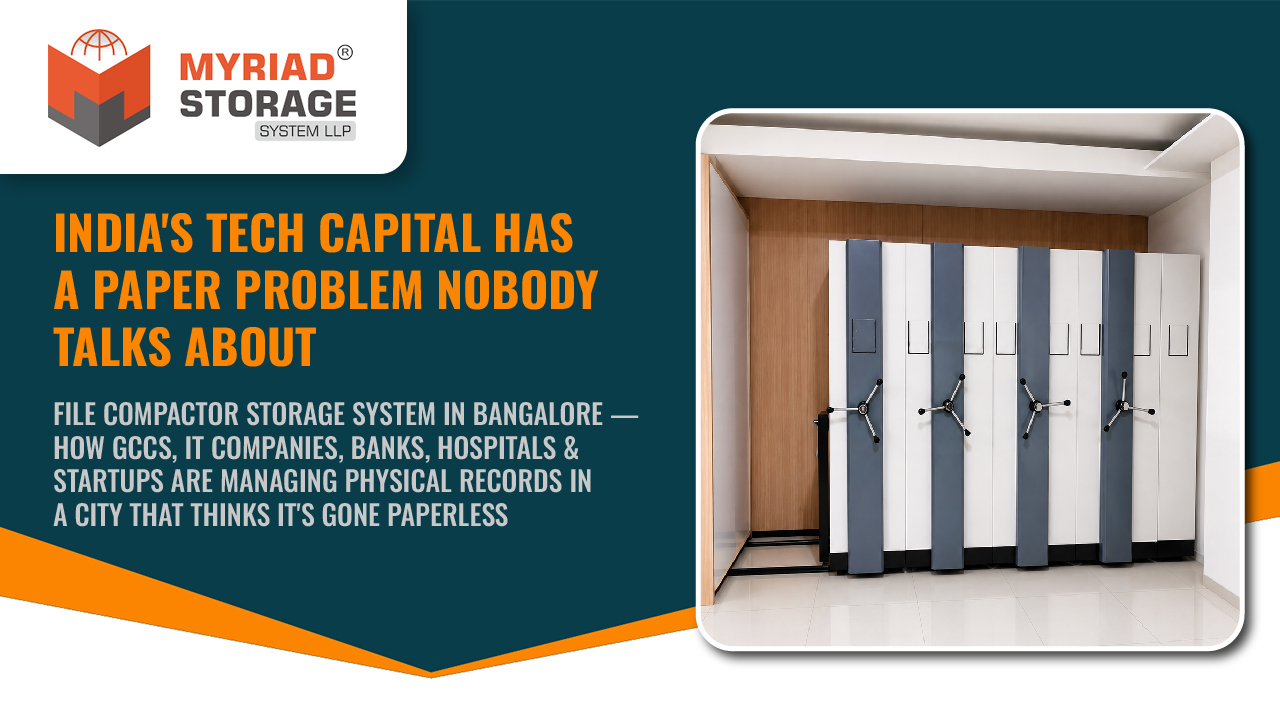
A file compactor storage system is how Bangalore’s smartest offices solve this problem — reducing physical record rooms by 50 to 70 per cent while adding the access control and organisation that compliance requires.
The Paperless Myth — Why Bangalore Offices Generate More Physical Records Than You Think
Bangalore is home to over 1,600 Global Capability Centres (GCCs) employing hundreds of thousands of professionals. The city hosts India’s largest concentration of IT companies, fintech startups, banking operations centres, and healthcare networks. Every one of these organisations generates physical records — not because they want to, but because Indian law requires it.
GCCs and IT companies maintain physical HR files for every employee. An offer letter, identity proof copies (Aadhaar, PAN), educational certificates, bank account details, insurance nominations, and non-disclosure agreements — all require physical originals or certified copies in the employee file. A GCC with 5,000 employees has 5,000 physical HR files. At 15 to 20 pages per file, that is 75,000 to 100,000 pages sitting in a records room — and growing with every new hire.
Banks and financial institutions on Outer Ring Road and MG Road maintain physical KYC records under RBI mandate. Five years of transaction records, customer identification documents, and suspicious transaction reports — all in paper form, all requiring controlled access and rapid retrieval during audits.
Hospitals across the city — Narayana Health, Manipal Hospital, Sakra World Hospital, Columbia Asia, Aster CMI — maintain physical patient files including consent forms, discharge summaries, prescription records, and imaging envelopes. Despite digital patient management systems, physical originals remain mandatory for medico-legal protection.
Startups raising funding maintain physical versions of shareholder agreements, board resolutions, cap table documents, ESOP letters, and regulatory filings. A Series B startup with 3 funding rounds has a document trail that fills multiple box files — all requiring secure, organised storage.
The volume of paper in Bangalore offices is not decreasing. It is increasing — because the number of GCCs, banks, hospitals, and startups in the city is increasing faster than digitisation can replace physical records.
Bangalore's Business Zones — Where File Compactors Make the Biggest Difference
Bangalore’s commercial landscape is spread across distinct business zones, each with its own industry concentration and office profile. Here is how the file compactor need differs across the city’s key corridors.
Outer Ring Road (Bellandur to Marathahalli)
ORR is Bangalore’s enterprise heartland — the highest-absorption office corridor in the city. Global Capability Centres, large IT companies, and BFSI operations centres dominate this zone. Office rents range from ₹70 to ₹150 per square foot per month for Grade A space.
These are large-floor-plate offices with 500 to 5,000 employees per facility. HR record rooms in these offices are massive — and the space they consume directly competes with employee workstations. A file compactor that recovers 300 square feet of record room space at ORR rent levels frees up room for 6 to 8 additional workstations — which directly increases revenue capacity for a GCC billing per headcount.
Whitefield
Bangalore’s largest Grade A corridor, anchored by ITPL and Brookefield. Major tech parks house MNC back-offices, software development centres, and BPO operations. Rents range from ₹65 to ₹140 per square foot.
Whitefield offices face a specific challenge: many are housed in tech park buildings with fixed floor plates and no expansion room. When the records room fills up, the only options are renting additional space in another building (adding commute and coordination overhead) or installing a file compactor that triples the storage capacity within the existing room. The compactor wins every time.
Koramangala
Bangalore’s startup capital — dense with coworking spaces, D2C brands, fintech offices, and venture-backed companies. Rents range from ₹60 to ₹120 per square foot.
Startups operate in tight spaces — 500 to 2,000 square feet is typical. Dedicating even 100 square feet to a records room feels like a luxury. But compliance requires it: Companies Act records, employee files, legal contracts, tax documentation. A compact 4 to 6 bay file compactor fits into a space smaller than a standard almirah setup and stores 3 times the volume — giving startups the compliance-ready storage they need without sacrificing their limited floor area.
MG Road and CBD
Bangalore’s original business district — home to BFSI headquarters, legal firms, consulting companies, and corporate HQs. Grade A rents reach ₹90 to ₹140 per square foot.
Many CBD offices operate in older buildings with fixed layouts designed before digital workflows existed. Record rooms in these offices are often oversized — 400 to 600 square feet of filing cabinets and almirahs that have accumulated over decades. A file compactor system can consolidate those decades of records into half the space, freeing the rest for meeting rooms, collaboration areas, or additional workstations.
Electronic City
Bangalore’s southern IT corridor — anchored by Infosys and Wipro campuses, plus hundreds of mid-size IT and engineering companies. Rents range from ₹45 to ₹90 per square foot — the most cost-effective Grade A space in the city.
Companies here tend to be large but cost-conscious. The value proposition of a file compactor is straightforward: even at Electronic City’s lower rent levels, recovering 300 square feet of wasted aisle space saves ₹13,500 to ₹27,000 per month — adding up to ₹1.6 to ₹3.2 lakh annually. Over a 15-year compactor lifespan, that is a significant return from a one-time investment.
Hebbal and North Bangalore
The fastest-growing commercial zone in the city — driven by airport proximity (25 to 30 minutes), new metro connectivity, and fresh Grade A supply. Rents range from ₹60 to ₹150 per square foot.
Companies relocating to North Bangalore from congested city-centre locations are setting up new offices from scratch. This is the ideal time to install a file compactor — before the records room fills up with almirahs and ad-hoc shelving. Designing the records room around a compactor from day one eliminates the pain of retrofitting later.
Bangalore Business Zones — File Compactor Need by Area
Industry concentration, office profile, and why each zone generates physical records that need controlled storage
Bangalore is India's most digital city — and still generates more physical records per office than most cities. Every GCC, startup, bank, and hospital needs controlled, space-efficient document storage.
Rent data: 2026 Bangalore commercial market reports · Zone analysis by Myriad Storage System LLP
See Myriad's File Compactor Range → · Book a Site Survey in Bangalore →
Bangalore's Climate — Different From Mumbai, Still Matters for Storage
Bangalore is not coastal like Mumbai, and it does not experience the same extreme humidity or salt air. But the city’s climate still affects physical document storage in ways that most offices overlook.
Monsoon humidity Bangalore receives approximately 970 mm of rainfall annually, concentrated between June and October. During monsoon months, relative humidity can reach 80 to 85 per cent — enough to cause paper yellowing, fungal growth, and ink bleeding in poorly stored documents.
Dust from ongoing construction Bangalore is in a perpetual state of construction — metro expansion, road widening, commercial development. Fine construction dust enters offices through windows and ventilation systems, settling on documents stored in open shelving or poorly sealed almirahs. Over time, this dust accelerates paper degradation and makes files look permanently dirty.
Temperature swings Bangalore’s temperature ranges from 15°C in December nights to 38°C in April afternoons. These swings cause paper to expand and contract, eventually making pages brittle — especially for older records stored for years.
A file compactor addresses all three challenges passively. Bays stay compacted together when not in use, creating a semi-sealed environment that significantly reduces exposure to humidity, dust, and temperature variation. The powder-coated CRCA steel structure — when coated at 60 to 80 microns with electrostatic application — resists corrosion even in monsoon-humidity conditions.
Industries That Drive Bangalore — And Why They All Need Controlled Document Storage
IT and GCCs — Bangalore has the largest GCC concentration in the world. Every GCC maintains physical HR records, vendor contracts, compliance documentation, and internal audit files. With employee counts ranging from 500 to 15,000 per facility, the physical records volume is staggering.
Banking and BFSI — Major banks operate processing centres and regional offices on ORR and MG Road. Physical KYC records, loan files, and audit documentation require secure, organised storage with controlled access — exactly what a file compactor with central locking provides.
Healthcare — Bangalore’s hospital networks — Narayana Health, Manipal, Sakra, Columbia Asia, Aster CMI, Apollo — maintain thousands of patient files across multiple locations. Medical records departments in these hospitals are prime candidates for file compactors with department-level locking.
Startups and Venture-Backed Companies — Koramangala, HSR Layout, and Indiranagar house hundreds of funded startups. Each one maintains physical records for compliance — Companies Act filings, employee documentation, funding agreements, IP registrations. Small offices need maximum storage in minimum space.
Legal and Consulting — MG Road and Richmond Road host major law firms and consulting companies. Case files, client documentation, engagement letters, and privileged communications require systematic organisation and partner-level access control.
Government and Public Sector — Vidhana Soudha, BBMP offices, state government departments, and public sector undertakings maintain decades of physical records. Under the Right to Information Act, these records must be retrievable within 30 days of request — impossible with disorganised almirah storage.
How Myriad Serves Bangalore — Pan-India Installation With a Dedicated Team
Myriad’s manufacturing facility is in Vasai, Mumbai — and we deliver and install across India with a dedicated installation team for each city. For Bangalore, this means:
Dedicated project coordination Every Bangalore installation gets a project coordinator who manages the entire process — site survey, design, manufacturing, logistics, and installation — as a single point of contact.
Site survey by an experienced team Our team visits your Bangalore office, measures the record room, checks floor conditions, maps access routes (lifts, staircases, building security protocols), and produces a layout drawing specific to your space.
Factory-direct quality Unlike local dealers or resellers who source from multiple factories with inconsistent quality, every Myriad file compactor is manufactured in our own ISO 9001:2015 certified factory using CRCA sheet steel with electrostatic powder coating. The same quality that serves ISRO, SBI, Tata, and L&T goes into every Bangalore installation.
Post-installation support After installation, if a rail adjustment or locking fine-tune is needed, our team coordinates resolution promptly — not “call the local dealer and hope they have the parts.”
Myriad has completed 500+ installations pan-India, including corporate offices, banks, hospitals, and government departments across multiple cities. Bangalore clients receive the same manufacturing quality, installation professionalism, and after-sales support as every other location.
Serving Bangalore with 500+ installations pan-India and a dedicated project team
Free Site Survey for Your Bangalore Office
ORR, Whitefield, Koramangala, MG Road, Electronic City, or Hebbal — our team will visit your office, measure your record room, and design a file compactor layout specific to your space. No cost, no obligation.
500+ installations
ISO 9001:2015
ISRO, SBI, Tata, L&T
Myriad Storage System LLP · ISO 9001:2015 · Factory in Vasai, Mumbai · Pan-India delivery & installation
Frequently Asked Questions
Is there a file compactor manufacturer that serves Bangalore?
Yes. Myriad Storage System LLP manufactures file compactors at its ISO 9001:2015 certified factory in Vasai, Mumbai and delivers pan-India with a dedicated installation team for Bangalore. All installations include site survey, custom layout design, professional installation, and after-sales support.
Why do Bangalore IT companies need file compactors if they are digital?
Indian law requires physical originals for employee HR files (offer letters, PAN copies, identity proofs), KYC documents, signed contracts, board resolutions, and regulatory filings. A GCC with 5,000 employees has 75,000 to 100,000 pages of physical records that need organised, secure storage — regardless of how digital their day-to-day operations are.
Which Bangalore business zones benefit most from file compactors?
Outer Ring Road (GCCs, BFSI operations), Whitefield (tech parks with fixed floor plates), Koramangala (startups in tight spaces), MG Road/CBD (older offices with oversized record rooms), and Electronic City (cost-conscious IT companies) all benefit from file compactors — each for different reasons related to their office profile and industry concentration.
Does Bangalore's climate affect physical document storage?
Yes. Monsoon humidity (80 to 85 per cent in peak months), construction dust, and temperature swings between 15°C and 38°C all degrade documents stored in open shelving or poorly sealed almirahs. A file compactor keeps bays sealed together when not in use, significantly reducing exposure to humidity, dust, and temperature variation.
Can a file compactor be installed in a Bangalore tech park office?
Yes. File compactor components are modular and can be transported through standard lifts and corridors in tech park buildings. The installation team assesses building access routes, security protocols, and permitted delivery hours during the site survey to ensure smooth installation without disrupting other tenants.
How long does file compactor installation take in Bangalore?
A standard 6 to 12 bay installation in Bangalore typically takes 2 to 3 weeks from approved layout to completion, including manufacturing time and logistics. The site survey and layout design are completed during the first visit.