Top Factors to Consider Before Investing in a File Compactor Storage System
India’s offices, banks, hospitals, and government departments are generating more physical documents than ever — while floor space grows more expensive by the year. Mumbai Grade A office rents reached ₹168 per sq ft in 2025. In Bengaluru and Delhi-NCR, rates are crossing ₹95–₹110 per sq ft. For organisations managing thousands of files, investing in the right file compactor storage system is no longer optional — it is a space and cost decision that directly affects the bottom line.
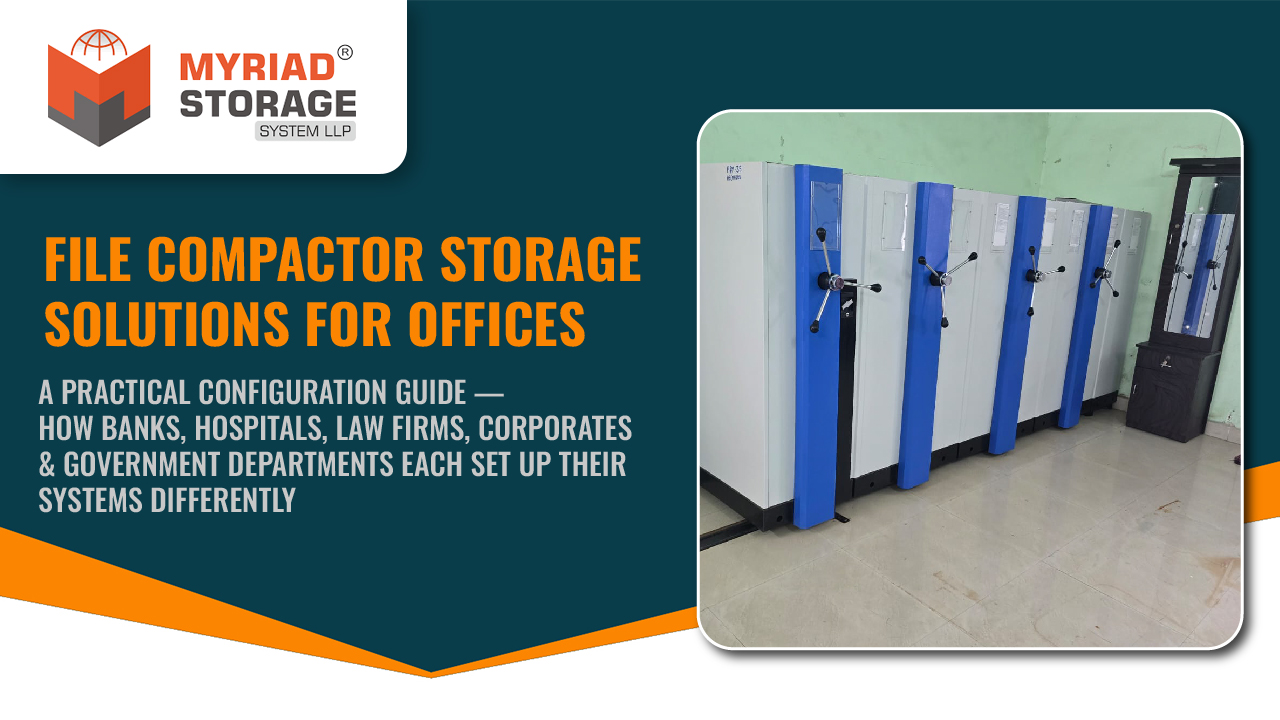
A file compactor storage system mounts shelving units on floor rails, allowing bays to compact together and open only the aisle that is needed — saving up to 70% of floor space compared to fixed cabinets. But not every system is built the same. Choosing the wrong type, size, or manufacturer leads to wasted investment, operational problems, and compliance risks.
This guide covers the 8 most important factors to evaluate before you invest — based on Myriad’s experience manufacturing and installing file compactor storage systems for 500+ clients across India since 2018, including SBI branches, hospitals, and government departments.
Why Choose a File Compactor Storage System for Your Office?
The shift toward file compactor storage systems across Indian offices, banks, and institutions is being driven by three converging forces in 2025–26:
Rising real estate costs — With Mumbai office rents at ₹168/sq ft and Bengaluru at ₹95–₹110/sq ft, every square foot occupied by fixed filing cabinets costs money without generating value. A file compactor recovers up to 70% of that space — freeing floor area for productive use.
Growing compliance obligations — RBI’s Master Circular on KYC Norms requires all customer KYC documents — identity proof, address proof, PAN, Aadhaar verification records — to be maintained for the entire duration of the customer relationship, plus 5 years after account closure. For a bank with 50,000 active accounts, this means maintaining organized, accessible records for potentially 100,000+ accounts spanning decades. Fixed cabinets simply cannot hold this volume efficiently.
Audit pressure — RBI concurrent auditors interpret the “readily available” requirement as retrievable within 30 minutes of request, without staff spending excessive time searching. Disorganised, overcrowded record rooms directly create audit findings that escalate to regulatory action.
Key reasons Indian organisations choose file compactor storage systems:
- Save up to 70% floor space by eliminating fixed aisles
- Organize files by account number, department, or date for fast retrieval
- Central locking protects confidential documents and satisfies audit requirements
- Adjustable shelves accommodate different file sizes and future growth
- Custom bay sizing fits any room footprint without structural changes
- CRCA steel construction lasts 15+ years — far longer than standard cabinets
- Professional, uniform appearance for client-facing and audit-ready environments
Because of these benefits, file compactor storage systems are now the standard storage solution in banks, corporate offices, hospitals, government departments, and educational institutions across India.
Key Factors to Consider Before Investing in a File Compactor Storage System
1. Available Floor Space and Layout Planning
Before selecting a system, conduct a detailed site assessment. Key measurements include total floor area, ceiling height, floor strength and levelness, column placements, door widths, and emergency exit clearances.
What has changed in 2026: One of the clearest market shifts in 2026 is the move away from fixed catalogue sizes. Modern file compactor systems are now custom-engineered to exact room dimensions — not cut to fit standard catalogue specs. This means even irregular rooms with columns, beams, or angled walls can be fully utilized. Always choose a manufacturer who conducts a free site inspection before quoting — not one who quotes from a catalogue without seeing the space.
Myriad provides free site inspections across India before every installation.
2. Type of File Compactor Storage System
File compactor systems are available in two primary operating mechanisms — choose based on usage frequency, load weight, and budget:
Manual file compactors — Operated using a hand wheel. Cost-effective, quiet, and zero electricity requirement. Ideal for small to medium offices with moderate daily usage. Best suited for rooms with 4–8 bays.
Mechanical (gear-driven) file compactors — A gear mechanism multiplies hand effort, allowing smooth, one-hand operation even for larger, heavier bays. Ideal for medium to large record rooms with frequent daily access — banks, hospitals, government archives. This is Myriad’s most widely installed variant.
Note: Motorized/electric compactors are available in the market but are typically suited only for very large installations with very heavy loads. For most Indian offices, banks, and hospitals, mechanical gear-driven systems provide the right balance of performance, reliability, and cost.
3. Storage Capacity and Load Requirements
Calculate your current storage requirements and plan for 5–7 years of growth. Key considerations:
- Total number of files or folders currently in storage
- Weight per shelf (CRCA steel shelves typically handle 50–80 kg per shelf)
- File dimensions — standard A4, legal size, or oversized documents
- Future expansion — choose a system with modular expandability
Organisations no longer want to replace an entire system to add capacity. Modern compactor designs allow new rows to slot into existing rail systems without reinstallation — protecting initial investment and enabling growth without disruption.
Always specify a system with at least 30% more capacity than your current need to accommodate growth without a full replacement.
4. Safety Features and Locking Systems
Safety requirements for file compactor systems have evolved significantly. Safety engineering has seen the most impactful improvement of any feature area in recent compactor generations. Older models were vulnerable to tilting under uneven loads and lacked meaningful user protection. Modern systems include welded base brackets that physically prevent forward or backward tilting — even under maximum or uneven loading conditions.
Key safety features to insist on:
- Anti-tilt mechanism — Physically prevents shelving units from tipping under uneven loads
- End-stop buffers — Prevents carriages from sliding off rail ends
- Aisle locking — Locks the open aisle to prevent accidental bay movement while in use
- Central locking — Single-action lock secures all bays simultaneously for compliance environments
For banks and institutions with RBI compliance requirements, central locking is not optional — it is an audit expectation.
5. Material Quality and Durability
The quality of construction determines how long your system lasts and how much it costs to maintain. Key quality indicators:
- CRCA (Cold Rolled Close Annealed) steel — Higher grade than standard MS (mild steel). Stronger, less prone to warping, and more corrosion resistant
- Powder-coated finish — Electrostatically bonded, not spray-painted. Resists scratches, moisture, and daily wear for 10–15+ years
- Precision-engineered rails and wheel assemblies — Smooth, quiet operation across millions of movement cycles
- Shelf thickness — Minimum 0.8mm CRCA for light duty, 1.0–1.2mm for medium, 1.5mm+ for heavy duty
Always ask for material specifications in writing before purchase. A price difference of ₹15,000–25,000 in upfront cost often reflects a 5–8 year difference in usable system life.
6. Ease of Access and User Comfort
A file compactor system that is difficult or uncomfortable to use leads to workarounds — files stacked outside the system, aisles left open, or the system abandoned entirely.
Check for:
- Smooth, low-effort movement — a mechanical gear-driven system should be operable with one hand
- Adjustable shelf pitch — to accommodate different file heights without wasting vertical space
- Clear aisle opening — minimum 600–750mm for comfortable single-person access
- Labelling systems — colour-coded tabs, number ranges, or magnetic labels for fast navigation
7. Installation Quality and After-Sales Support
A file compactor system is a precision installation. Uneven floor compensation, correct rail anchoring, and proper carriage alignment are all critical to long-term smooth operation. Poor installation leads to stiff movement, misaligned shelves, and premature wear on rails and wheels.
Before finalising a manufacturer, confirm:
- Free site inspection prior to installation
- Trained installation team (not outsourced to local labour)
- Warranty coverage — minimum 1 year on parts and mechanisms
- Post-installation service response time
- Availability of replacement parts
Myriad provides professional installation through trained in-house teams, warranty coverage, and dedicated post-installation support across India.
8. Budget and Return on Investment
Price is important — but ROI is what matters. A cheaper system with lower-grade materials may cost ₹15,000–30,000 less upfront but require partial replacement in 4–5 years. A properly built system from a quality file compactor storage system manufacturer runs for 15+ years with minimal maintenance.
How to calculate ROI for your organisation:
At Mumbai’s ₹168/sq ft/month, freeing 150 sq ft of storage space saves ₹25,200/month — ₹3 lakh per year in real estate costs alone. Most quality file compactor systems pay for themselves within 12–18 months through space savings, before counting productivity gains from faster file retrieval.
Compare manufacturers on: build quality, warranty period, installation quality, after-sales response, and total cost of ownership over 10 years — not just the upfront price.
(real estate)
full ROI
Applications of File Compactor Storage Systems
Banks and Financial Institutions — Highest demand segment
India’s banking sector is the single largest buyer of file compactor systems in 2025–26. The reason is straightforward: KYC documents must be maintained for the entire duration of the customer relationship, plus 5 years after account closure — meaning a customer who has been with the bank for 20 years and then closes their account represents 25 years of retention requirements.
RBI records and correspondences with statutory bodies must be retained permanently. Forms, statutory returns, and reports must also be maintained under RBI compliance requirements.
With concurrent audits happening 2–4 times per year and file retrieval expected within 30 minutes, banks need a file compactor storage system organised by account number range with central locking. Myriad has supplied systems to SBI branches and cooperative banks across Maharashtra for exactly this requirement.
Corporate Offices and GCCs
India’s Global Capability Centres leased 8.7 million sq ft in Q1 2026 — the second highest quarterly volume ever recorded. HR files, legal contracts, financial records, and compliance documents need secure, organized storage that does not consume expensive office floor area.
Hospitals and Medical Facilities
India’s healthcare expansion into tier-2 cities is creating urgent storage demand. Patient records, diagnostic reports, discharge summaries, and administrative files need organized storage with central locking. A file compactor storage system organises records by patient ID or date range — making any file retrievable in under 60 seconds.
Government Departments and Archives
India’s government digitization programs are creating a dual-format transition period — physical records must be retained while digital systems are built and verified. State government offices across Maharashtra, Gujarat, Karnataka, and Rajasthan are investing in file compactor systems for long-term, compliant archival storage.
Educational Institutions
Schools, colleges, and universities under India’s National Education Policy 2020 expansion maintain admission records, certificates, transcripts, and administrative files. File compactor systems provide safe, organized storage with easy future expansion as institutions grow.
Legal Firms and Compliance Departments
Law firms, CA firms, and corporate compliance departments managing case files, tax records, and regulatory filings need secure, organised storage with central locking and fast retrieval.
Conclusion
Investing in a file compactor storage system in 2025–26 is not just a storage decision — it is a compliance decision, a real estate decision, and a long-term cost decision rolled into one.
With Mumbai office rents at ₹168/sq ft, RBI concurrent audits requiring file retrieval within 30 minutes, and India’s BFSI and healthcare sectors expanding rapidly, the demand for organised, secure, space-efficient file storage has never been higher. The question is not whether to invest in a file compactor system — it is which one to choose and which manufacturer to trust.
The 8 factors above — space assessment, type selection, capacity planning, safety features, material quality, accessibility, installation quality, and ROI calculation — give you a structured framework to evaluate any manufacturer or supplier in India.
Myriad Storage System LLP manufactures file compactor storage systems in Mumbai — mechanical and manual variants, central locking, adjustable shelves, custom bay sizes, CRCA steel construction, and pan-India installation included. Trusted by banks, hospitals, government offices, and 500+ organisations across India since 2018.