File Compactor Storage System in Mumbai — A Zone-by-Zone Guide to Space Savings in India's Most Expensive Office Market
Mumbai is home to India’s highest commercial office rents. A 500 square foot record room in Bandra Kurla Complex does not just store files — it costs between ₹1.5 lakh and ₹1.75 lakh every single month in rent alone. That is ₹18 to ₹21 lakh per year spent on a room full of paper.
Most Mumbai offices do not have the luxury of dedicated record rooms either. Files end up stacked on desks, crammed into corridors, piled on top of metal almirahs, or pushed into corner spaces that should be workstations. This is not a storage problem — it is a real estate problem.
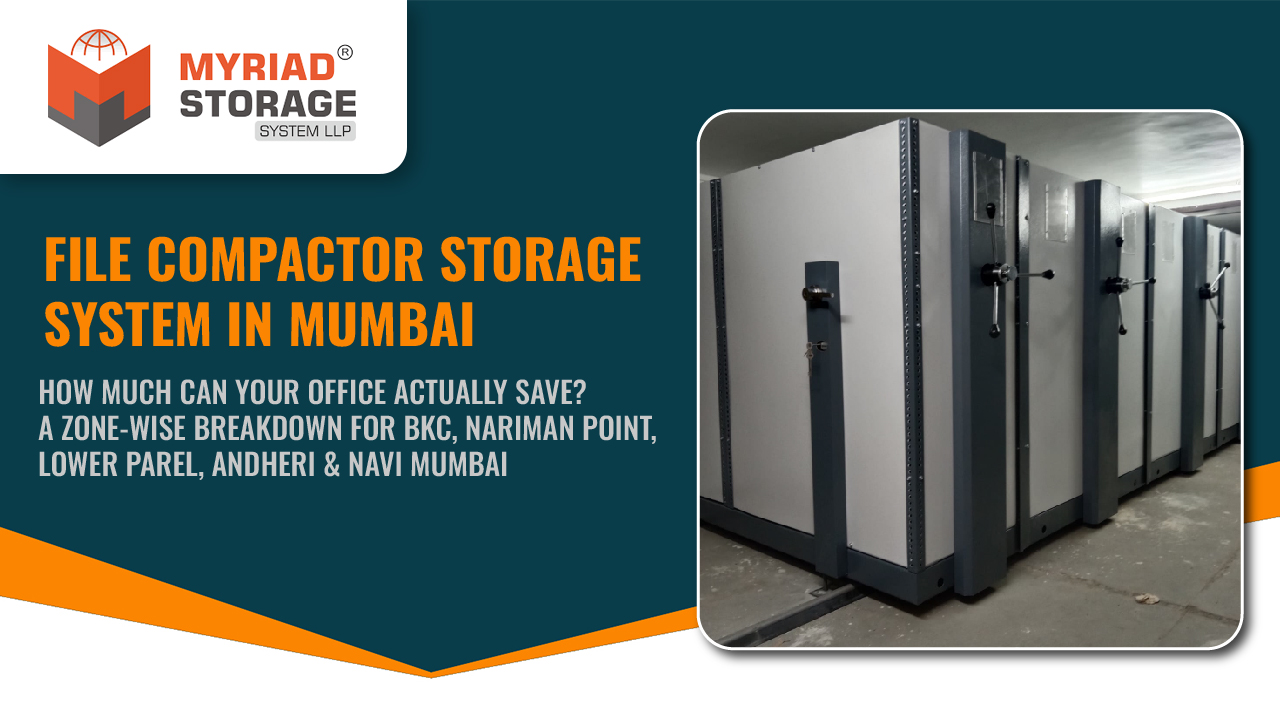
A file compactor storage system solves it by eliminating the permanent aisles between shelving rows and compacting everything into a fraction of the original footprint. The space recovered goes back to revenue-generating use — workstations, meeting rooms, or client-facing areas. In a city where every square foot is billed monthly, that recovery translates directly into rupees saved.
This guide breaks down exactly how much a file compactor saves across five major Mumbai business zones — with actual 2026 rent figures, not estimates.
Zone-by-Zone Savings — What a File Compactor Actually Recovers in Each Part of Mumbai
The savings from a file compactor depend entirely on where your office is located. A compactor that frees up 300 square feet saves dramatically more in BKC than it does in Navi Mumbai — even though the physical space recovered is identical. Here is the zone-wise reality.
Bandra Kurla Complex (BKC)
BKC is Mumbai’s premium financial district, housing global banks, investment firms, fund houses, and multinational headquarters. Office rents here range from ₹300 to ₹350 per square foot per month — among the highest in Asia.
A typical corporate record room in BKC occupies 400 to 600 square feet. Replacing traditional fixed shelving with a file compactor system recovers 50 to 70 per cent of that space — roughly 250 to 400 square feet.
At ₹325 per square foot (midpoint), recovering 300 square feet saves ₹97,500 per month — or ₹11.7 lakh per year. The compactor itself typically pays for itself within 6 to 10 months at BKC rent levels.
Nariman Point
Mumbai’s original business district remains the address of choice for legal firms, financial institutions, consulates, and established corporate houses. Office rents range from ₹200 to ₹300 per square foot per month.
Many Nariman Point offices operate in older buildings with fixed floor plans designed decades ago. Record rooms in these offices are often oversized because the original layout allocated large spaces for physical filing before digital systems existed. A compactor can reduce a 500 square foot legacy record room to 200 square feet, freeing 300 square feet.
At ₹250 per square foot, that is ₹75,000 per month — or ₹9 lakh per year in recovered rent.
Lower Parel
Lower Parel transformed from a textile mill district into one of Mumbai’s most sought-after corporate zones. It offers modern glass-facade office buildings at ₹130 to ₹180 per square foot per month.
Many corporate headquarters, media companies, advertising agencies, and tech firms operate from Lower Parel. These offices typically run lean on space — 1,500 to 5,000 square foot floor plates where every room serves multiple purposes.
A file compactor that frees 200 square feet at ₹155 per square foot saves ₹31,000 per month — or ₹3.72 lakh per year. In a 2,000 square foot office, recovering 200 square feet is a 10 per cent increase in usable workspace — enough for 3 to 4 additional workstations.
Andheri East
Mumbai’s IT and BPO corridor, Andheri East has become the preferred location for mid-size companies, IT firms, aviation offices, and back-office operations. Rents range from ₹100 to ₹150 per square foot per month, with metro connectivity making it increasingly popular.
Companies here prioritise operational efficiency over premium addresses. A file compactor fits this mindset — it is a one-time investment that reduces ongoing rent costs. Recovering 300 square feet at ₹125 per square foot saves ₹37,500 per month — or ₹4.5 lakh per year.
Navi Mumbai
Navi Mumbai has emerged as a cost-effective alternative for companies willing to move away from the Island City. Office rents start from ₹73 per square foot in areas like Vashi, Belapur, and Airoli, going up to ₹100 per square foot in newer commercial developments.
Even at these lower rates, a compactor recovering 300 square feet saves ₹22,500 to ₹30,000 per month — or ₹2.7 to ₹3.6 lakh annually. For large operations with bigger record rooms — logistics companies, educational institutions, government departments — the savings scale proportionally.
Mumbai Zone-Wise File Compactor Savings
How much your office saves per month and per year based on your location — 2026 rent data
Calculation basis: Space freed = 50–70% of a typical record room after installing a file compactor. Monthly saving = space freed × midpoint rent per sq ft. Payback = estimated compactor cost ÷ monthly rent saving. Actual savings depend on your specific room size and location.
Rent data: 2026 Mumbai commercial property market reports · Calculations by Myriad Storage System LLP
See Myriad's File Compactor Range → · Book a Free Site Survey →
Three Things Mumbai's Climate Does to Your Filing System That Other Cities Never Face
Mumbai’s geography creates storage challenges unique to this city. Any file compactor installed here must account for conditions that offices in Delhi, Bangalore, or Hyderabad simply do not encounter.
Coastal Humidity and Salt Air
Mumbai’s average relative humidity stays between 70 and 85 per cent for most of the year, spiking above 90 per cent during monsoon months from June to September. The city’s coastal position adds salt-laden air that accelerates corrosion on any exposed metal surface.
For a file compactor — a steel structure that will stand in your office for 15 to 20 years — the quality of the protective coating is not a cosmetic choice. It is the difference between a system that lasts and one that shows rust spots within 3 years.
What to look for: high-pressure electrostatic powder coating applied at 60 to 80 microns thickness with baking at 200 to 220 degrees Celsius. This creates a sealed, non-porous surface that resists both humidity penetration and salt corrosion. A cheaper dip-painted or low-micron coating will fail in Mumbai’s conditions within 2 to 3 monsoon cycles.
For the documents inside, humidity is equally damaging. Paper absorbs moisture, leading to yellowing, fungal growth, and ink bleeding. A properly sealed compactor — with bays closed together when not in use — creates a semi-enclosed environment that significantly reduces moisture exposure compared to open shelving or metal almirahs with ventilation slats.
Compact Office Footprints
Mumbai offices are, on average, smaller than offices in Delhi, Bangalore, or Hyderabad for the same employee count. Companies here have learned to operate in tighter spaces — which means a file compactor installation must be measured with precision down to the centimetre.
A compactor that is 50 mm too wide for the available wall-to-wall distance cannot be installed. A compactor that blocks an emergency exit route fails BMC inspection. A compactor that requires a 900 mm aisle width in a room that only allows 750 mm after installation becomes a daily frustration.
This is why the site survey — measuring the room, checking floor load capacity, mapping electrical outlets and fire equipment positions — is non-negotiable in Mumbai.
Monsoon Season and Document Preservation
Mumbai receives 2,400 to 2,500 mm of rainfall annually, concentrated in four months. During peak monsoon, water ingress through windows, walls, and even ceilings is common in older buildings — particularly in South Mumbai and the western suburbs.
Files stored in open shelving, on the floor, or in poorly sealed almirahs are vulnerable to water damage during these months. A compactor system — elevated on rails above the floor level — provides significantly better protection. The raised rail system keeps the lowest shelf 100 to 150 mm above the floor, protecting documents from minor water ingress.
For offices in flood-prone ground floors or basements, this elevation alone can save irreplaceable records during heavy rainfall events.
Why Buying From a Vasai-Based Manufacturer Changes the Entire Experience
Most file compactor manufacturers that serve Mumbai are actually based in Rajasthan, Delhi NCR, or Pune. They take orders from Mumbai clients, manufacture at their distant factory, ship the finished units by road, and send an installation team that arrives days later. The process typically takes 3 to 4 weeks from order to installation — and if something needs adjustment post-installation, you are waiting again.
Myriad’s manufacturing facility is in Vasai, Palghar — 60 to 90 minutes from most Mumbai office locations depending on traffic.
Same-Day Site Surveys. When a Mumbai client requests a site survey, our team can visit the same day or the next morning. There is no scheduling delay, no waiting for a team to fly in from another city. The surveyor measures the room, photographs the space, notes the floor condition, checks access routes, and provides a preliminary layout on the spot.
Installation Crews Who Know Mumbai Buildings. Installing a file compactor in a Mumbai high-rise is not the same as installing one in a standalone office. Mumbai buildings have narrow service lifts — some as small as 3 feet by 4 feet — tight staircases, security protocols that restrict goods movement to specific hours, and sometimes no service elevator at all. A local crew that has worked in Mumbai buildings for years knows how to plan around these constraints.
Post-Installation Support Within Hours. If a rail needs adjustment after the first week of use, or a locking mechanism needs fine-tuning once the compactor is fully loaded, a Vasai-based team can be at your office within hours. This is support that a manufacturer 1,200 km away simply cannot offer.
No Long-Distance Shipping Costs. Shipping heavy steel structures across state borders adds freight, handling, and transit insurance costs. A Vasai-to-Mumbai delivery eliminates all of this. The savings on shipping alone can reduce the total project cost by 8 to 12 per cent compared to equivalent products shipped from North India.
Document-Heavy Industries That Run Mumbai — And Why They All Need File Compactors
Mumbai is not just any city. It is the concentration point for several industries that generate more paperwork per square foot than almost anywhere else in India.
Banking and Financial Services — The Reserve Bank of India headquarters is in Fort. Major banks — SBI, Bank of India, Union Bank, IDBI — have their head offices or regional offices here. BKC alone houses dozens of global banks and fund houses. Every one of these institutions maintains physical records that require secure, organised, space-efficient storage.
Legal Services — The Bombay High Court at Fort is one of India’s busiest. Nariman Point and Fort house hundreds of law firms, from large full-service practices to boutique litigation chambers. Case files, court records, briefs, and affidavits accumulate rapidly and must be retained for years.
Healthcare — Mumbai is home to some of India’s largest hospital networks — Hinduja, Kokilaben Dhirubhai Ambani, Lilavati, Breach Candy, Tata Memorial, KEM, and Nair. Each hospital maintains thousands of patient files, imaging records, and clinical documentation.
Government and Municipal — The Brihanmumbai Municipal Corporation is India’s wealthiest municipal body. State government departments operate from Mantralaya. District offices, ward offices, and municipal courts all maintain decades of physical records in space-constrained government buildings.
Media and Entertainment — Andheri and Goregaon house production houses, advertising agencies, post-production studios, and broadcaster offices. Contracts, licensing agreements, talent files, and production documentation require organised long-term storage.
Each of these industries has specific filing requirements — but they all share one common problem in Mumbai: paying premium rent for rooms full of paper that a file compactor can reduce by 50 to 70 per cent.
Our factory is in Vasai — same-day site surveys for all Mumbai offices
Same-Day Site Survey for Your Mumbai Office
We are 60 minutes away — not in Rajasthan, not in Delhi. Our surveyor can be at your office today. We measure your space, check your floor, and give you a custom layout drawing at no cost.
500+ installations
ISO 9001:2015
ISRO, SBI, Tata, L&T
Myriad Storage System LLP · Factory in Vasai, Mumbai · ISO 9001:2015 · Pan-India delivery & installation
Frequently Asked Questions
How much does a file compactor save in a Mumbai office?
The savings depend on your office location. In BKC at ₹300 to ₹350 per square foot per month, recovering 300 square feet saves approximately ₹97,500 per month or ₹11.7 lakh annually. In Lower Parel at ₹130 to ₹180 per square foot, the same space recovery saves ₹39,000 to ₹54,000 per month. The compactor typically pays for itself within 6 to 14 months depending on location.
Does Mumbai's humidity affect file compactor durability
Yes. Mumbai’s coastal humidity of 70 to 85 per cent year-round and salt air accelerate corrosion on poorly coated steel. A file compactor for Mumbai must have high-pressure electrostatic powder coating at 60 to 80 microns thickness with baking at 200 to 220 degrees Celsius to resist humidity and salt corrosion for 15+ years.
Is there a file compactor manufacturer based in Mumbai?
Yes. Myriad Storage System LLP has its manufacturing facility in Vasai, Palghar — approximately 60 to 90 minutes from most Mumbai office locations. This allows same-day site surveys, local installation crews familiar with Mumbai buildings, and post-installation support within hours. The factory is ISO 9001:2015 certified.
Can a file compactor be installed in an old Mumbai building with a small lift?
Yes. File compactor components are designed to be transported in modular sections that fit through narrow lifts and tight staircases. A local installation crew experienced with Mumbai buildings knows how to plan material delivery during permitted hours and work within building society regulations.
How quickly can a file compactor be installed in Mumbai?
For a standard 6 to 12 bay installation, the typical timeline from site survey to completed installation is 2 to 3 weeks. Because Myriad’s factory is in Vasai, there is no cross-state shipping delay. The site survey itself can be scheduled on the same day.
What fire safety rules apply to file compactors in Mumbai offices?
BMC fire safety norms apply to any room storing large volumes of paper. Record rooms must maintain clear access to fire extinguishers, have adequate ventilation, and not block emergency exits. The compactor layout must account for minimum aisle width per BMC requirements. A professional site survey includes fire safety compliance in the layout design.