Compactor Storage System Guide: Types, Sizes and How to Set Up
Looking to buy? See our mobile compactor storage systems or file compactor storage systems, made at our Vasai factory in Mumbai. A compactor room is a space fitted with a compactor storage system — one of the most effective space-saving storage solutions for offices and industries in India today. It helps store more files, materials, and documents in less floor space by using movable shelving units mounted on floor rails — eliminating the fixed aisles that waste nearly half your room in traditional static shelving.
With commercial rents crossing ₹168 per sq ft in Mumbai and ₹110 per sq ft in Bengaluru, businesses can no longer afford to dedicate expensive floor space to permanent walkways between racks. Whether you run a corporate office managing growing compliance records, a bank branch storing RBI-mandated documents, or a warehouse handling spare parts and industrial materials — turning that space into a compactor room is the most cost-effective way to solve a storage problem without relocating.
Myriad Storage System LLP has completed 1500+ installations across India, including mobile compactor storage systems for spaces from 80 sq ft office record rooms to 10,000 sq ft industrial warehouses. This guide covers everything you need to know about compactor rooms and compactor storage systems before you invest.
What is a Compactor Room?
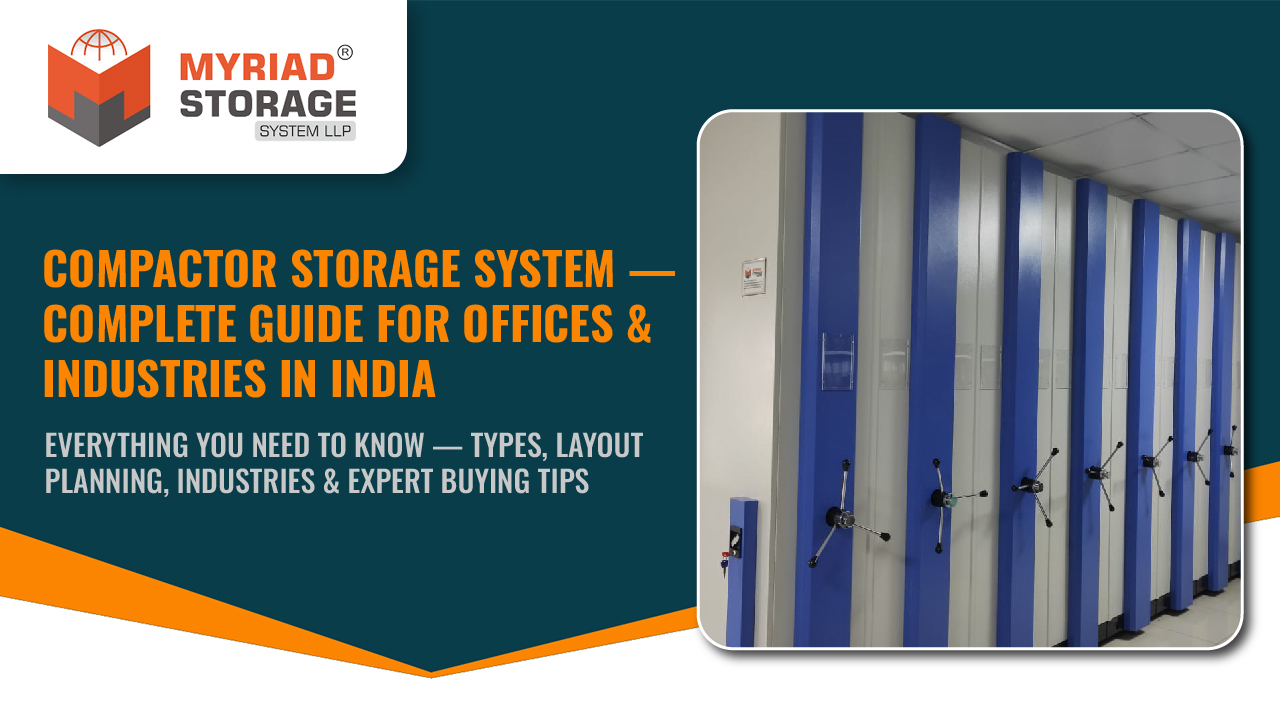
A compactor room is any room or storage area fitted with a compactor storage system — shelving units mounted on floor rails that slide together instead of standing in fixed rows. Rather than every row having its own permanent aisle, only one aisle opens at a time, exactly where it’s needed. The rest of the space that would normally be empty walkway is used for storage instead.
In practice, this means an ordinary record room, archive, or storage cupboard becomes a compactor room simply by replacing static shelving with rail-mounted units — no construction, no expansion, no relocation required.
What Is a Compactor Storage System?
A compactor storage system replaces rows of fixed cabinets or shelving with units mounted on floor rails, so they slide sideways instead of standing in place. Instead of every unit needing its own walking aisle, one shared aisle opens wherever you need access — the rest of the space that would normally sit empty between cabinets goes toward actual storage.
That’s the core difference from ordinary racking or almirahs: a fixed shelving layout needs an aisle in front of every row, all the time. A compactor storage system needs only one aisle, wherever it’s currently opened. In a typical office record room, that single change can free up 50-70% of the floor area a fixed layout would otherwise need.
Myriad builds hand-operated compactor storage systems that need no electricity, in heavy-duty, file, perforated, manual push-pull, and library variants built around what’s being stored. All of them work on the same sliding-rail principle; what changes is the load capacity and the shelf configuration inside.
Applications of Compactor Storage Systems
Compactor storage systems are used across a wide range of industries in India. Common applications include:
Corporate Offices — Storing files, contracts, and compliance documents. GST mandates 6-year retention, and file volumes quickly exceed standard cupboards.
Banks & Financial Institutions — RBI guidelines require 7–10+ years of KYC and loan document retention. A lockable file compactor doubles capacity in the same 150–300 sq ft branch record room.
Hospitals & Healthcare — NABH-accredited hospitals must retain patient and billing records for defined periods. Compactors manage growing archives without expanding the facility.
Libraries & Education — Purpose-built shelf spacing and reinforced frames for books, journals, and academic archives.
Industrial & Warehouse — Heavy duty compactors rated for 500–1,000 kg per shelf level handle spare parts and maintenance inventory.
Government & Defence — Central locking and the 900 mm double-face depth Myriad builds for government-sector units help record rooms cope with chronic paper storage shortages
Which Compactor System Suits Your Industry?
Tap your industry — get the right recommendation instantly
Types of Compactor Storage Systems
Compactor storage systems come in different types based on operation, load capacity, and environment
Manual (Hand-Wheel Operated) —A hand wheel moves the units with light effort. No electricity and very little maintenance. The standard choice for banks, corporate offices, hospital record rooms, CA firms and clinics.
Mobile Compactor — The umbrella category covering all moving shelving systems. Myriad builds hand-operated systems that need no electricity, in the variants listed here.
File Compactor — Purpose-built for documents, narrower depth optimised for A4/legal files. Ideal where 90%+ of storage is paper-based.
Heavy Duty Industrial — Reinforced construction for spare parts, tooling, and cartons — not paper files.
Benefits of Using a Compactor Storage System
Maximises floor space — Eliminates fixed aisles, recovering 50–70% more usable storage from the same room.
Improves organisation — Systematic arrangement speeds up retrieval and daily workflow.
Enhanced security — Central locking and individual bay locks — protection open shelving can’t match.
Long-term cost savings — At Mumbai’s ₹168/sq ft, eliminating just 100 sq ft of extra storage saves ₹2,01,600/year in rent.
Durable, low maintenance — CRCA steel with powder coating lasts 15–20 years; routine maintenance is just twice-yearly rail cleaning and annual lubrication.
Fully customisable — Shelf height, bay width, depth, and locking configuration all adjust to your exact space.
How to Set Up a Compactor Room in Your Office
Setting up a dedicated compactor room is one of the most practical ways to solve a chronic storage problem without relocating. Here is the step-by-step approach Myriad follows across 1500+ installations
Step 1 — Choose the right room Most offices allocate a back room, utility space, or underused store for their compactor installation. The minimum workable size is 80 sq ft — though rooms between 150–300 sq ft give the most layout flexibility. Avoid rooms with excessive moisture, direct sunlight on the floor, or structural columns that interrupt the rail path.
Step 2 — Measure precisely Take exact measurements of the room length, width, and ceiling height. Note door positions and which way they swing, location of electrical switchboards, fire extinguishers, and any wall projections. In small office compactor rooms, even a 150 mm discrepancy changes the number of bays that fit.
Step 3 — Choose the right system For standard A4 and legal-size files, a file compactor storage system is purpose-built for office record rooms — narrower depth, optimised shelf spacing, maximum filing density. For mixed materials including boxes and equipment, a mechanical mobile compactor is more suitable.
Step 4 — Plan access zones Active files — current year records, active client files — go in the outermost bays closest to the door. Archived files (3+ years old) go in the innermost bays opened rarely. This zoning reduces daily movement and makes the compactor room significantly easier to use.
Step 5 — Account for ventilation In coastal cities like Mumbai and Chennai, closed compactor bays trap moisture. Without ventilation or air conditioning, paper degrades within 2–3 years. Choose perforated panel compactors that allow airflow even when closed, or ensure the room has dehumidification.
Step 6 — Get a free site survey A physical site survey by an experienced installer catches real-world problems that floor plan analysis misses — uneven surfaces, hidden conduits, load-bearing limits, door clearance issues. Myriad provides free site surveys and layout design across India before you commit to any purchase.
Compactor Room Setup Checklist
Tick each item before your installation day — avoid costly surprises
Conclusion
A compactor storage system is the most practical solution for any Indian office, bank, hospital, warehouse, or government department running out of space but unable to expand. Banks use compactors to meet RBI retention mandates, hospitals to manage growing OPD archives, government departments to handle DPDPA 2025 compliance, and manufacturers to reclaim warehouse floor space for production.
With 50–70% more capacity from the same room and a 15–20 year lifespan, the investment pays for itself quickly. Myriad has completed installations for ISRO, State Bank of India, Tata, L&T, Berger, Hikvision, WAAREE, JSW, and HP Gas — each custom-built to the exact room dimensions at our Vasai facility.
The right system depends on your room size, what you store, how often you access it, and your security requirements. Myriad’s team will assess your space, design a layout, and give you a full cost breakdown — at no charge and no obligation.
Not Sure Which Compactor System Fits Your Space?
Our team visits your office or warehouse, measures the room, designs a layout, and gives you a full cost breakdown — at no charge and no obligation. 1500+ installations across India since 2018.
Trusted by ISRO · SBI · Tata · L&T · BEL · JSW · WAAREE
Compactor Room & Storage System — Frequently Asked Questions
What is a compactor room?
A compactor room is any storage area fitted with a compactor storage system — shelving mounted on floor rails that slides together, eliminating fixed aisles. Only one aisle opens at a time, freeing up space that would otherwise be permanent walkway.
What is a compactor storage system?
A compactor storage system is a high-density storage solution where shelving units move on floor rails instead of standing fixed in place. This allows a single room to hold 50–70% more files or materials than traditional static shelving, without any construction or relocation.
What is the minimum room size for a compactor?
The minimum workable size is around 80 sq ft, though rooms between 150–300 sq ft offer the most layout flexibility for bay configuration and future expansion.
What types of compactor storage systems are available?
Myriad builds hand-operated compactor storage systems that need no electricity. The main types are heavy-duty, file, perforated, manual push-pull and library compactors. They all work on the same sliding-rail principle; the difference is load capacity and shelf configuration. A free site survey helps you pick the right one for your room.
How is a compactor storage system priced?
Cost depends on the number of bays, the size of your room, the load each shelf must carry and the type of system. Myriad’s team visits your office or warehouse, measures the space and gives you a full cost breakdown at no charge before you commit.
Does Myriad provide a free site survey before installation?
Yes. Myriad’s team visits your office or warehouse, measures the space, designs a layout, and provides a full cost breakdown at no charge before you commit to a purchase.