Benefits of Compactor Storage Systems for Optimizing Space in Mumbai
A compactor storage system in Mumbai has become essential for businesses struggling with space. Walk into any bank branch in Fort, any government office near Mantralaya, or any hospital records room in Andheri — and you will see the same scene. Files stacked on top of cupboards. Boxes blocking corridors. Record rooms so stuffed that the door barely opens. Staff members spending half their morning searching for a single file from 2019 that an auditor has requested.
This is not a storage problem. This is a Mumbai problem. And it has been getting worse every year.
Mumbai businesses do not struggle with storage because they have too many files. They struggle because they are using a storage method designed for the 1980s in a city where every square foot of floor space directly impacts the bottom line. Traditional steel almirahs and open shelving waste nearly half the room on permanent aisles that exist only so someone can walk between the racks. In a city where office space is among the most expensive in Asia, giving away half your storage room to empty walkways is a cost no business can afford.
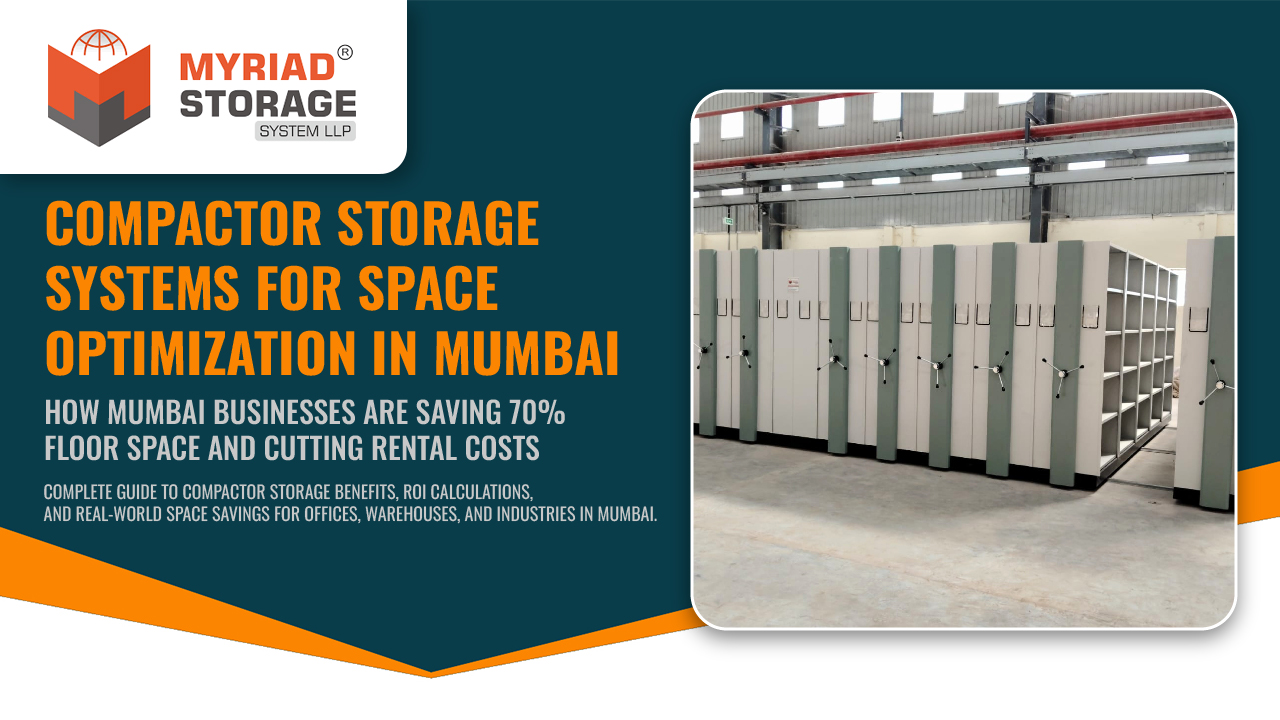
A compactor storage system eliminates this problem entirely. It places your shelving units on floor-mounted steel rails so the racks slide together and share a single aisle between them. You access only the section you need — the rest stays compacted. The result is the same number of files stored in 60 to 70 percent less floor space.
But space saving is just one part of the story. For Mumbai businesses specifically, compactor storage systems solve problems that businesses in other cities do not even think about.
The Monsoon Problem: Protecting Documents in Mumbai's Wettest Months
Mumbai receives an average of 2,400 mm of rainfall every monsoon season. The city’s drainage infrastructure, originally designed to handle just 25 mm per hour, regularly fails during heavy downpours. Waterlogging in areas like Hindmata, Sion, Dadar, and even BKC is an annual event — and ground-floor offices and basement storage rooms are the first casualties.
Every monsoon, Mumbai businesses lose irreplaceable documents to water damage. Loan files from banks. Patient records from hospitals. Property documents from law firms. Land records from government offices. Once paper files absorb moisture, mould sets in within 48 to 72 hours, and the damage becomes permanent. No amount of drying or restoration can fully recover a mould-damaged document.
A compactor storage system addresses this risk in three ways that traditional open shelving cannot.
First, compactors are fully enclosed steel units. When the bays are closed, documents inside are shielded from splashing water, leaking pipes, and minor flooding that would soak files on open shelves. The sealed panels act as a protective barrier during the critical hours when water enters a building before it can be pumped out.
Second, compactors elevate your files off the floor. The rail-and-base system raises the lowest shelf several inches above ground level. In a minor flooding event — the kind that happens in dozens of Mumbai offices every monsoon — this elevation difference can be the difference between dry files and destroyed files.
Third, the steel construction with powder coating resists the humidity and moisture that Mumbai experiences for four to five months every year. Traditional wooden shelving absorbs moisture, warps, swells, and eventually develops fungus. CRCA steel compactors remain structurally intact through decades of monsoons without deterioration.
What happens to unprotected documents during Mumbai monsoon
The timeline of irreversible damage to files stored on open shelving
Water enters the building
Waterlogging in Hindmata, Sion, Dadar, and BKC pushes water into ground-floor offices and basements. Open shelves expose files to splashing water and dripping from leaking pipes and windows.
Paper absorbs moisture
Paper files act like sponges. Documents swell, ink begins to bleed, and pages stick together. Files on lower shelves are fully soaked. Adhesive labels peel off, destroying file identification.
Mould begins to grow
Mumbai's 80-95% humidity combined with 28-32°C temperatures creates perfect conditions for mould and fungus. Once mould sets in, it spreads rapidly between stacked files and cannot be fully reversed.
Documents become unreadable
Ink fades completely on wet pages. Printed text dissolves. Signatures become illegible. Stapled documents rust at contact points. Carbon copies merge into unreadable blocks.
Permanent loss — documents destroyed
Loan files, patient records, property documents, court papers — gone permanently. No restoration service can fully recover mould-damaged paper records. Regulatory compliance is broken.
How compactor storage prevents this
Enclosed steel panels shield documents from water splashing and pipe leaks. Rail-mounted base elevates files above floor level during minor flooding. CRCA steel with powder coating resists humidity and corrosion through decades of monsoons. Documents stay dry, protected, and intact.
The Fire Safety Problem: Why Overstuffed File Rooms Are a Compliance Risk
Under the Maharashtra Fire Prevention and Life Safety Measures Act and BMC fire regulations, commercial premises in Mumbai must maintain clear emergency exit pathways, properly installed fire extinguishers, and unobstructed access routes. The Mumbai Fire Brigade inspects commercial buildings and can issue closure notices for non-compliance.
Here is where this connects to storage. In hundreds of Mumbai offices, the file room has become a fire hazard. Papers stacked to the ceiling. Boxes blocking sprinkler coverage. Files piled against electrical panels. Narrow passages between overstuffed racks that would be impossible to navigate during an emergency evacuation.
A compactor storage system directly addresses these fire safety concerns. By consolidating the same volume of files into 60 to 70 percent less space, compactors free up floor area for clear pathways. The closed steel construction contains paper documents behind metal panels rather than leaving them exposed on open shelves where they become fuel for fire spread. Sprinkler systems can operate without obstruction because the compacted units have a clean, uniform top surface rather than the uneven towers of boxes and loose files that characterise most Mumbai file rooms.
Several Mumbai organisations have specifically installed compactor systems after receiving observations from fire safety auditors about their storage rooms. The compactor eliminated the compliance issue while simultaneously solving their space problem.
The Old Building Challenge: Installing Compactors in Mumbai's Unique Architecture
One of the most common concerns Mumbai businesses raise before purchasing a compactor system is whether it will work in their specific building. Mumbai has a unique mix of heritage structures in South Mumbai, mill-conversion offices in Lower Parel, traditional commercial buildings in Fort and Churchgate, and modern glass towers in BKC and Goregaon. Each presents different challenges.
Narrow lifts and staircases: Many older Mumbai buildings have lifts that are too small to transport fully assembled compactor units. An experienced manufacturer accounts for this by designing the system in modular sections that can be carried up narrow staircases and assembled on-site. Every component is designed to fit through standard doorways and tight corridors.
Floor load capacity: Older buildings may have lower floor load bearing capacity than modern constructions. A quality compactor manufacturer calculates the total loaded weight of the system and distributes it across the floor rails to stay well within safe limits. In some cases, the load distribution of a rail-mounted compactor is actually more even than heavy standalone almirahs placed on specific floor points.
Uneven or sloped floors: Some older Mumbai buildings have floors that are not perfectly level. The rail system can be shimmed and levelled during installation to ensure smooth, friction-free movement of the racks even on imperfect surfaces.
Limited ceiling height: Ground-floor offices and basement storage rooms in older Mumbai buildings sometimes have lower ceiling heights. Compactor systems can be custom-built to any height — from 6 feet for low-ceiling basements to 10 feet or more for standard rooms.
Installation during business hours: Mumbai offices cannot afford to shut down operations for days while a storage system is installed. Professional installation teams work in phases — laying the floor rails over a weekend, assembling racks section by section, and transferring files systematically — so that the office continues to function throughout the process. Most installations are completed within 3 to 5 days with minimal disruption.
Myriad Storage System has installed compactor systems in heritage bank buildings in Fort, converted mill offices in Lower Parel, government buildings in Mantralaya, hospital basements in Andheri, and modern corporate towers across the western suburbs. Every installation is planned around the building’s specific constraints.
The Alternatives: What Mumbai Businesses Try Before Choosing Compactors
Before investing in a compactor system, most Mumbai businesses try one or more alternatives to solve their storage problem. Here is how each option compares.
Renting additional godowns or storage space: Many businesses rent warehouse space in Bhiwandi, Taloja, or Navi Mumbai to store inactive files. This seems cheaper initially but creates ongoing costs — monthly rent, transportation charges every time a file is needed, security risks during transit, and retrieval delays of 24 to 48 hours. Over three to five years, the cumulative cost of off-site storage often exceeds the one-time investment in a compactor system that keeps all files accessible within your own office.
Digitisation and scanning: Scanning documents is useful for creating digital backups, but it does not eliminate the need for physical storage in most regulated industries. Banks must retain original loan documents. Hospitals need physical patient consent forms. Law firms require original agreements and court filings. Government departments maintain original land records. Even after digitisation, the originals must be preserved for the legally mandated retention period — which can be 8, 10, or even 30 years depending on the document type. Digitisation complements compactor storage but does not replace it.
Buying more almirahs and cupboards: This is the most common and least effective solution. Adding more almirahs simply fills up more floor space without increasing storage density. Ten almirahs taking up 200 sqft of floor space can be replaced by a compactor system storing the same volume in 80 sqft — freeing 120 sqft for productive use.
Stacking files in boxes on top of shelves and in corridors: This is not a solution — it is a symptom of a problem that has been ignored too long. Stacked boxes are unstable, inaccessible, unorganised, and a fire hazard. When an auditor or regulator visits and sees files stacked in corridors, it raises immediate red flags about the organisation’s record management practices.
The compactor storage system is the only solution that simultaneously increases storage capacity, reduces floor space usage, maintains organised accessibility, protects documents from environmental damage, and satisfies regulatory compliance requirements.
4 alternatives Mumbai businesses try before choosing compactors
An honest comparison of cost, practicality, and long-term value
Real Impact: What Changes After a Compactor Installation
Organisations that switch from traditional storage to a mobile compactor storage system consistently report several immediate changes in their daily operations.
File retrieval time drops from 15 to 20 minutes to under 2 minutes. When files are systematically organised in labelled compactor bays instead of stuffed into random cupboards, employees find what they need almost immediately. For a bank branch processing 50 to 100 file requests daily, this saves 10 to 15 hours of staff time every single day.
Audit preparation becomes straightforward. Instead of spending two weeks pulling files from different locations before an audit, organisations with compactor systems can produce any requested document within minutes. RBI auditors, NABH assessors, and ISO auditors have all noted the difference when records are stored in properly organised compactor systems.
Employee satisfaction improves. This is less obvious but significant. Staff members who previously dreaded being assigned to the file room — because it meant crawling between overstuffed shelves in a dusty, cramped space — find that the reorganised storage area is clean, well-lit, and easy to navigate. The psychological impact of an organised workspace on team morale is well documented.
Clients and visitors notice. When a client visits your office and sees a professional, well-organised storage system instead of a chaotic file room, it communicates competence and attention to detail. For professional services firms — chartered accountants, lawyers, consultants — this visual impression directly influences client confidence.
Traditional storage vs compactor storage
Side-by-side comparison for Mumbai businesses
| Factor | Traditional shelving | Compactor storage |
|---|---|---|
| Space used | 50% wasted on permanent aisles that sit empty most of the day | Only 1 shared aisle — saves 60-70% floor space instantly |
| Monsoon protection | Open shelves expose files to water splashing, pipe leaks, humidity | Enclosed steel panels shield documents. Elevated base above floor |
| Fire safety | Exposed papers fuel fire. Stacked boxes block exits and sprinklers | Papers behind steel panels. Clear pathways. Unobstructed sprinklers |
| Security | Anyone can access any file. No bay-level locking | Individual bay locks. Anti-tilt prevents unauthorised multi-aisle opening |
| Retrieval time | 15-30 minutes searching in overstuffed cupboards | Under 2 minutes with organised, labelled shelving |
| Termite and pest risk | Wood attracts termites. Open racks attract silverfish and rodents | Full steel. Powder coated. No wood. Enclosed bays deter pests |
| Lifespan | Wood: 3-5 years. Steel almirahs: 8-10 years with rust | CRCA steel with powder coating: 15-20 years |
| Professional look | Cluttered rooms with boxes stacked on top of cupboards | Clean, uniform appearance. Custom colours match office interiors |
Types of Compactor Systems for Different Mumbai Applications
Not every Mumbai business needs the same type of compactor. Here is a quick guide to matching the right system to your requirement.
For corporate offices, banks, and insurance companies managing files and documents, a file compactor storage system with adjustable shelving, individual bay locks, and mechanical hand-crank operation is the most popular choice. These systems handle the volume and weight of paper files efficiently while providing security for sensitive records.
For hospitals and diagnostic centres storing patient records, X-ray films, and medical supplies, a compactor with a combination of file shelving and wider compartments works best. Some bays can be configured for standard files while others accommodate bulkier medical supplies or imaging films.
For warehouses in Bhiwandi, MIDC areas, and Navi Mumbai storing industrial materials, inventory, or heavy components, a heavy duty mobile compactor with reinforced shelving and higher load capacity per bay is required. These systems are built to handle significantly heavier loads than office file compactors.
For schools, colleges, and libraries storing books, journals, and academic records, a library compactor system with smooth, quiet operation and adjustable shelf spacing for different book sizes is ideal.
For smaller offices, clinics, and startups with limited budgets and lighter storage needs, a manual push-pull compactor without mechanical parts offers a simple, cost-effective solution with zero maintenance requirements.
Why Local Manufacturing Matters for Mumbai Businesses
When choosing a compactor manufacturer, Mumbai businesses have a specific advantage — several manufacturers are based in Mumbai itself or in nearby areas like Vasai, Thane, and Navi Mumbai. Choosing a local manufacturer matters more than most businesses realise.
Faster delivery: A system manufactured in Vasai can be delivered to any Mumbai location within 1 to 2 days. Manufacturers from Gujarat, Rajasthan, or North India require 7 to 15 days for transportation alone.
Site survey accuracy: A local team can visit your office, take precise measurements, photograph the space, assess the floor, check lift sizes, and note every constraint — often within 24 hours of your enquiry. Out-of-town manufacturers either skip the site survey entirely or rely on measurements you provide, increasing the risk of design errors.
Installation quality: Installation is the most critical phase. Rails must be perfectly aligned. Racks must be precisely levelled. The system must be tested under full load. A local manufacturer sends their own trained installation team rather than relying on third-party contractors who may not understand the product.
After-sales service: If a wheel needs replacement, a rail needs adjustment, or a locking mechanism needs repair three years after installation, a local manufacturer can send a technician within 24 to 48 hours. Try getting that response time from a manufacturer 1,500 kilometres away.
Myriad Storage System LLP manufactures all compactor systems at our facility in Vasai, Palghar — approximately 60 kilometres from central Mumbai. Our team conducts free site surveys across Mumbai, handles complete installation with our own trained crew, and provides ongoing maintenance support. With over 500 installations completed since 2018 for clients including ISRO, SBI, Tata, L&T, and Bharat Electronics, we understand the specific requirements of Mumbai businesses across every industry.
Get Started: Free Site Survey for Your Mumbai Office
If your file room has reached its limit, or if you are spending money on off-site storage that you would rather bring back in-house, a compactor storage system is likely the most practical and cost-effective solution available.
Our process starts with a free site survey. We visit your location, measure the available space, understand your storage requirements, and present a custom design within 3 to 5 days. There is no obligation and no cost for the survey.
Call us at +91 97693 77043 orWhatsApp us to schedule your free site survey. We typically visit within 48 hours of your request.
FAQ — Compactor Storage Systems in Mumbai
How does a compactor storage system protect documents during Mumbai's monsoon season?
Compactor systems are fully enclosed steel units with powder-coated panels that shield documents from splashing water, leaking pipes, and humidity. The rail-and-base system elevates files above floor level, protecting them from minor flooding. Unlike wooden shelving that absorbs moisture and develops fungus, CRCA steel compactors remain structurally intact through Mumbai’s monsoon season year after year.
Can a compactor system be installed in an old Mumbai building with narrow lifts?
Yes. Experienced manufacturers design compactor systems in modular sections that can be carried through narrow staircases and doorways. The system is assembled on-site within 3 to 5 days. Floor load capacity is calculated in advance and the weight is distributed across the rail system. We have installed compactors in heritage buildings in Fort, old commercial buildings in Churchgate, and converted mill offices in Lower Parel.
Is a compactor storage system better than off-site document storage in Bhiwandi?
For most businesses, yes. Off-site storage involves ongoing monthly rent, transportation costs, retrieval delays of 24 to 48 hours, and security risks during transit. A compactor system is a one-time investment that keeps all your files accessible within your own office with instant retrieval. Over 3 to 5 years, the total cost of off-site storage often exceeds the one-time cost of a compactor system.
Does a compactor storage system help with fire safety compliance in Mumbai?
Yes. By consolidating files into 60 to 70 percent less space, compactors free up floor area for clear emergency pathways. The closed steel construction contains paper documents behind metal panels rather than leaving them exposed on open shelves. This addresses common fire safety audit observations about blocked exits, obstructed sprinkler coverage, and overstuffed storage rooms.
How long does a compactor storage system last in Mumbai's humid climate?
A quality compactor built from CRCA steel with electrostatic powder coating lasts 15 to 20 years with minimal maintenance. The powder coating resists rust, corrosion, and moisture — unlike wooden furniture that warps and deteriorates within a few years in Mumbai’s high-humidity environment. Annual lubrication of the rail system is the only maintenance required.