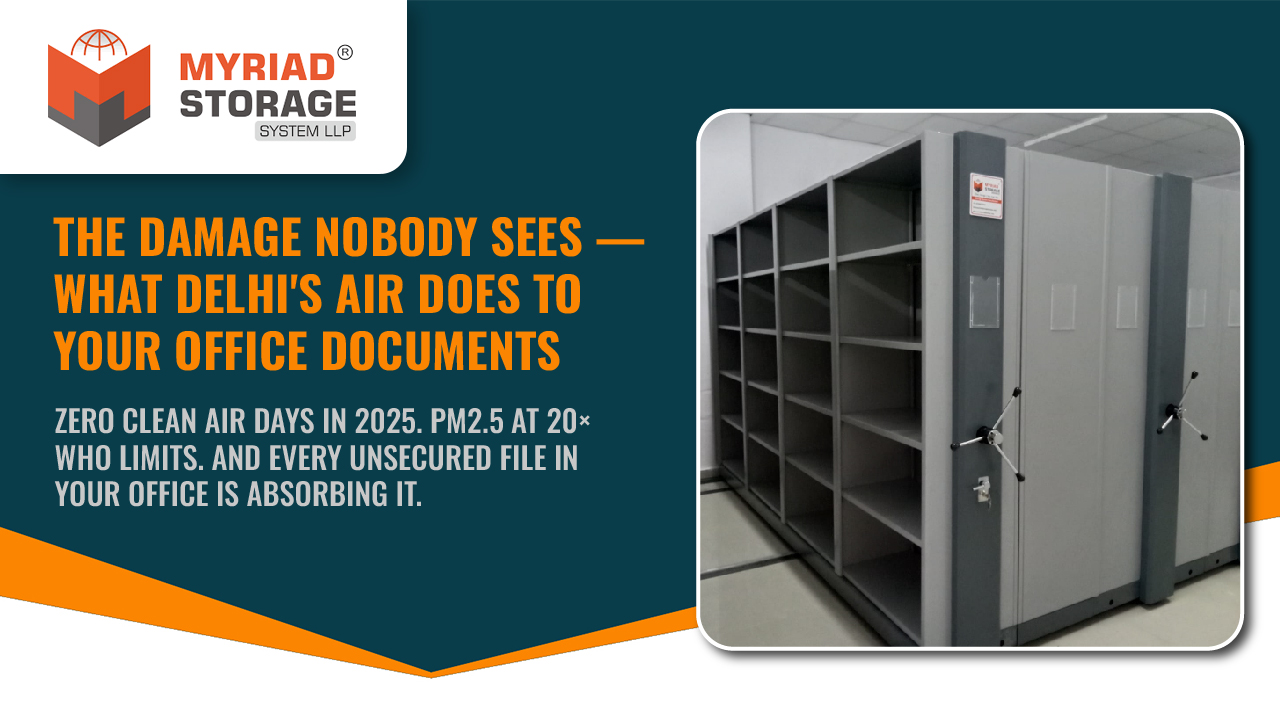
Delhi's Air Pollution Isn't Just a Health Crisis — It's Quietly Destroying Every Paper Document in Your Office
Delhi recorded zero good air quality days in 2025. Not a single day when the air met clean-air benchmarks under US EPA standards. The city’s annual average PM2.5 concentration hovered around 100 µg/m³ — twenty times the World Health Organization’s safe annual limit of 5 µg/m³.
You already know what this does to your lungs. You buy air purifiers for your home. You check AQI apps before stepping outside. You keep N95 masks in your car.
But have you looked at what the same air is doing to the paper records sitting in your office?
Every document stored in an open shelf, an unlocked metal almirah, or a filing cabinet with ventilation slats is breathing the same air you are trying to avoid. PM2.5 particles, soot, nitrogen dioxide, sulphur dioxide, and construction dust settle on paper surfaces every single day — 365 days a year in a city that never gets a break from pollution.
The result: yellowing that starts at the edges and creeps inward. Brittleness that makes pages crack when you turn them. Ink that fades and bleeds. And a slow, invisible chemical reaction that turns your compliance records, KYC documents, legal contracts, and HR files into degraded copies of what they were when you first filed them.
A file compactor storage system does not filter the air. But it does something no almirah or open shelf can — it seals your documents away from the air when they are not being accessed. Bays stay compacted together, creating a semi-enclosed environment that dramatically reduces the exposure of paper to Delhi’s toxic atmosphere.
This guide explains exactly what Delhi’s air does to paper, why your current storage is making it worse, and how one infrastructure change protects your records for 15+ years.
What Delhi's Air Actually Contains — And What Each Pollutant Does to Paper
Delhi’s pollution is not a single substance. It is a cocktail of particles and gases, each of which attacks paper through a different mechanism.
PM2.5 (Fine Particulate Matter)
These are particles smaller than 2.5 micrometres — invisible to the naked eye. Delhi’s PM2.5 levels routinely reach 100 to 220 µg/m³, peaking during November and December when stubble burning, vehicle emissions, and temperature inversions trap a toxic blanket over the city.
PM2.5 particles contain iron, carbon, and organic compounds. Research published in Heritage Science confirms that particulate matter deposited on paper accelerates cellulose degradation through iron-mediated chemical reactions. The paper’s polymer chains break down, making pages progressively weaker and more brittle — even in dark storage conditions.
In practical terms: a KYC document filed in an open almirah in a Delhi office in 2024 will be noticeably more fragile by 2027 than the same document stored in a sealed environment.
PM10 (Coarse Particulate Matter)
Larger particles — construction dust, road dust, sand from Rajasthan dust storms — that are visible as the grey film that coats every surface in a Delhi office within hours of cleaning. Delhi’s PM10 levels frequently exceed 200 to 300 µg/m³ during peak months.
These particles cause physical abrasion when they settle on paper. Every time someone pulls a file from a dusty shelf, the friction between the dust layer and the paper surface scratches the fibre. Over years of repeated handling, this abrasion weakens the paper and makes printed text harder to read.
Nitrogen Dioxide (NO₂) and Sulphur Dioxide (SO₂)
Gaseous pollutants from vehicle emissions and industrial sources. These gases react with moisture in the air (and moisture within paper fibres) to form nitric acid and sulphuric acid. This acid deposits on paper surfaces and accelerates a process called acid hydrolysis — the same chemical reaction that makes old newspaper clippings turn yellow and crumble.
The connection between atmospheric acidity and paper degradation is well documented in archival science. Delhi’s NO₂ and SO₂ levels make this process significantly faster than in cities with cleaner air.
Soot and Carbon Particles
Black carbon from vehicle exhausts, biomass burning, and industrial emissions. Soot settles on paper as a fine black residue that is nearly impossible to remove without damaging the document surface. Over time, soot causes permanent discolouration — the grey-black tint visible on documents stored in Delhi offices for more than 2 to 3 years.
The Four Seasons of Document Destruction in Delhi
The 4 Seasons of Document Destruction in Delhi
How each season attacks your paper records through a different mechanism — and why there's no safe month
AQI data: IQAir 2025, CPCB, AQI.in · Paper degradation research: Heritage Science, Canada Conservation Institute
See Myriad's File Compactor Range → · Get a Free Site Survey in Delhi NCR →
Delhi’s climate does not give your documents a single month of relief. Each season attacks paper through a different mechanism.
October to January — Smog Season
The worst period. Temperature inversions trap pollution at ground level. PM2.5 spikes to 200+ µg/m³. AQI regularly crosses 400, sometimes reaching 500+ during Diwali and peak stubble burning weeks. Visibility drops to under 200 metres.
During these months, the concentration of airborne particles that settle on office surfaces — desks, shelves, files — is at its highest. A document stored in an open shelf accumulates more particulate deposit in these 4 months than in the remaining 8 months combined.
February to April — Transition Period
Temperatures rise, wind picks up, and AQI improves to the 100 to 200 range. But this is also when offices open windows for ventilation after months of keeping them shut — allowing accumulated outdoor pollutants to enter record rooms in large volumes. The transition from cold-dry to warm-dry conditions also causes paper to lose moisture rapidly, leading to curling and edge brittleness.
May to June — Heat and Dust Storm Season
Delhi temperatures hit 45 to 47°C. Dust storms from the Thar Desert in Rajasthan carry coarse sand particles that spike PM10 to extreme levels. These storms deposit a visible layer of fine sand on every exposed surface — including files stored in ventilated almirahs.
The extreme heat also accelerates chemical degradation. Every 10°C increase in temperature roughly doubles the rate of acid hydrolysis in paper. A record room without climate control in a Delhi summer is essentially a slow oven for your documents.
July to September — Monsoon Season
Relative humidity jumps to 80 to 95 per cent. While the rain temporarily washes pollution from the air, the humidity creates a different problem: moisture absorption. Paper fibres swell, pages stick together, and the warm-wet conditions create ideal conditions for fungal growth — the green and black mould spots visible on documents stored in poorly ventilated almirahs.
The combination of monsoon moisture and the acid deposits accumulated during smog season creates a particularly destructive cycle. Moisture reactivates the acid on paper surfaces, accelerating the yellowing and embrittlement that began months earlier.
Why Your Current Storage Is Making Everything Worse
Most Delhi offices store documents in one of three systems — and all three expose records to maximum environmental damage.
Standard metal almirahs have ventilation slats or perforated panels designed to prevent moisture buildup. In Delhi’s environment, these ventilation openings do the opposite of protection — they allow a continuous flow of polluted air directly onto the documents inside. The almirah becomes a pollution collection chamber with perfect airflow.
Open shelving units offer zero protection. Documents on open shelves are directly exposed to every particle, gas, and temperature swing in the room. The top shelves — closest to ceiling-level dust accumulation — suffer the worst damage.
Filing cabinets with gaps provide slightly better protection than open shelving, but standard filing cabinets are not sealed. The gaps between drawers, the spaces around handles, and the imperfect closure of most cabinet doors allow fine particles (PM2.5) to enter continuously.
None of these systems were designed for a city where the air itself is a destructive agent. They were designed for normal environments where dust is an aesthetic nuisance, not a chemical threat to the documents they store.
How a File Compactor Protects Documents in Delhi's Environment
A file compactor storage system does not have air filtration or climate control. It protects documents through a simpler and more reliable mechanism: physical isolation.
Sealed bay environment. When bays are compacted together (which is their default state — bays are only opened when a specific file is needed), the documents inside are surrounded by steel panels on all sides. The tight bay-to-bay contact eliminates the air gaps that allow pollutants to reach the paper. This creates a semi-sealed microenvironment where air exchange with the room is minimal.
Compare this to an almirah with ventilation slats that is open to room air 24 hours a day, 365 days a year. In a compactor, the average document is exposed to room air only for the few minutes when its specific bay is opened for retrieval — not all day, every day.
Powder-coated steel surfaces. The CRCA steel panels of a quality file compactor are finished with 60 to 80 micron electrostatic powder coating that creates a smooth, non-porous surface. Unlike raw steel or thin-painted almirahs, this surface does not harbour dust particles or moisture — it can be wiped clean in seconds, preventing the pollutant buildup that transfers to documents on contact.
Raised rail system. The compactor sits on rails 100 to 150 mm above floor level. In Delhi offices where dust settles fastest at floor level — especially during dust storm season — this elevation keeps the lowest shelf above the heaviest dust concentration zone.
Central locking reduces unnecessary access. Every time an almirah is opened, room air rushes in. In a compactor with central locking, bays are opened only when a specific file is needed and only by authorised personnel. Fewer openings means less air exchange, which means less pollutant exposure. This access control benefit — originally designed for data security compliance — doubles as environmental protection in Delhi’s conditions.
Delhi NCR Business Zones — Where the Problem Is Worst
Delhi NCR is vast, and pollution levels vary by zone. But the document storage challenge is universal.
Central Delhi — Connaught Place, ITO, Barakhamba Road
Government offices, PSU headquarters, established corporate houses, and legal firms. Many operate from buildings constructed in the 1960s to 1980s with large record rooms that have not been modernised. Decades of accumulated documents — already degraded from years of exposure — sit in rusting almirahs. These offices have the oldest records AND the worst storage infrastructure.
South Delhi — Nehru Place, Saket, Greater Kailash
IT companies, consulting firms, startups, and professional services offices. Modern office spaces but with standard almirahs or filing cabinets for physical records. The assumption that “we’re a digital company” means physical storage gets zero attention — while KYC documents, contracts, and HR files slowly degrade in an undersized cupboard.
Gurgaon — Cyber City, Golf Course Road, Sohna Road
The corporate capital of NCR. MNCs, GCCs, BFSI operations centres, and large law firms. Glass-tower offices with centralised HVAC — which filters air for humans but does nothing for the record room in the basement or utility floor where documents are stored without climate control.
Noida — Sector 62, Sector 16, Film City Road
IT parks, media companies, government institutions (including multiple central government offices that relocated from Delhi). Similar to Gurgaon in office profile but with slightly higher PM10 due to massive ongoing construction across Greater Noida and the Yamuna Expressway corridor.
Old Delhi — Chandni Chowk, Daryaganj, Sadar Bazaar
Wholesale traders, small businesses, distributors, and family-run enterprises operating from 100 to 300 square foot offices. The tightest spaces, the oldest buildings, the most paper-heavy operations, and the highest ambient pollution exposure in the entire NCR.
Every zone has the same air. Every zone stores documents in systems designed for a city with clean air. The mismatch is universal.
Delhi’s conditions.
What Changes When You Switch From Open Storage to a Compactor in Delhi
The transition is straightforward and the effects are immediate:
Day 1: All documents move from scattered almirahs, shelves, and cabinets into the compactor. The record room suddenly has 50 to 70 per cent more free floor space. The visual clutter disappears. Documents are systematically organised by section — the filing system is built into the bay layout.
Week 1: The first time you open a bay, you notice the documents inside are noticeably cleaner than files stored in the old almirahs. The sealed bay environment is already reducing dust deposit.
Month 3: Files retrieved from the compactor show visibly less dust accumulation than files stored alongside in any remaining open shelving. The difference is obvious when you compare a compactor-stored file against one from an almirah.
Year 1: No new yellowing on documents stored in the compactor. Compare against files stored in traditional almirahs for the same period — the edge yellowing and brittleness differences are measurable. In Delhi’s environment, one year of sealed storage makes a visible difference in document condition.
Year 5 and beyond: Documents stored in a compactor remain in retrievable, legible, presentable condition. Documents stored in open systems in Delhi for the same period show significant degradation — yellowed edges, brittle pages, faded text, dust staining, and in some cases fungal spots from monsoon moisture cycles.
For organisations that must retain records for 5 to 10 years — banks under RBI KYC rules, corporates under Companies Act, hospitals for patient records — this preservation difference is not cosmetic. It determines whether a document is usable during an audit or legal proceeding 7 years after filing.
Why Myriad for Delhi NCR Installations
Myriad Storage System has completed 500+ installations across India, including offices, banks, hospitals, and government departments in environments ranging from Mumbai’s coastal humidity to Delhi’s extreme pollution.
Pan-India delivery with dedicated Delhi NCR project coordination. Site survey, layout design, manufacturing at our ISO 9001:2015 certified Vasai factory, and installation managed as a single coordinated project.
CRCA steel with 60 to 80 micron electrostatic powder coating. The same coating specification that resists Mumbai’s salt air provides an equally smooth, non-porous surface in Delhi — one that does not harbour dust or pollutant particles and can be cleaned easily.
Enterprise clients who trust us with their records. ISRO, SBI, Tata, L&T, JSW, TVS, Bharat Electronics Limited, WAAREE, Berger, Hikvision, and HP Gas.
Delhi had zero clean air days in 2025. Your documents are breathing it all.
Delhi's Air Isn't Getting Cleaner. Protect What's Inside.
Request a free site survey for your Delhi NCR office. We'll measure your record room and design a file compactor layout that seals your documents away from the pollutants damaging them right now.
SBI, ISRO, Tata clients
500+ installations
ISO 9001:2015
Myriad Storage System LLP · ISO 9001:2015 · Factory in Vasai, Mumbai · Pan-India delivery & installation
Frequently Asked Questions
Does Delhi's air pollution actually damage paper documents?
Yes. PM2.5 particles contain iron and carbon compounds that accelerate cellulose degradation in paper through chemical reactions. PM10 (dust) causes physical abrasion. NO₂ and SO₂ form acids on paper surfaces that cause yellowing and embrittlement. Research in Heritage Science confirms that particulate matter deposited on paper accelerates degradation even in dark storage conditions. Delhi’s PM2.5 levels at 20 times the WHO limit make this process significantly faster than in cleaner cities.
How does a file compactor protect documents from pollution?
A file compactor keeps bays sealed together when not in use, creating a semi-enclosed environment with minimal air exchange. Documents are only exposed to room air for the brief moments when a specific bay is opened for retrieval. This dramatically reduces the amount of dust, PM2.5, and gaseous pollutants that settle on paper compared to open almirahs or shelving that expose documents to room air 24 hours a day.
Is pollution damage to documents reversible?
Most pollution-related document damage is irreversible. Yellowing from acid hydrolysis, brittleness from cellulose breakdown, soot staining, and ink fading cannot be undone through normal office means. Professional conservation treatment exists but costs thousands per document. Prevention through proper storage is far more effective and economical than restoration.
Which Delhi NCR zone has the worst document storage conditions?
Old Delhi (Chandni Chowk, Daryaganj) has the highest ambient pollution exposure combined with the smallest office spaces and oldest storage infrastructure. However, all Delhi NCR zones — including Gurgaon and Noida — experience PM2.5 levels that damage documents in open storage. Modern offices with HVAC filter air for occupants but typically do not extend climate control to record rooms.
How much space does a file compactor save compared to almirahs in a Delhi office?
A file compactor recovers 50 to 70 per cent of floor space compared to equivalent almirah storage. A record room with 15 almirahs can be replaced by a file compactor occupying less than half the space — freeing the rest for workstations or meeting areas. In Delhi NCR where office space is at a premium, this space recovery is a significant operational benefit.
Does Myriad install file compactors in Delhi NCR?
Yes. Myriad delivers and installs pan-India with dedicated project coordination for Delhi NCR — covering Delhi, Gurgaon, Noida, Faridabad, and Ghaziabad. All compactors are manufactured at our ISO 9001:2015 certified factory in Vasai, Mumbai using CRCA steel with 60 to 80 micron electrostatic powder coating. Site survey and layout design are provided at no cost.