Hospital Storage Solutions India: How Smart Healthcare Facilities Are Solving Their Record Room Crisis in 2026
Walk into the record room of almost any mid-sized hospital in India today, and you will find the same scene — files stacked on top of files, manila folders stuffed into shelves that were never designed for them, and a nursing administrator quietly dreading the next time an audit team walks through the door.
It is not a small problem. And it is getting worse.
India’s hospital sector is growing at a compound annual growth rate of 10.8% through 2032, with tier-2 cities like Lucknow, Indore, Bhubaneswar, and Jaipur now seeing aggressive expansion from major private chains. New hospitals mean new patients. New patients mean more records. More records mean more pressure on storage infrastructure that, in most cases, was designed for a fraction of today’s volumes.
This guide is written specifically for hospital administrators, facility managers, and procurement teams trying to make sense of their storage options — practically, legally, and within a real budget.
Why Hospital Storage Is Different From Any Other Industry
Most industries treat storage as an operational afterthought. Hospitals cannot afford to.
Patient records in India are governed by the Clinical Establishments (Registration and Regulation) Act, 2010, which under Section 14 requires hospitals to maintain accurate, up-to-date records for all patients. Beyond that, surgical and in-patient records typically need to be retained for a minimum of three years, with medico-legal and clinical trial data often held for significantly longer — and courts rely heavily on these records in negligence cases.
That means storage in a hospital is not just a space problem. It is a compliance problem, a legal liability problem, and increasingly, an accreditation problem. The National Accreditation Board for Hospitals (NABH) evaluates record management as part of its facility assessment criteria — poorly organized record rooms actively hurt a hospital’s accreditation score.
There is also a very specific challenge that hospitals share with pharmaceutical departments and laboratories: not all stored items should be in a sealed, unventilated environment.
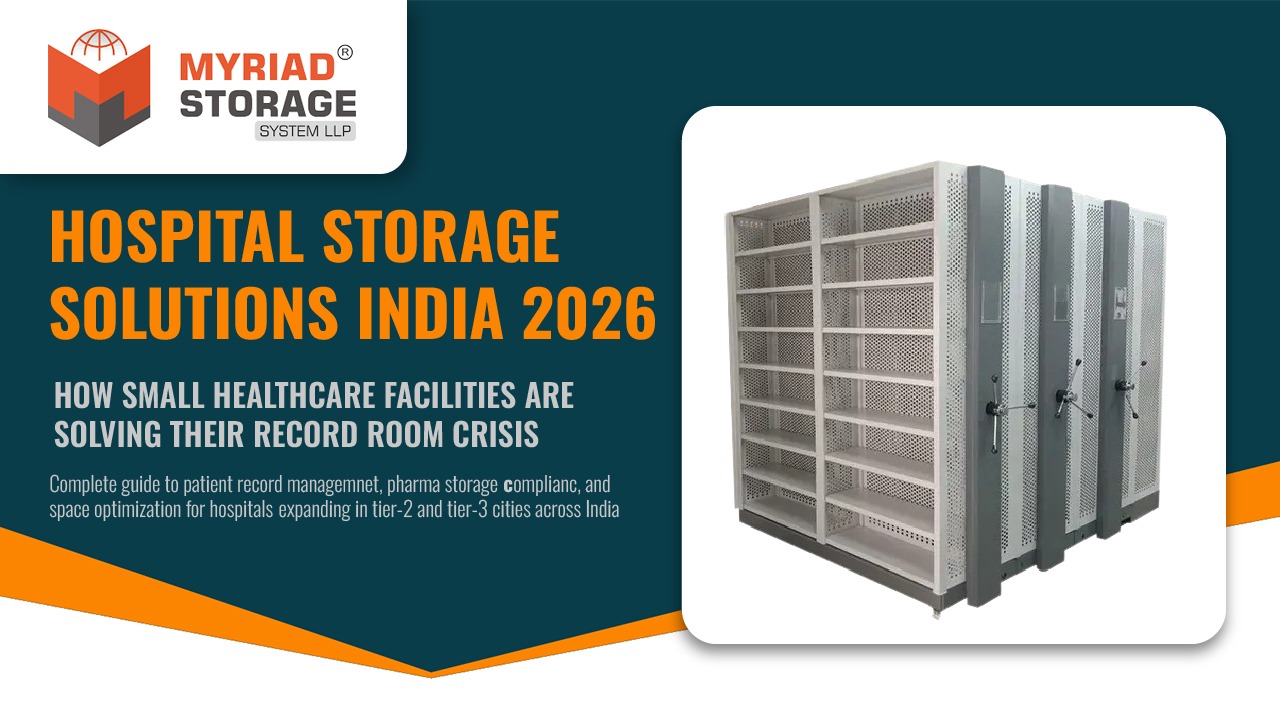
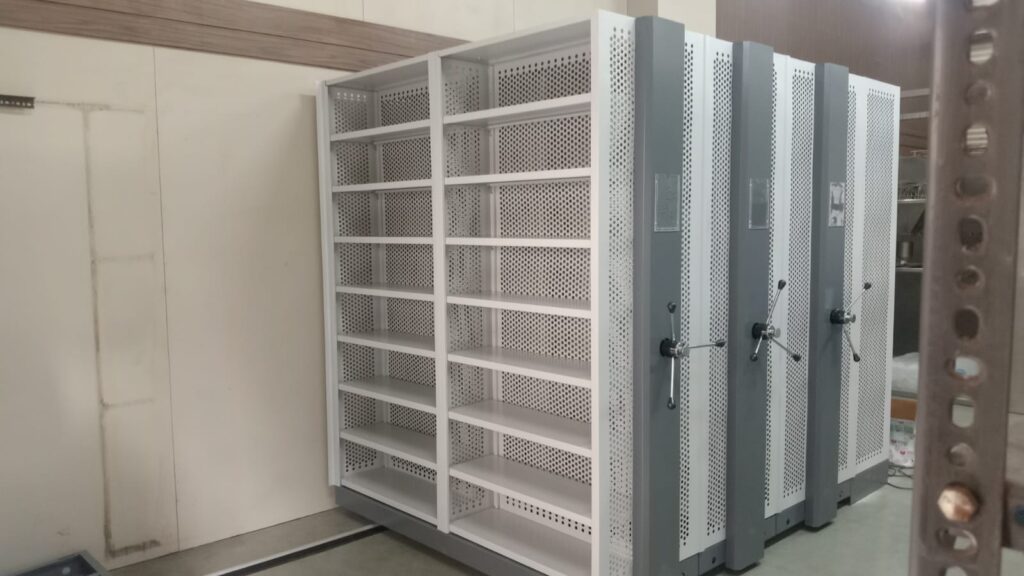
Medications, biological samples, diagnostic reagents, and temperature-sensitive supplies all require airflow around them to maintain storage compliance. Conventional closed steel shelving traps heat and moisture — which is why modern healthcare facilities are moving toward perforated compactor storage systems that allow 360-degree air circulation while still maximizing floor space.
The Scale of the Problem: What Indian Hospitals Are Actually Dealing With
Let’s put some numbers to this.
A mid-sized 200-bed hospital in a metro city generates roughly 600–800 new in-patient files per month. Over five years, that is 36,000 to 48,000 physical files — each of which may need to be held for three years minimum, many for longer. A 400-bed hospital doubles that volume. Tertiary care facilities treating complex cases, running clinical trials, or handling medico-legal referrals can exceed several lakh files in active or near-active storage.
Traditional fixed shelving — the metal or wooden rack systems that most hospitals still rely on — consumes 40 to 60 percent of the total floor area just for the aisles between shelves. In a city like Mumbai, where hospital real estate costs anywhere from ₹15,000 to ₹35,000 per square foot in a mid-tier location, that aisle space is extraordinarily expensive dead space.
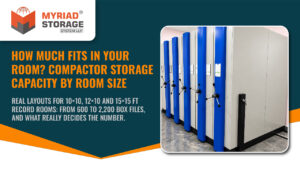
A mobile compactor storage system eliminates all but one working aisle — the rows of shelving move on floor rails, compacting together when not in use and opening only where access is needed. The result, consistently, is 50 to 70 percent more usable storage from the same floor area. For a hospital record room of 400 square feet, that difference can mean storing 6,000 files instead of 3,500 — without taking on a single additional square foot.
The Five Storage Zones Every Hospital Needs to Plan For
Hospital storage is not one problem — it is five distinct ones, each with different requirements.
1. Patient Record Room
This is the core of the challenge for most hospitals. Thousands of in-patient files, discharge summaries, consent forms, operation theatre notes, and billing records that need to be findable, organized by ward or year, and retrievable quickly when a patient presents for readmission or when a legal notice arrives.
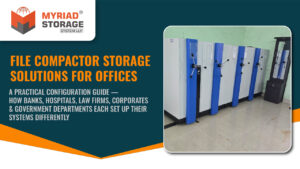
The right solution here is a file compactor storage system — specifically one configured for A4 and legal-size files with label holder rails on every shelf, color-coded dividers per ward or department, and a centralized locking mechanism that secures the entire row at end of shift. Hospitals that have made this switch consistently report retrieval times dropping from 10–15 minutes per file to under two minutes.
2. Pharmacy and Medicine Storage
Pharmaceutical storage in hospitals is one of the most compliance-sensitive environments in the country. Medicines have strict temperature and humidity requirements. Certain drug categories need to be stored separately. And pharmaceutical departments are subject to inspection by state drug controllers under the Drugs and Cosmetics Act — poor storage is grounds for regulatory action.
This is where standard closed-shelf compactors are the wrong answer. A perforated compactor storage system with open-panel shelving allows air to circulate freely around stored medicines and consumables, preventing heat pockets and moisture buildup. The same ventilated system works for laboratory reagents, biological samples, and any supply that requires ambient air movement to stay within specification.
3. Diagnostic Imaging Archives
X-ray films, scan reports, and imaging documentation are bulky, fragile, and legally required to be retained. They are also stored in formats that do not fit neatly into standard file shelves. Hospitals typically need custom-configured shelving with deeper-than-standard shelf pitches and specific height allowances for film jackets and large-format folders.
A well-configured mobile compactor system can accommodate custom shelf spacing — set at whatever pitch your imaging archive requires — and still deliver the same space savings as a standard file room setup.
4. Medical Supplies and Consumables
Sterile gloves, syringes, IV fluids, wound care materials, surgical consumables — every ward has a storeroom, and most of them are overflowing. The challenge here is weight: IV fluid bags and packed surgical kits are heavy, and cheap shelving bends or fails under sustained loads.
For supply stores handling heavier loads, hospitals benefit from heavy duty storage racks — built to industrial load specifications, with per-shelf ratings high enough for dense medical consumable stacking. Where floor space is tight and vertical height is available, a mezzanine storage system can effectively double the usable storage area of a supply room without any external construction.
5. Staff and Security Storage
Nurses, technicians, and hospital support staff need secure personal storage — lockers that are durable enough for shift after shift of heavy use and sized appropriately for scrubs, footwear, and personal items in a clinical environment. Storage lockers designed for healthcare use are built with smooth, easy-to-clean surfaces and locking mechanisms that hold up under daily use — a meaningful difference from basic commercial locker options.
What NABH Accreditation Expects From Your Record Room
For hospitals pursuing or maintaining NABH accreditation, record management is an evaluated domain — not a side note.
The NABH standards under the Management of Information (MIS) chapter specifically require that:
- Patient records are maintained in a manner that ensures confidentiality and security
- Records are accessible to authorized personnel in a timely manner
- The hospital demonstrates a defined process for record retention and retrieval
A record room where files are scattered, shelves are overloaded, and retrieval requires extensive manual searching will not pass a serious NABH audit. Assessors look for organized, labeled, access-controlled storage — and the physical infrastructure of your record room is part of that evaluation.
A properly configured file compactor system with centralized locking, labeled shelf rails, and a defined organizational layout directly supports these criteria. It is not just storage — it is compliance infrastructure.
The Tier-2 Hospital Opportunity: Getting Infrastructure Right From the Start
One of the most significant shifts in Indian healthcare right now is what is happening outside the metro cities.
Tier-2 cities are expected to add 40 million people by FY27. Major hospital chains — Max, Apollo, Fortis, Manipal — have all announced aggressive tier-2 expansion plans. The government’s NBCS 2026 guidelines have recently removed the 45-metre height cap on hospitals, enabling vertical expansion that was previously blocked for urban facilities facing land constraints.
What this means practically is that a large number of new hospitals are being designed and built right now — in Nagpur, Coimbatore, Bhubaneswar, Mysuru, Kochi, and dozens of other cities — and their record room and storage infrastructure is being decided at the planning stage.
Getting storage wrong at the planning stage is expensive to fix. A hospital that installs fixed shelving in its record room and supply areas will face the same overfull, disorganized reality within three to five years. A hospital that installs mobile compactor systems at commissioning builds scalable, compliant infrastructure from day one — and avoids a costly retrofit later.
For facility planners and hospital project managers, the right moment to specify compactor storage is during fit-out, before walls are finished and before fixed shelving becomes the default because it was cheaper upfront.
A Practical Checklist: What to Ask Before You Buy
Whether you are retrofitting an existing record room or specifying a new facility, these are the questions that determine whether a storage system will actually work for a hospital environment.
On compliance and safety:
- Does the system include an aisle interlock mechanism that prevents two rows from closing simultaneously? This is a basic safety requirement in any occupied facility.
- Can individual compartments or rows be locked independently, so different departments can access their own sections without opening the full system?
- Is the steel grade CRCA (Cold Rolled Close Annealed) — the standard that resists corrosion and holds dimensional tolerances under sustained load?
On pharmaceutical and lab storage specifically:
- Are perforated shelf panels available for medicine and reagent storage where airflow compliance is needed?
- What is the per-shelf load rating? IV fluid boxes and packed pharmaceutical stock are significantly heavier than paper files.
On customization:
- Can shelf pitch be configured for your specific file formats, imaging archives, or supply sizes?
- Is the system genuinely modular — can rows be added later as your patient volumes grow, without dismantling the existing installation?
On installation and service:
- Will the manufacturer’s own team handle installation? Third-party contractors who have not installed compactor rail systems before create problems that are expensive to fix.
- What does the warranty actually cover, and what is the response time for service calls?
Why Hospitals Across India Are Choosing Myriad
Myriad Storage System LLP has been manufacturing storage systems in Mumbai since 2018 and has supplied installations to some of India’s most demanding organizations — including ISRO, SBI, Bharat Electronics Limited, Tata, and L&T. The client list includes healthcare institutions, pharmaceutical companies, and research facilities.
Every system is manufactured from CRCA steel with electrostatic powder coat finishing, configured to the exact dimensional and layout requirements of each facility, and installed by Myriad’s own trained team with pan-India coverage.
For hospitals specifically, Myriad offers:
- File Compactor Storage — for patient record rooms, with A4-optimized shelving, label holders, and centralized locking
- Perforated Compactor Storage — for pharmacy departments, labs, and reagent storage requiring airflow compliance
- Heavy Duty Storage Racks — for medical supply stores and consumables storerooms handling significant weight loads
- Storage Lockers — for nursing stations, changing rooms, and staff facilities
All systems come with complete customization on dimensions, configuration, and color, and with pan-India installation and after-sales support.
Frequently Asked Questions
What type of compactor is best for a hospital record room?
A file compactor storage system configured for A4 and legal-size files is the standard recommendation for hospital record rooms. Key features to insist on are centralized locking (to secure entire rows at end of shift), label holder rails on each shelf for department and year organization, and an aisle interlock safety mechanism. Look for CRCA steel construction and electrostatic powder coat finish for long-term durability in a high-use environment.
Does pharmacy storage require a different type of compactor than a record room?
Yes. Pharmaceutical and laboratory storage requires perforated shelf panels that allow air to circulate around stored medicines, reagents, and biological samples. Standard closed-shelf compactors trap heat and moisture — which can compromise drug quality and cause compliance failures during state drug controller inspections. A perforated compactor storage system maintains the same space-saving benefits while keeping stored pharmaceuticals within their required environmental conditions.
What is the minimum floor space needed to install a mobile compactor in a hospital record room?
There is no universal minimum — systems can be configured for rooms as small as 100 square feet. What matters is that the floor is level and has adequate load-bearing capacity for the system and its contents. Myriad provides free site assessments for hospital projects, which include a floor load calculation and a proposed layout showing exactly how many files the system will accommodate.
How does a compactor storage system support NABH accreditation?
NABH’s Management of Information standards require that records are maintained securely, accessibly, and with defined retrieval processes. A properly configured compactor system — with centralized locking, labeled shelf rails, and organized department-wise layouts — directly demonstrates these capabilities to NABH assessors. It is one of the most practical infrastructure investments a hospital can make in preparation for an accreditation review.
Can mobile compactor systems be expanded as patient volumes grow?
Yes, if the system is designed with modular expansion in mind. Myriad’s compactor systems allow new rows to be added to existing floor rails without removing or disrupting the installed setup. This is particularly important for hospitals, where patient volume growth is predictable but the pace varies — the storage infrastructure should be able to scale without requiring a full reinstallation.
How long does installation take, and does the hospital need to close the record room during installation?
For a typical hospital record room installation, Myriad’s team completes installation in one to three days depending on the size of the system. Most hospitals prefer to do it over a weekend or in phases — the team coordinates around operational requirements. Records can be migrated systematically from the old shelving to the new system during the same installation period.
Looking to solve your hospital’s record room or pharmacy storage challenge? Contact Myriad Storage System LLP for a free site assessment and customized quote. We serve hospitals, clinics, and healthcare facilities across Mumbai, Pune, Bangalore, Chennai, Delhi, and pan-India.