India's Pharma Capital Produces 35% of the Country's Medicines — And Drowns in the Documentation to Prove It
Hyderabad produces approximately 35 per cent of India’s pharmaceuticals. The city is home to Dr. Reddy’s, Aurobindo Pharma, Natco, Hetero, Bharat Biotech, Laurus Labs, Divis Laboratories, and over 300 other pharma companies. Genome Valley alone houses 200+ life sciences enterprises. One-third of the world’s vaccine doses are manufactured within this city’s boundaries.
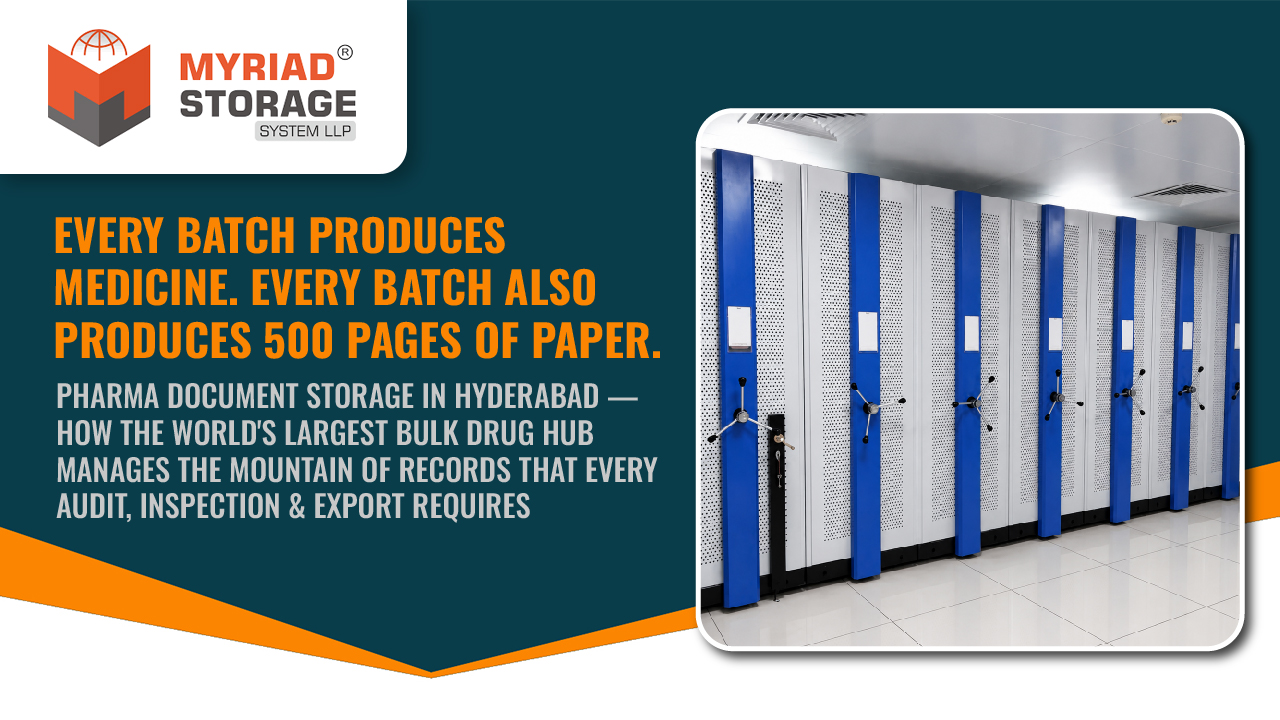
But here is a number nobody in the industry talks about: every single batch of every single product manufactured in every single one of these facilities generates 500 to 1,500 pages of documentation. Batch manufacturing records. Batch packaging records. Analytical test reports. Stability data. Environmental monitoring logs. Equipment qualification records. Deviation reports. Change control files.
A mid-sized Hyderabad pharma company producing 50 products with 10 batches each per year generates 250,000 to 750,000 pages of records annually. A large manufacturer producing 200+ products generates millions of pages. Every page must be retained, retrievable, and presentable during inspections — from the Telangana Drug Control Administration, from CDSCO, from WHO-GMP auditors, and from US FDA investigators.
Where do all these pages go after production ends?
In most Hyderabad pharma facilities, they go into the same place they have gone for decades: rows of metal almirahs lining the corridors of a record room that was designed for a company one-tenth of its current size.
A file compactor storage system is how pharma companies solve this — tripling storage capacity in the same floor area while adding the systematic organisation and access control that GMP documentation requires.
What Records a Hyderabad Pharma Company Must Actually Maintain
Pharma Documentation Volume — One Facility, One Year
How a mid-sized Hyderabad pharma company generating 50 products × 10 batches/year drowns in paper
Estimates based on mid-sized pharma facility (50 products, 500 batches/year, 500 employees)
See Myriad's File Compactor Range → · Get a Free Site Survey →
Non-pharma people have no idea how much documentation pharmaceutical manufacturing generates. Here is what a single facility must maintain — not optionally, but as a regulatory requirement under the Drugs & Cosmetics Act, Schedule M (GMP guidelines), and WHO-GMP standards.
Batch Manufacturing Records (BMR)
The complete record of every manufacturing batch — raw material weights, process parameters, in-process test results, equipment used, personnel involved, yield calculations, and supervisor sign-offs. One BMR for one batch of one product runs 50 to 150 pages. A facility producing 500 batches per year generates 25,000 to 75,000 pages of BMRs alone.
Retention requirement: minimum 1 year after the expiry date of the batch — which for most products means 3 to 6 years from the date of manufacture.
Batch Packaging Records (BPR)
Similar to BMR but for the packaging operation — label reconciliation, packaging material usage, rejected units, artwork verification, and barcode verification. Add another 20 to 50 pages per batch.
Analytical Test Records and Certificates of Analysis (CoAs)
Every batch undergoes multiple quality control tests — assay, dissolution, content uniformity, microbial limits, stability testing. Each test generates its own record with raw data, calculations, and results. The Certificate of Analysis accompanies every shipment to the customer. Retained for the same period as the BMR.
Stability Study Data
Every product undergoes long-term stability studies (12 to 36 months at controlled conditions) and accelerated stability studies (6 months at stressed conditions). These generate ongoing data points at regular intervals. A single stability study can produce 200+ pages of data over its duration. Companies running stability studies on 100+ products simultaneously maintain tens of thousands of pages of active stability data.
Standard Operating Procedures (SOPs)
A mid-sized pharma facility maintains 300 to 800 active SOPs covering manufacturing, quality control, quality assurance, warehouse operations, engineering, and administration. Each SOP has a master copy, revision history, training records, and periodic review documentation. SOPs are living documents — they are revised regularly, and both current and previous versions must be retained.
Equipment Qualification Records
Every piece of manufacturing and laboratory equipment undergoes Installation Qualification (IQ), Operational Qualification (OQ), and Performance Qualification (PQ). These qualification files run 100 to 300 pages each. A facility with 50 qualified equipment items maintains 5,000 to 15,000 pages of qualification records — plus requalification records every 3 to 5 years.
Deviation and Change Control Records
Every manufacturing deviation — any departure from the approved process — requires a written investigation, root cause analysis, corrective action, and closure sign-off. Similarly, every change to a process, material, or equipment requires a change control record. A busy facility may process 200+ deviations and 100+ change controls per year.
Training Records
GMP requires documented evidence that every employee involved in manufacturing, testing, or quality assurance has been trained on the relevant SOPs before performing any task. Training records for 500 employees across 300+ SOPs generate enormous documentation volumes.
Environmental Monitoring Records
Cleanroom facilities maintain daily, weekly, and monthly environmental monitoring data — particulate counts, microbial monitoring, temperature and humidity logs, differential pressure readings. For a facility with 10 cleanrooms monitored daily, this adds thousands of pages per year.
Why This Problem Is Uniquely Hyderabad's
Every pharma facility in India faces documentation requirements. But Hyderabad faces them at a scale that no other city matches.
Volume concentration. With 35 per cent of India’s drug manufacturing and 40 per cent of pharma exports concentrated in one city, Hyderabad has more pharma documentation per square kilometre than any place on earth. Genome Valley, Bachupally, Jeedimetla, Medchal, and Bollaram together house a pharma production capacity that exceeds most countries.
Multi-regulatory exposure. Hyderabad’s pharma companies don’t just sell domestically. They export to the US, Europe, Japan, and 140+ countries through WHO-prequalified facilities. Each regulatory market adds its own documentation layer — US FDA requires specific record formats, European EMA has its own dossier structure, WHO-GMP has its own audit documentation requirements. A single company exporting to all three markets maintains parallel documentation sets for the same products.
Vaccine manufacturing adds another layer. Bharat Biotech, Biological E, Shantha Biotech, and Indian Immunologicals produce one-third of the world’s vaccine doses from Hyderabad. Vaccine documentation requirements are even more stringent than general pharmaceuticals — every lot requires additional release testing, cold chain documentation, and pharmacovigilance records.
Rapid growth. India’s pharma sector is growing at 10 to 12 per cent annually. Hyderabad companies are expanding production lines, adding products, and filing new dossiers at an accelerating pace. The documentation grows proportionally — but the record rooms do not.
What Happens When an Inspector Arrives
Pharma inspections are high-stakes events. A single “critical observation” during a CDSCO or FDA inspection can result in production stoppage, product recall, or export ban. The speed and accuracy of document retrieval during an inspection directly affects the outcome.
CDSCO inspections. The Central Drugs Standard Control Organisation conducts scheduled and surprise inspections of manufacturing facilities. Inspectors request specific batch records, SOPs, qualification files, and training documentation. The facility must produce the requested records — complete and organised — within minutes, not hours. An inspector who waits 45 minutes for a batch record while the quality team digs through disorganised almirahs forms an immediate impression about the facility’s GMP compliance.
WHO-GMP audits. For facilities holding WHO prequalification — essential for exporting vaccines and essential medicines to UN agencies — audits are even more rigorous. WHO auditors spend 3 to 5 days examining documentation in detail. They cross-reference batch records against equipment logs against training records against deviation reports. Any gap in documentation — a missing page, an incomplete investigation, a training record that cannot be located — becomes an audit finding.
US FDA inspections. For Hyderabad companies exporting to the United States, FDA inspections carry the highest stakes. An FDA Form 483 listing documentation deficiencies can result in import alerts that block the company’s products from the US market entirely. In 2023 and 2024, multiple Indian pharma facilities received FDA warning letters citing inadequate documentation management.
In every one of these inspection scenarios, the outcome depends not just on whether the documents exist — but on whether they can be retrieved, presented, and cross-referenced efficiently. A systematically organised file compactor storage system is the difference between a smooth inspection and a compliance crisis.
How Pharma Companies Should Configure a File Compactor for GMP Documentation
Standard office filing systems do not work for pharma documentation. The volume, the cross-referencing requirements, and the retention periods demand a purpose-built configuration.
Zone-based bay allocation:
- Zone 1 — Active batch records (current year). The most frequently accessed section. BMRs and BPRs for ongoing and recently completed batches. Sorted by product name, then batch number. These records are accessed multiple times during production and immediately after for review and release.
- Zone 2 — Released batch records (previous 1 to 3 years). Records for batches already released and shipped but still within active retention. Sorted by year, then product, then batch number. Accessed during customer complaints, stability reviews, and regulatory queries.
- Zone 3 — Archival batch records (3+ years). Records approaching the end of their retention period. Sorted by year. Lower access frequency. These can occupy upper shelves or rear bays.
- Zone 4 — SOPs and qualification files. Current SOPs in the front section, previous versions behind. Equipment qualification files sorted by equipment ID number. This section needs frequent access during audits and training activities.
- Zone 5 — Stability and regulatory files. Long-term stability data, CDSCO dossiers, WHO prequalification files, FDA submission documents. These are bulky files accessed primarily during inspections and annual reviews.
Shelf configuration for pharma documents:
Pharma records come in three primary formats — A4 ring binders (the most common for BMRs and SOPs), box files (for bulky dossiers), and log books (for environmental monitoring and equipment logs). A well-configured compactor uses:
- 280 mm shelf height for standard A4 ring binders
- 320 to 350 mm shelf height for box files and dossiers
- Bottom shelves (350 mm+) for heavy log books and registers
Locking for GMP compliance:
GMP requires controlled access to documentation. A file compactor with central locking satisfies this requirement — only authorised quality assurance personnel hold the key. Compartment-level locks allow further segregation:
- QA/QC section: locked separately, accessed only by quality team
- Regulatory section: locked separately, accessed only by regulatory affairs
- General production records: accessible to production supervisors
This access control structure demonstrates to inspectors that documentation integrity is maintained — a critical GMP expectation.
Hyderabad's Pharma Zones — Where the Document Volume Is Highest
Genome Valley (Shamirpet, Turkapally)
The epicentre — 2,000 acres of life sciences infrastructure housing 200+ companies including Bharat Biotech, Novartis, GlaxoSmithKline, and research facilities. Companies here maintain the most complex documentation sets due to vaccine manufacturing requirements, clinical trial records, and multi-regulatory export filings.
Jeedimetla Industrial Area
One of Hyderabad’s oldest pharma manufacturing zones. Bulk drug and API manufacturers dominate this area. Each API production facility generates dense technical documentation — synthesis records, impurity profiles, analytical methods, and process validation reports.
Bachupally
Home to formulation manufacturing units that convert APIs into finished dosage forms — tablets, capsules, injectables. Each formulation adds its own layer of batch records, packaging records, and stability data on top of the API documentation.
Medchal-Malkajgiri
Expanding pharma zone with newer facilities. Companies relocating here from congested city-centre locations have an opportunity to design their record rooms around file compactor systems from day one — before the almirahs start multiplying.
Bollaram Industrial Area
Bulk drug manufacturers and intermediate producers. Technical documentation here is heavy on chemical process records, environmental compliance reports (pollution control board filings), and raw material testing certificates.
Why the Almirah System Fails Pharma Faster Than Any Other Industry
Every industry that uses almirahs eventually outgrows them. But pharma outgrows them fastest because of three factors unique to the industry:
Exponential growth. When a pharma company adds one new product to its portfolio, it does not just add one file. It adds BMRs for every batch (10 to 50 per year), stability data (3 years of ongoing records), SOPs (5 to 10 new ones), qualification records for any new equipment, and regulatory submission dossiers. One product addition can generate 5,000 to 15,000 new pages per year — every year until the product is discontinued.
Cross-reference requirements. During inspections, auditors do not examine documents in isolation. They trace a batch record to the equipment log, to the training record of the operator, to the SOP version in effect on that date, to the environmental monitoring data for that cleanroom on that day. If these records are scattered across 20 different almirahs in 3 different rooms, the cross-referencing becomes a time-consuming ordeal that damages the facility’s inspection performance.
Retention periods that overlap. A product with a 3-year shelf life requires batch records to be retained for at least 4 years (1 year after expiry). But stability data for the same product might be retained for 5 to 7 years. Regulatory dossiers are retained indefinitely. This means the documentation for a single product accumulates across multiple retention horizons — and the record room must accommodate all of them simultaneously.
A file compactor with adjustable shelving and zone-based organisation handles all three challenges — capacity scaling, systematic cross-referencing, and multi-horizon retention — within a single, locked, space-efficient system.
Why Myriad for Hyderabad Pharma Installations
Myriad Storage System has completed 500+ installations across India for organisations including ISRO, SBI, Tata, L&T, JSW, Bharat Electronics Limited, and WAAREE — clients where documentation integrity and secure access control are non-negotiable.
CRCA steel construction with 60 to 80 micron electrostatic powder coating. Pharma record rooms require surfaces that do not harbour dust or moisture. The smooth, non-porous finish of properly coated CRCA steel meets this requirement and withstands Hyderabad’s humid monsoon conditions without corrosion.
ISO 9001:2015 certified manufacturing. Quality-controlled production at our Vasai factory — consistent material specifications, consistent coating thickness, consistent build standards across every installation. The same quality assurance mindset that pharma companies apply to their own manufacturing.
Pan-India delivery with dedicated project coordination for Hyderabad. Site survey, layout design, manufacturing, logistics, and installation managed as a single project with a dedicated coordinator.
Your next FDA inspection shouldn't depend on someone remembering which almirah has the batch record
GMP-Ready Documentation Storage Designed for Pharma
Request a free site survey for your Hyderabad pharma facility. We'll assess your documentation volume, cross-referencing needs, and design a zone-based file compactor layout built specifically for batch records, SOPs, and regulatory files.
ISRO, SBI, Tata, BEL clients
500+ installations
ISO 9001:2015
Myriad Storage System LLP · ISO 9001:2015 · Factory in Vasai, Mumbai · Pan-India delivery & installation
Frequently Asked Questions
How many pages of documentation does a pharma batch generate?
A single batch of a single product generates 500 to 1,500 pages of documentation — including batch manufacturing records, batch packaging records, analytical test reports, certificates of analysis, environmental monitoring logs, and related SOPs. A facility producing 500 batches per year generates 250,000 to 750,000 pages annually.
How long must pharma batch records be retained in India?
Under Schedule M of the Drugs & Cosmetics Act and GMP guidelines, batch manufacturing records must be retained for a minimum of 1 year after the expiry date of the batch. For most products with a 2 to 3 year shelf life, this means 3 to 6 years from the date of manufacture. Stability data and regulatory dossiers may need to be retained even longer.
How should pharma documents be organised in a file compactor?
The recommended configuration is zone-based: Zone 1 for active batch records (current year), Zone 2 for released records (1 to 3 years), Zone 3 for archival records (3+ years), Zone 4 for SOPs and qualification files, and Zone 5 for stability and regulatory dossiers. Within each zone, records are sorted by product name or code, then by batch number.
Does a file compactor meet GMP access control requirements?
Yes. A file compactor with central locking and compartment-level locks provides the controlled access that GMP requires for documentation. Only authorised quality assurance personnel hold the key. Compartment locks allow further segregation — QA/QC records, regulatory files, and general production records can each have independent access control.
How much space does a file compactor save in a pharma record room?
A file compactor recovers 50 to 70 per cent of floor space compared to equivalent almirah storage by eliminating permanent aisles between shelving rows. A pharma record room with 20 almirahs can be replaced by a file compactor occupying less than half the space — freeing the remainder for additional storage capacity or other uses.
Does Myriad install file compactors in Hyderabad pharma facilities?
Yes. Myriad delivers and installs pan-India with dedicated project coordination for Hyderabad — covering Genome Valley, Jeedimetla, Bachupally, Medchal, and Bollaram. All compactors are manufactured at our ISO 9001:2015 certified factory using CRCA steel with 60 to 80 micron electrostatic powder coating. Site survey and layout design are provided at no cost.