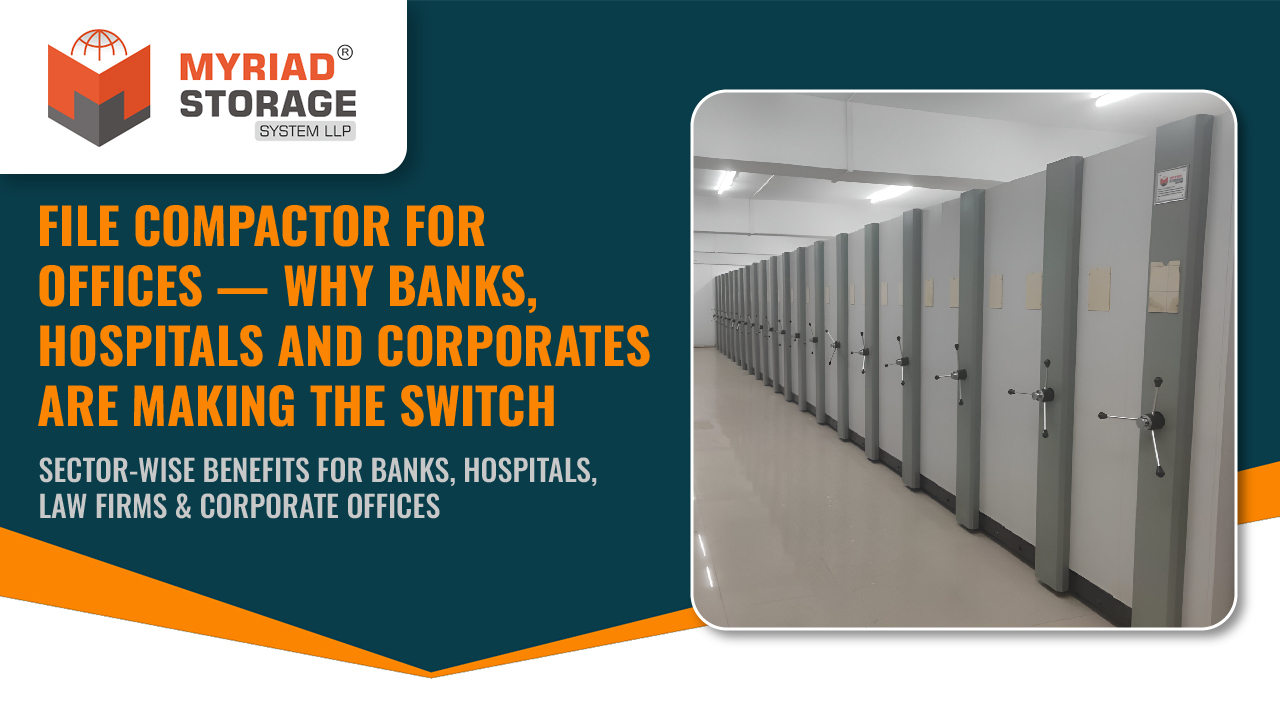
File Compactor for Offices — Why Banks, Hospitals and Corporates Are Making the Switch
Every year, Indian offices spend lakhs on additional storage space — renting extra rooms, buying more almirahs, or simply stacking files on top of cabinets until the pile becomes a safety hazard. The real cost of bad storage is not just the rent. It is the 20 minutes an employee wastes searching for a single file, the compliance penalty when an auditor asks for a document you cannot find, and the fire risk when paper records block emergency exits.
A file compactor storage system eliminates all of these problems by storing 60–70% more files in the same floor area, while keeping every document organised, secure, and retrievable in seconds. But the real question is not whether file compactors work — it is how different industries use them differently. A bank’s needs are very different from a hospital’s, and a law firm has challenges that a corporate office never faces.
This guide breaks down exactly how each sector benefits from a file compactor, with real numbers and practical examples from Indian organisations.
How File Compactors Work — A 30-Second Explanation
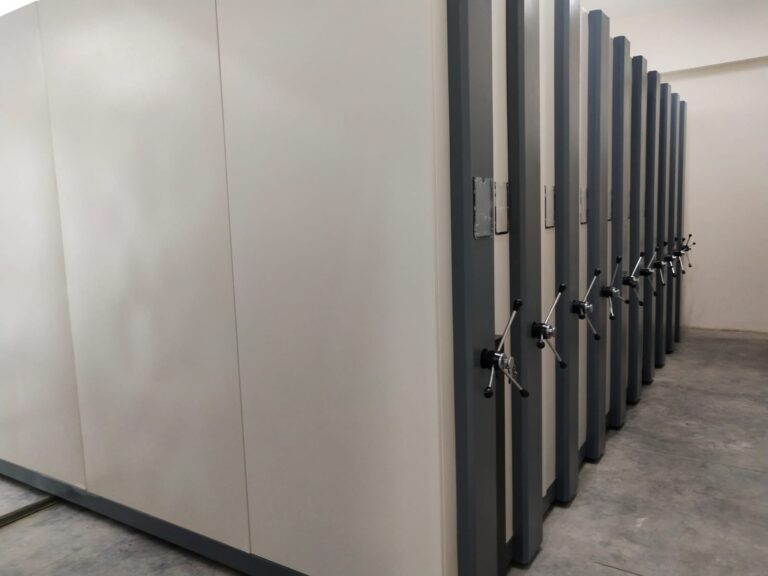
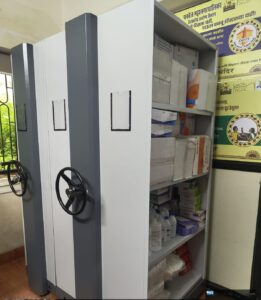
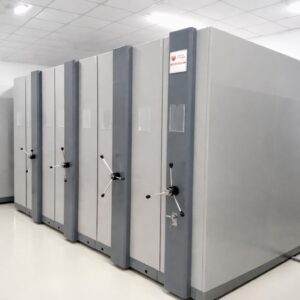
A file compactor is a set of steel shelving units mounted on rails. Instead of fixed racks with permanent aisles between them, compactors slide together and only open one aisle at a time — wherever you need access. This simple mechanism eliminates wasted walkway space.
In a typical 200 sq ft record room with traditional racks, you can store approximately 1,200 files. The same room fitted with a file compactor system can store 3,000–3,500 files. The floor area stays the same; the storage capacity nearly triples.
Which Sector Are You In?
Tap your industry to see sector-specific file compactor benefits
18-24 months
3x more
< 2 min
< 6 months
1.2 lakh
< 60 sec
12-18 months
500-2,000
< 30 sec
10-14 months
₹3.6L+
60%
25-50 yrs
GeM Portal
60-70%
Sector 1: Banks and Financial Institutions
Indian banks are among the heaviest users of file compactors, and for good reason. The Reserve Bank of India mandates physical retention of certain documents for 8 to 30 years depending on the record type. Loan files, KYC documents, account opening forms, fixed deposit receipts, and audit records must all be stored in physical form for specified periods.
A single branch of a mid-sized bank generates approximately 15,000–25,000 physical documents per year. Multiply that across 500+ branches, and the storage challenge becomes enormous.
Why Banks Choose File Compactors
RBI Compliance: Under RBI’s Master Direction on KYC (updated 2026), banks must retain customer identification documents for at least 5 years after the business relationship ends. Loan documents must be kept for the entire loan tenure plus 8 years. File compactors allow banks to store these records systematically with year-wise and category-wise organisation.
Space Cost Savings: A bank branch in South Mumbai pays approximately Rs. 200–350 per sq ft per month in rent. A 100 sq ft record room costs Rs. 20,000–35,000 monthly. By installing a file compactor that reduces storage space by 60%, the bank saves Rs. 12,000–21,000 per month — that is Rs. 1.4–2.5 lakh per year from a single branch.
Security: File compactors come with central locking mechanisms that restrict access to authorised staff only. This is critical for KYC documents, loan files, and financial audit records that contain sensitive customer data.
Audit Readiness: When RBI auditors or internal compliance teams need specific documents, a well-organised compactor system with labelled sections allows retrieval in under 2 minutes instead of the 15–30 minutes it takes with traditional storage.
Real Example
State Bank of India, one of India’s largest public sector banks, uses file compactor storage systems across multiple branches and regional offices to manage their massive document archives. The compactor systems handle everything from loan files to compliance documents across their extensive branch network.
Sector 2: Hospitals and Healthcare Facilities
Healthcare storage has unique challenges that most storage solutions cannot address. Patient medical records must be maintained for years (the National Medical Commission recommends 3 years minimum, while many hospitals retain records for 10+ years for medico-legal protection). These records contain sensitive health information protected under the Digital Personal Data Protection Act (DPDPA) 2023.
Why Hospitals Choose File Compactors
Medical Records Department (MRD) Efficiency: A 200-bed hospital generates approximately 250–400 new patient files daily during peak OPD hours. Over a year, that is 75,000–1,20,000 files. Without systematic storage, the MRD becomes chaotic within months.
Patient Safety: When a patient arrives in emergency, their previous medical history (allergies, existing conditions, past surgeries) must be accessible immediately. A disorganised record room can delay treatment. File compactors with colour-coded, department-wise organisation reduce retrieval time to under 60 seconds.
Humidity and Pest Protection: Hospital record rooms in Indian cities face moisture damage, especially during monsoon season. File compactors with sealed, enclosed structures protect paper records from humidity, dust, and pest damage far better than open shelving.
NABH Accreditation: The National Accreditation Board for Hospitals and Healthcare Providers (NABH) evaluates record management as part of its accreditation criteria. Hospitals with systematic, secure, and accessible record storage score higher during NABH assessments.
Space Recovery for Clinical Use: Every square foot in a hospital has clinical value. A 300 sq ft room used for file storage could instead house 2 additional patient beds generating Rs. 10,000–15,000 per day in revenue. Installing a compactor in a 120 sq ft room to hold the same records frees up 180 sq ft for clinical use.
Sector 3: Law Firms and Legal Departments
Legal practices are built on documentation. Court filings, contracts, evidence files, property documents, affidavits, and correspondence must be preserved for the duration of a case — which in Indian courts can span 5 to 20 years. A single litigation matter can generate 500–2,000 pages of documentation.
Why Law Firms Choose File Compactors
Case File Organisation: Compactors allow law firms to organise files by case number, client name, court, and year. Partners and associates can locate any case file within seconds, which is critical during hearings when judges ask for specific documents.
Confidentiality: Client-attorney privilege requires that legal documents are stored with strict access controls. File compactors with individual bay locks ensure that only assigned staff can access specific client files.
Long-Term Preservation: Property documents, trust deeds, and corporate agreements must often be stored for decades. The enclosed steel structure of compactors protects these irreplaceable documents from deterioration.
Space Efficiency in Premium Locations: Most law firms in India operate from prime commercial areas — South Mumbai, Connaught Place in Delhi, MG Road in Bangalore. Office rent in these locations ranges from Rs. 150–500 per sq ft per month. Reducing storage space by 60% directly impacts the firm’s bottom line.
Sector 4: Corporate Offices
Corporate offices across sectors — from IT companies to manufacturing firms — face a growing storage challenge. Despite digital transformation, physical documents remain necessary for tax records (8-year retention under Income Tax Act), employee HR files, contracts, and vendor agreements.
Why Corporates Choose File Compactors
Multi-Department Organisation: A corporate office typically has HR, Finance, Legal, Admin, and Operations departments — each with different storage needs. Compactors can be configured with separate locked sections for each department within the same unit.
ESG and Green Building Compliance: India’s SEBI BRSR (Business Responsibility and Sustainability Reporting) framework, mandatory for the top 1,000 listed companies, evaluates resource efficiency including office space utilisation. Installing compactors that reduce storage footprint by 60% directly improves ESG metrics. Buildings seeking IGBC (Indian Green Building Council) or LEED certification earn additional credits for efficient space utilisation.
Cost Reduction: A mid-sized corporate office in Mumbai’s BKC (Bandra-Kurla Complex) pays approximately Rs. 250–400 per sq ft per month. A 150 sq ft storage room costs Rs. 37,500–60,000 monthly. Compacting that to 60 sq ft saves Rs. 22,500–36,000 per month — Rs. 2.7–4.3 lakh annually.
Professional Aesthetics: For client-facing offices, a cluttered record room visible during office tours creates a poor impression. Compactors create a clean, modern, professional appearance that reflects well on the organisation.
Sector 5: Government Departments and PSUs
Government offices in India handle possibly the largest volume of physical records of any sector. From district collector offices to central government ministries, paper-based record keeping remains the norm for RTI (Right to Information) responses, land records, tax documents, pension files, and citizen service applications.
Why Government Departments Choose File Compactors
RTI Compliance: Under the Right to Information Act 2005, government departments must produce requested documents within 30 days. A well-organised compactor system makes RTI compliance faster and more efficient.
Archive Management: Government records are often maintained for 25–50+ years. The National Archives of India recommends systematic storage solutions that protect documents from degradation while maintaining accessibility.
Space Constraints in Heritage Buildings: Many government offices operate from old buildings with limited space and structural load restrictions. Compactors on well-designed rail systems distribute weight evenly, making them suitable for older buildings where heavy static racking might not be feasible.
Centralised Procurement: Government departments often procure through GeM (Government e-Marketplace) and DGS&D rate contracts. Manufacturers registered on these platforms, like Myriad Storage System LLP, can supply directly to government buyers.
The Numbers That Matter — ROI Across Sectors
Here is a quick comparison of how file compactors deliver ROI across different industries:
Banking Branch (100 sq ft record room, Mumbai):
- Current rent for storage: Rs. 2.4 lakh/year
- After compactor (40 sq ft needed): Rs. 96,000/year
- Annual savings: Rs. 1.44 lakh
- Compactor cost: Rs. 2.5–4 lakh (one-time)
- Payback period: 18–24 months
Hospital MRD (300 sq ft, Pune):
- Current rent for storage: Rs. 3.6 lakh/year
- After compactor (120 sq ft needed): Rs. 1.44 lakh/year
- Annual savings: Rs. 2.16 lakh
- Additional revenue from freed space (2 beds): Rs. 36–54 lakh/year
- Payback period: Under 6 months when bed revenue is counted
Corporate Office (150 sq ft, BKC Mumbai):
- Current rent for storage: Rs. 6 lakh/year
- After compactor (60 sq ft needed): Rs. 2.4 lakh/year
- Annual savings: Rs. 3.6 lakh
- Compactor cost: Rs. 3–5 lakh (one-time)
- Payback period: 10–14 months
File Compactor ROI — Sector Comparison
How fast does a file compactor pay for itself across different industries?
How to Choose the Right File Compactor for Your Office
Regardless of your industry, these factors determine which file compactor system is right for your organisation:
1. Volume Assessment: Count your current files and project 3–5 years of growth. This determines the number of bays and shelf spacing you need.
2. Room Dimensions: Measure your available room — length, width, ceiling height, and door width (for installation access). Share these with your manufacturer for a custom layout.
3. Operation Type: Manual push-pull compactors work well for smaller installations (up to 5 bays). Mechanical hand-wheel operated compactors are ideal for medium installations (5–15 bays). Motorized compactors suit large archives with heavy daily usage.
4. Security Requirements: Banks and legal firms need central locking plus individual bay locks. Hospitals may need key-card or biometric access for sensitive patient records.
5. Manufacturer Credibility: Work with an ISO-certified manufacturer who has a proven track record with organisations similar to yours. Ask for client references, visit their factory if possible, and verify their installation portfolio.
Myriad Storage System LLP has installed file compactor storage systems for organisations including ISRO, State Bank of India, Tata Group, Larsen & Toubro, and Bharat Electronics Limited. With 500+ installations across India and a 4.9-star Google rating from 100+ reviews, we offer free site surveys, custom design, manufacturing, delivery, and professional installation pan-India.
File Compactor Storage System - FAQ
How much space does a file compactor save compared to traditional shelving?
A file compactor storage system saves 60-70% of floor space compared to traditional fixed shelving. For example, a 200 sq ft room with regular racks storing 1,200 files can store 3,000-3,500 files with a compactor system installed, without any increase in room size.
Are file compactors suitable for banks and financial institutions?
Yes. File compactors are widely used by banks including SBI, HDFC, and other financial institutions for storing KYC documents, loan files, audit records, and compliance documents. The central locking mechanism ensures security, and systematic organisation enables quick retrieval during RBI audits.
Can a file compactor be installed in an existing office without renovation?
Yes. File compactors are installed on rails that are placed on the existing floor. No major structural changes are needed. Professional installation teams complete most projects within 2-5 days with minimal disruption to office operations.
What is the typical cost of a file compactor system for an office?
File compactor costs depend on size, number of bays, and operation type (manual, mechanical, or motorized). For a typical office record room, systems start from approximately Rs. 2-3 lakh for manual variants and go up to Rs. 8-12 lakh for large motorized installations. Contact the manufacturer for a customised quotation based on your specific requirements.
How long does a file compactor system last?
A well-manufactured file compactor built with CRCA steel and powder-coated finish lasts 15-25 years with minimal maintenance. The rail system and mechanical components are designed for daily use over decades, making it a long-term investment rather than a recurring expense.