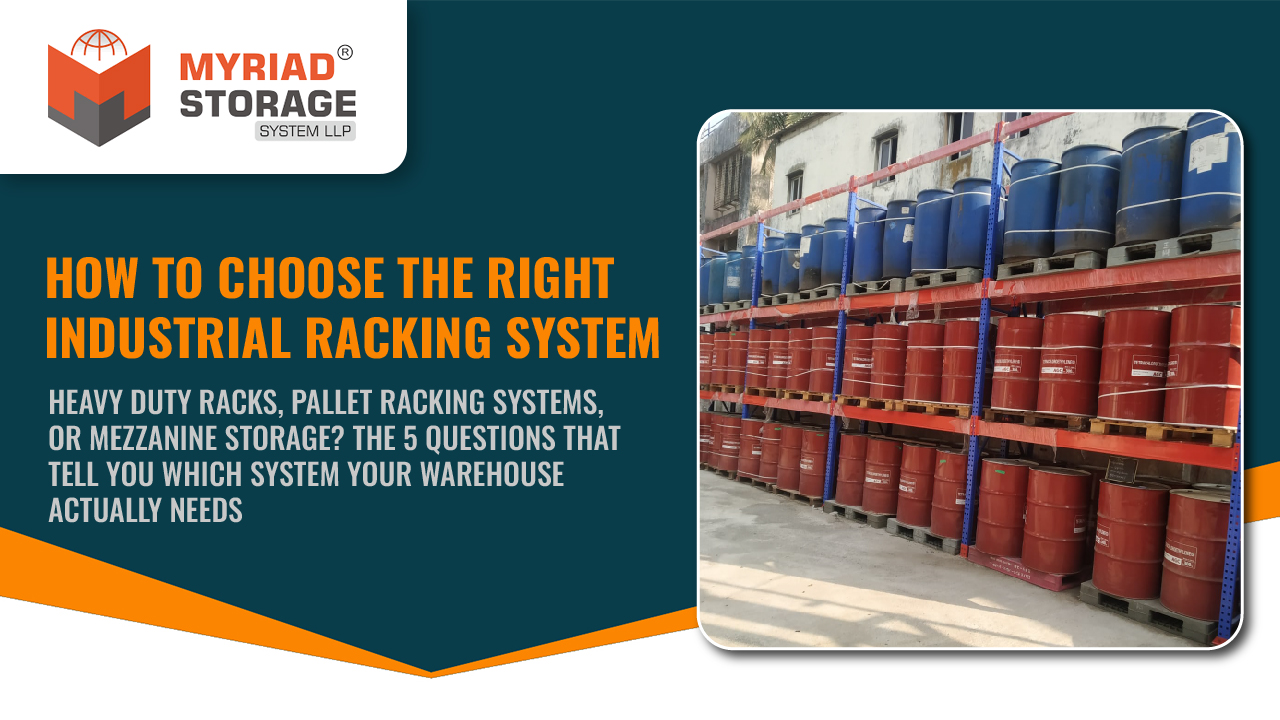
How to Choose the Right Industrial Racking System — Heavy Duty Racks vs Pallet Racking vs Mezzanine Storage for Indian Warehouses
The most expensive racking mistake is not buying the wrong brand — it is buying the wrong type. A pallet racking system installed in a warehouse that stores loose engineering components without pallets wastes money on beam structures you do not need. A heavy duty storage rack installed in a high-ceiling warehouse that only uses the first 4 metres of a 10-metre vertical space is throwing away half its storage potential.
The racking type must match your operation — what you store, how you access it, and how much vertical space you can use. Get this decision right, and the racking system works for you for 15 to 20 years. Get it wrong, and you are either replacing it or working around its limitations every single day.
This guide gives you a clear decision framework based on five questions about your warehouse. Answer them, and you will know which industrial racking system your operation needs — before talking to any manufacturer.
The 5 Questions That Determine Your Racking Type
Before comparing systems, answer these five questions. Your answers will narrow down the right choice immediately.
Question 1: What are you storing — palletised goods, loose items, or both?
This is the most fundamental question. If your inventory arrives and ships on standard pallets (1200 × 1000 mm or 1200 × 800 mm), you need a system designed for forklift-loaded pallet storage — that is pallet racking. If you store loose items, tools, components, spare parts, cartons, or materials that are handled manually or with hand trucks, you need heavy duty storage racks with adjustable shelving. Many warehouses store both — palletised finished goods on one side and loose components or spares on the other. These operations often use a combination of both systems.
Question 2: How many different products (SKUs) do you store?
A warehouse storing 5 to 15 SKUs in large volumes — raw materials, bulk finished goods, seasonal stock — needs high-density storage that packs maximum pallets into minimum space. A warehouse storing 100+ SKUs — a distribution centre, an e-commerce fulfilment operation, an automotive spare parts distributor — needs high selectivity where every item is individually accessible without moving other stock.
- Fewer than 20 SKUs in bulk → density-focused pallet racking (drive-in configuration)
- 20 to 100 SKUs → standard selective pallet racking
- 100+ SKUs with manual picking → heavy duty racks with adjustable shelving or multi-tier setup
Question 3: Do you need FIFO inventory rotation?
FIFO (First In, First Out) means the oldest stock ships first. This is mandatory for perishable goods, pharmaceuticals, chemicals with shelf life, and any product where expiry dates matter. If FIFO is critical, you need selective pallet racking or flow racking — systems where every pallet position is accessible from the aisle.
If LIFO (Last In, First Out) is acceptable — common for non-perishable raw materials, building materials, and products that do not expire — drive-in pallet configurations provide significantly higher storage density.
Question 4: What is your clear ceiling height?
This is the question most Indian warehouse managers overlook. Vertical space is free storage capacity. A warehouse with 8 metres of clear height using only 4-metre-tall racks is wasting half its cubic volume.
- Up to 4 metres clear height → heavy duty storage racks (manual or hand-truck access)
- 4 to 8 metres → standard pallet racking with counterbalance forklift access
- 8 to 12 metres → high-reach pallet racking with reach truck
- High ceiling but limited floor area → mezzanine storage system to create a second floor level
Question 5: What material handling equipment do you have?
Your existing equipment determines what racking configurations are practical. A reach truck accesses racks up to 10+ metres and operates in narrow aisles. A standard counterbalance forklift needs wider aisles and works up to 5 to 6 metres. Manual pallet jacks only access ground-level positions. If you have no forklift at all, you need manual-access heavy duty racks or a mezzanine with a goods lift.
Heavy Duty Storage Racks — For Direct Loading Without Pallets
Heavy duty storage racks are the workhorse of Indian manufacturing and industrial facilities. Built from reinforced CRCA sheet steel with powder-coated finish, these racks support heavy loads directly on shelves — without requiring pallets.
How they work: Vertical frames connect to horizontal shelves at adjustable heights. Items are placed directly onto shelves by hand, hand truck, or light lifting equipment. No forklift needed for standard-height configurations.
Best for:
- Manufacturing units storing raw materials, semi-finished components, tools, dies, and jigs
- Automotive workshops organising spare parts, tyres, batteries, and accessories
- Retail back-stock rooms holding boxed inventory, seasonal stock, and display supplies
- Industrial tool rooms storing heavy equipment, machine parts, and maintenance inventory
- Warehouse storage where items are too varied in size and shape for standard pallets
Load capacity: Heavy duty racks from quality manufacturers support 200 to 1,000 kg per shelf level depending on shelf span, gauge, and reinforcement. The CRCA steel construction with anti-rust powder coating ensures durability even in harsh factory environments.
Key advantage over pallet racking: Flexibility. Shelf heights are fully adjustable to fit items of any size — from small component bins on narrow shelves to heavy machine parts on deep reinforced shelves. You do not need uniform pallet sizes. You do not need a forklift. You load and retrieve by hand.
Key limitation: Not designed for palletised goods. If your inventory arrives on pallets and needs forklift handling, pallet racking is the right choice.
Pallet Racking Systems — For Forklift-Operated Palletised Storage
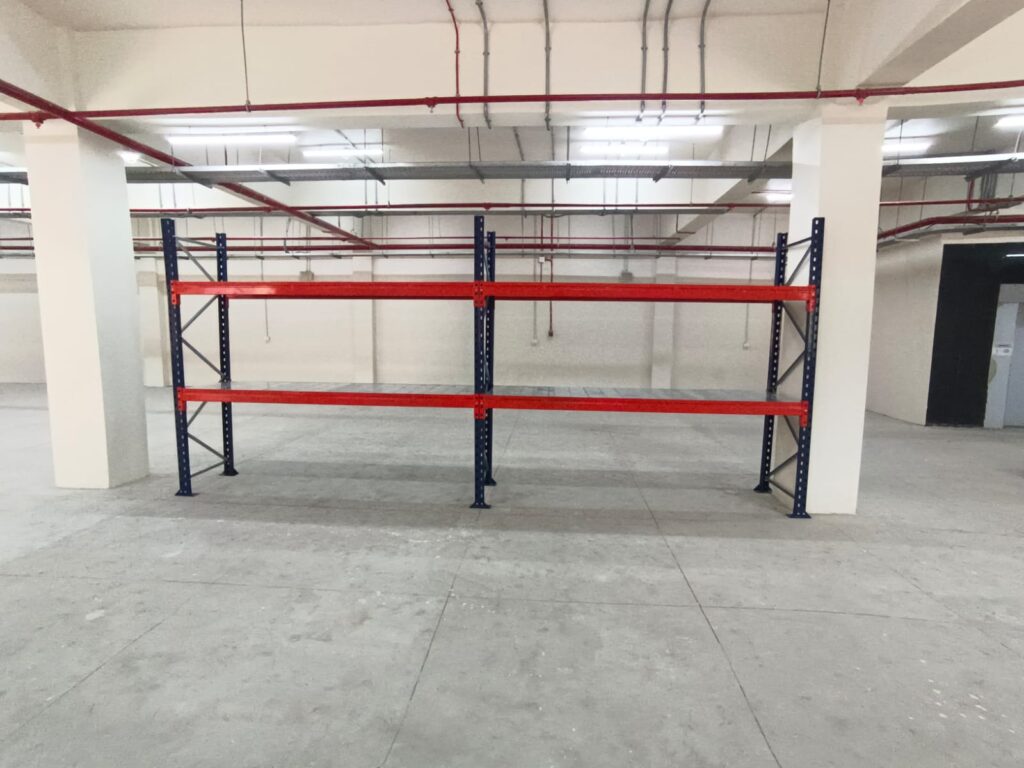
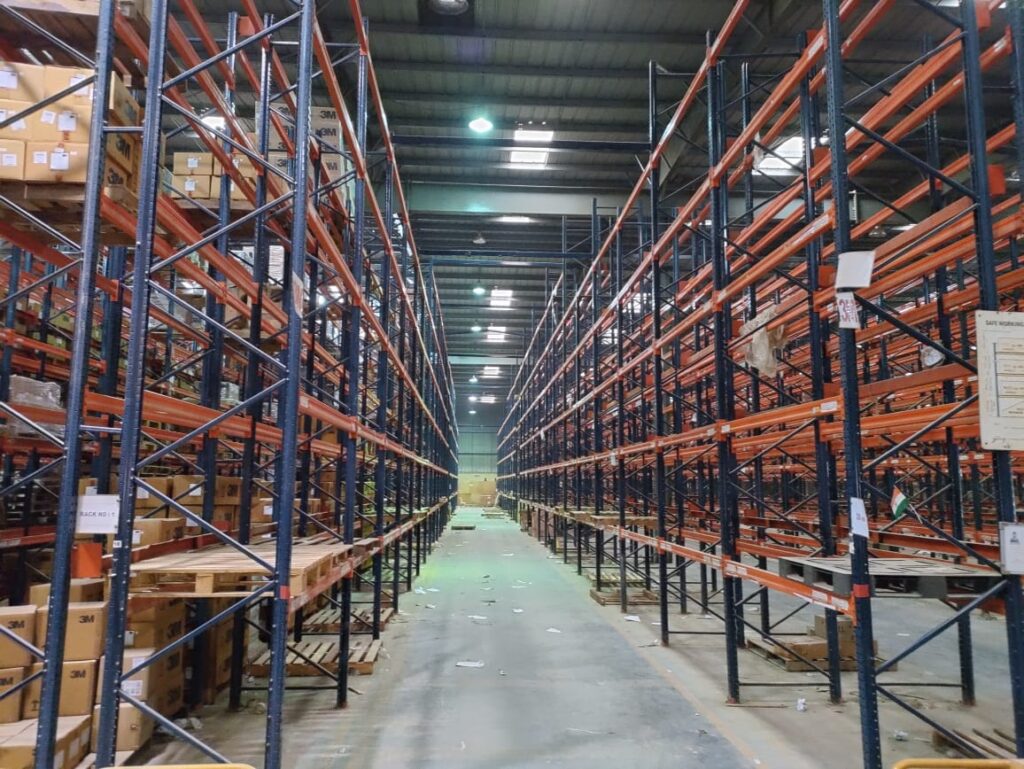
Pallet racking systems are the backbone of modern warehouses and distribution centres. Specifically engineered for palletised goods, they allow forklifts to load and retrieve pallets from multiple levels — maximising both floor area and vertical height.
How they work: Vertical frames (uprights) support horizontal beams at adjustable heights. Pallets sit on pairs of beams. A forklift drives down the aisle, lifts a pallet from any level, and retrieves it directly. The system scales from 3 metres to 12+ metres in height depending on forklift capability.
Best for:
- Warehouses and logistics centres with palletised inventory that ships on standard pallets
- Distribution centres requiring access to multiple SKUs with forklift retrieval
- E-commerce fulfilment centres storing bulk stock on pallets for replenishment into picking zones
- FMCG, food, and pharmaceutical warehouses requiring FIFO rotation and batch-level access
- Cold storage facilities where maximising cubic volume directly reduces refrigeration costs
Two main configurations:
Selective pallet racking — every pallet position is directly accessible from the aisle. One pallet deep on each side. Best for 20+ SKU warehouses where individual pallet access and FIFO rotation are critical. Uses approximately 50 to 55 per cent of floor area for storage, with the remainder as aisles.
Drive-in pallet racking — pallets are stored 4 to 10 deep on continuous rails. The forklift drives into the rack structure to place and retrieve pallets. LIFO rotation only. Best for fewer than 20 SKUs in bulk volume. Uses up to 85 per cent of floor area for storage — roughly 60 to 75 per cent more pallet positions than selective racking in the same footprint.
Load capacity: Standard pallet racking beams support 1,000 to 3,000 kg per beam level depending on beam span and steel gauge. Frame heights can reach 12+ metres with appropriate forklift equipment.
Key advantage over heavy duty racks: Designed specifically for forklift operations and pallet-based workflows. Far more efficient for palletised goods than trying to stack pallets on shelving racks. Scales vertically to use full warehouse height.
Key limitation: Requires palletised inventory and forklift equipment. Not cost-effective for loose items, small components, or manual picking operations.
Mezzanine Storage Systems — Doubling Your Warehouse Without New Rent
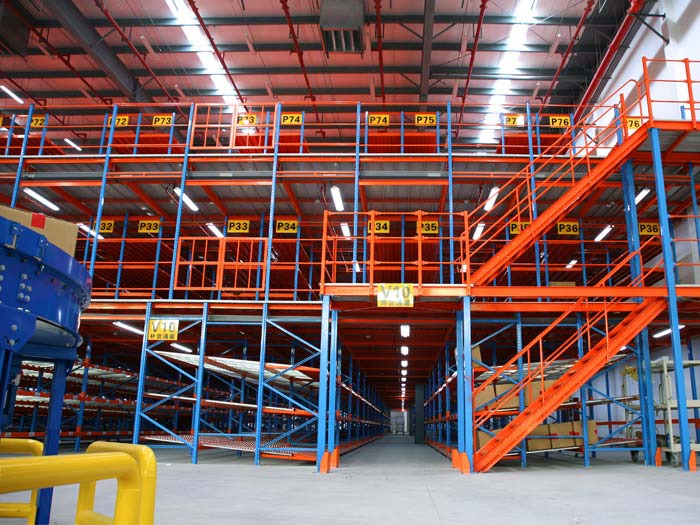
A mezzanine storage system is not a racking type in the traditional sense — it is a structural steel platform that creates a second (or third) floor level within your existing warehouse. The space above and below the mezzanine can then be fitted with heavy duty racks, pallet racking, shelving, workstations, or office areas.
How it works: Steel columns and beams create an elevated floor platform within the warehouse. The floor surface can be grated steel, chequered plate, or plywood-on-steel depending on load requirements. Access is through staircases, goods lifts, or conveyor systems.
Best for:
- Warehouses with high ceilings (6+ metres) but limited floor area — common in Indian industrial estates where plot sizes are fixed but buildings have tall rooflines
- Operations that need to separate functions vertically — storage below, packing and dispatch above (or vice versa)
- E-commerce fulfilment where manual picking of small items happens on the upper level and bulk pallet storage sits on the ground floor
- Any business facing a rent increase or relocation decision — a mezzanine can delay or eliminate the need to move to a larger facility
Capacity: A mezzanine effectively doubles the usable floor area within the existing building footprint. A 5,000 square foot warehouse with a mezzanine becomes 10,000 square feet of usable space — without any construction permits, landlord negotiation, or rent increase.
Cost comparison vs renting more space: Installing a mezzanine typically costs ₹800 to ₹1,500 per square foot depending on load rating, floor type, and finish. Renting additional warehouse space in industrial areas around Mumbai, Pune, or Bangalore costs ₹25 to ₹50 per square foot per month. A 2,000 square foot mezzanine at ₹1,200 per square foot costs ₹24 lakh — equivalent to roughly 20 to 40 months of additional warehouse rent. After payback, the mezzanine is free capacity for the remaining 20+ years of its lifespan.
Key advantage: The only racking solution that creates entirely new floor space rather than just organising existing space. Every other system (heavy duty racks, pallet racking) optimises how you use your floor area. A mezzanine gives you more floor area.
Which System for Which Industry — A Practical Guide
Different industries tend to need different racking systems based on the type of inventory they handle. Here is where each system fits across Myriad’s key application areas.
Warehouses and logistics centres — Pallet racking (selective or drive-in depending on SKU count). These operations live and die on pallet throughput and forklift efficiency. Selective racking for distribution, drive-in for bulk storage.
Manufacturing industries — Heavy duty storage racks for raw materials, tools, dies, and work-in-progress components. These items are rarely palletised and need flexible shelf configurations. Mezzanine addition if vertical space is available for separating raw material storage from finished goods.
Automotive industry — Combination setup. Pallet racking for bulk parts (batteries, tyres, body panels). Heavy duty racks for small spares (fasteners, filters, electrical components). Mezzanine for creating an upper-level picking zone for fast-moving replacement parts.
Retail inventory storage — Heavy duty racks for back-stock in stores (boxed merchandise in varying sizes). Pallet racking in central distribution warehouses where goods arrive palletised from suppliers and ship to stores.
E-commerce fulfilment centres — Mezzanine with heavy duty shelving on the upper level for individual item picking. Pallet racking on the ground floor for bulk stock that replenishes the picking zones. This two-tier model is the standard for Indian e-commerce fulfilment.
Industrial storage units — Heavy duty racks for tooling, maintenance supplies, and production consumables. These environments need racks that handle varied item sizes, resist factory conditions (dust, oil, vibration), and survive years of daily loading.
The Decision Flowchart — Start Here
If you have read through all three systems and still are not sure, use this simplified path:
What are you storing?
→ Palletised goods, need forklift access → Pallet Racking Systems
- Few SKUs, bulk storage → Drive-in configuration
- Many SKUs, individual access → Selective configuration
→ Loose items, components, tools, cartons → Heavy Duty Storage Racks
- Adjustable shelving, manual or hand-truck access
→ Running out of floor space but have high ceilings → Mezzanine Storage System
- Creates a second floor level, fits any racking below
→ Need a combination of the above → Free warehouse assessment — most real-world operations use two or more systems together
This is a starting framework. A site visit by an experienced racking manufacturer will refine the recommendation based on your floor load capacity, column spacing, ceiling height, fire safety clearances, forklift equipment, and material flow patterns.
Which Industrial Racking System Do You Need?
Compare Myriad's 3 racking systems — access type, load capacity, best use & ideal industries
Quick Decision Path
All systems built from CRCA steel with powder-coated finish · Myriad Storage System LLP · ISO 9001:2015
See Myriad's Full Racking Range → · Get a Free Warehouse Assessment →
Wrong racking = 40% wasted capacity. Get it right the first time.
Free Warehouse Assessment — We Recommend the Right System
Our team will visit your warehouse, assess your inventory type, ceiling height, forklift equipment, and material flow — then recommend the exact racking system that fits your operation. Layout drawing and quotation included.
500+ installations
ISO 9001:2015
ISRO, SBI, Tata, L&T
Myriad Storage System LLP · Manufacturer since 2018 · Factory in Vasai, Mumbai · Pan-India delivery & installation
FAQ About Industrial Racking
What is the difference between heavy duty racks and pallet racking systems?
Heavy duty storage racks are designed for storing loose items, tools, components, and materials directly on adjustable shelves — without pallets or forklifts. Pallet racking systems are specifically designed for palletised goods with forklift access between rack bays. Choose heavy duty racks for manual-access industrial storage and pallet racking for warehouse and distribution operations handling palletised inventory.
Which racking system gives the most storage density?
Drive-in pallet racking provides the highest density, using up to 85 per cent of floor area for storage. However, it only works with LIFO (Last In, First Out) inventory rotation and is best for warehouses storing fewer than 20 SKUs in bulk. For operations needing FIFO rotation or individual pallet access, selective pallet racking is the right choice at 50 to 55 per cent floor utilisation.
How does a mezzanine storage system increase warehouse capacity?
A mezzanine creates a second floor level within your existing warehouse using a structural steel platform. This doubles the usable floor area without any building construction or additional rent. The space above and below the mezzanine can be fitted with heavy duty racks, pallet racking, shelving, or workstations. Mezzanines work best in warehouses with 6+ metres of ceiling height.
Can I use more than one racking type in the same warehouse?
Yes, and most efficient warehouses do exactly this. A common setup in Indian e-commerce and distribution operations uses pallet racking on the ground floor for bulk storage and heavy duty shelving on a mezzanine level for manual picking. Manufacturing facilities often combine heavy duty racks for components and pallet racking for finished goods in separate zones.
What load capacity should I look for in industrial racking?
Heavy duty racks typically support 200 to 1,000 kg per shelf level. Pallet racking beams support 1,000 to 3,000 kg per beam level. Always ask for per-shelf or per-beam capacity — not total system capacity. Myriad’s racking is built from CRCA sheet steel with powder-coated finish for durability in industrial environments.
How do I know if my warehouse floor can support industrial racking?
A site survey is essential to check floor load capacity, especially for pallet racking above 4 metres or mezzanine installations. Concrete floors in standard Indian industrial buildings typically support 3 to 5 tonnes per square metre, which is adequate for most racking systems. The site survey also maps column spacing, electrical conduits, and fire safety clearances to ensure the racking layout works within your specific building constraints.