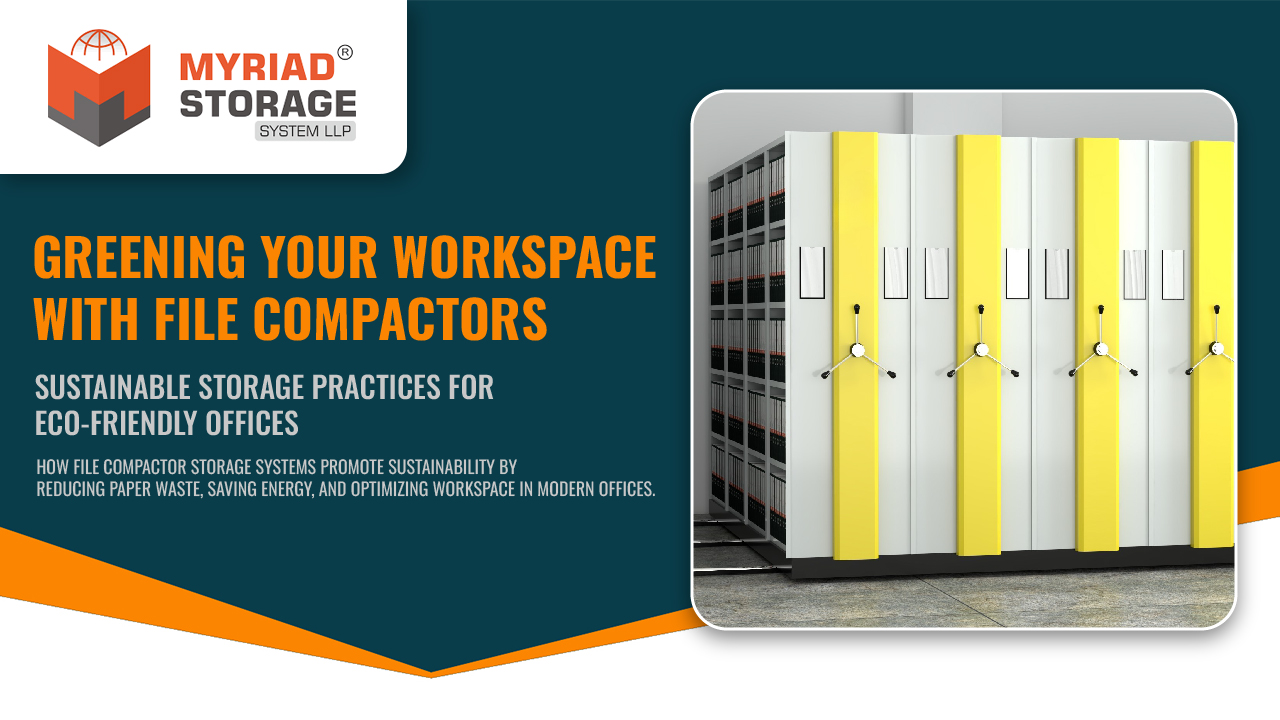
Greening Your Workspace: Sustainable Practices with File Compactors
Sustainability in Indian offices has moved far beyond the “reduce, reuse, recycle” posters in the cafeteria. In 2026, it has become a compliance requirement, an investor expectation, and a measurable business metric.
SEBI now mandates that India’s top 1,000 listed companies file Business Responsibility and Sustainability Reports (BRSR) with verifiable ESG data — including energy consumption per square foot, waste generation, and resource efficiency. Green building certifications like IGBC and LEED evaluate office interiors on sustainable material choices, space utilisation efficiency, and indoor environmental quality. Even mid-size companies working with MNCs are being asked to demonstrate sustainability practices across their supply chains.
So when an office manager or facility head is told to “make the workspace more sustainable,” the question is no longer whether to act — it is what specific actions create measurable, reportable sustainability outcomes.
This is where most people overlook one of the simplest and most impactful changes available: replacing traditional open shelving and almirahs with a file compactor storage system.
A file compactor does not just save space. It directly contributes to measurable improvements in energy efficiency, material lifecycle sustainability, waste reduction, and indoor environment quality — the exact metrics that IGBC, LEED, and BRSR frameworks evaluate. And unlike solar panels or HVAC overhauls that cost crores to implement, a compactor system delivers sustainability improvements at a fraction of the investment.
This article breaks down exactly how file compactor storage systems contribute to each pillar of real workplace sustainability — with specific data, framework alignment, and practical implementation guidance.
The ESG Connection: How Storage Choices Appear in BRSR Reporting
Most organisations think of ESG reporting as something that covers emissions, water usage, and corporate governance. Storage systems seem irrelevant. But look more closely at what BRSR actually measures, and the connection becomes clear.
BRSR Principle 6 (Environment) requires companies to report on energy consumption intensity — that is, how much energy they consume per unit of revenue or per square foot of office space. When a file compactor reduces the storage footprint from 500 sqft to 200 sqft, the energy consumed for lighting, cooling, and maintaining that 300 sqft of freed space drops directly. If that space is repurposed for productive use rather than storage, the energy intensity per rupee of revenue improves — a metric that appears directly in the BRSR filing.
BRSR also requires disclosure of waste generation and waste management practices. Traditional wooden shelving deteriorates in 3 to 5 years in Indian conditions, generating wood waste, paint waste, and hardware waste that typically ends up in landfills. A steel compactor system lasts 15 to 20 years and is 100 percent recyclable at end of life. Choosing steel over wood is a waste reduction decision that is reportable under Principle 6.
For listed companies already preparing annual BRSR filings, the impact of switching storage systems may seem small on its own — but sustainability reporting is built on dozens of small measurable improvements, not one dramatic gesture. A compactor installation is exactly the kind of practical, quantifiable action that fills BRSR disclosures with genuine data rather than aspirational statements.
Green Building Credits: How Compactors Contribute to IGBC and LEED Scores
India has registered over 19,000 green building projects with IGBC, covering more than 15.74 billion square feet. LEED has certified over 1,600 buildings in India. Both systems evaluate not just the building’s shell but also its interior fit-out — including how storage is designed and what materials are used.
Here is where file compactor storage systems earn measurable green building credits.
Material and resources credits. Both IGBC and LEED award credits for using materials with high recycled content and long lifecycles. CRCA steel — the primary material in quality compactor systems — typically contains 25 to 30 percent recycled steel content from the manufacturing process. At end of life, the entire compactor system is fully recyclable through India’s existing steel recycling infrastructure. Compare this to wooden or particleboard furniture, which has limited recyclability and often releases formaldehyde and other VOCs (volatile organic compounds) during its useful life. This single material choice can contribute to 1 to 2 credits under the Materials and Resources category.
Indoor environmental quality credits. IGBC and LEED both evaluate indoor air quality, including the presence of VOCs from furniture and fixtures. Steel compactors with powder-coated finishes release zero VOCs after the initial curing process — unlike wooden furniture, MDF, or particleboard that can off-gas formaldehyde for years. Choosing low-VOC or zero-VOC interior elements earns credits under the Indoor Environmental Quality category. This is especially relevant for healthcare facilities and educational institutions pursuing green certification, where indoor air quality directly affects patient recovery and student performance.
Space optimisation and energy efficiency credits. When compactors reduce the storage footprint by 60 to 70 percent, the freed space reduces the total area requiring lighting and air conditioning. IGBC’s Green Interiors rating specifically evaluates how efficiently a fit-out uses the available floor plate. A well-designed compactor installation that eliminates an entire storage room’s worth of energy load contributes to the Energy Performance category — particularly in buildings where storage rooms represent a significant percentage of total floor area.
Sustainable site credits (for new fit-outs). When companies relocate or expand, compactors allow them to choose a smaller office footprint than they would otherwise need. Leasing 4,000 sqft instead of 5,000 sqft because compactors handle the storage in less space means less built environment per employee — a metric that LEED evaluates under Sustainable Sites.
The Material Lifecycle: Steel vs Wood — What the Numbers Say
The sustainability advantage of steel compactors over traditional wooden or mixed-material storage becomes stark when you look at the full lifecycle.
Manufacturing phase. CRCA steel production involves high initial energy — approximately 20 to 25 GJ per tonne. However, this steel is sourced from mills that increasingly use electric arc furnaces with 25 to 30 percent recycled scrap steel content, which reduces virgin material extraction. Wooden furniture, while lower in manufacturing energy, relies on timber harvesting that contributes to deforestation — a particularly sensitive issue in India where forest cover is already under pressure.
Usage phase. A steel compactor lasts 15 to 20 years with minimal maintenance — annual rail lubrication is the only requirement. A wooden almirah in Indian conditions (high humidity, monsoon exposure, termite risk) lasts 3 to 5 years before requiring replacement. Over a 20-year period, one steel compactor replaces four to five sets of wooden furniture, each generating waste and requiring new raw materials.
End of life phase. This is where the difference is most dramatic. India’s steel recycling rate is among the highest in the world — approximately 70 to 80 percent of steel is recycled through the country’s extensive secondary steel sector. When a compactor system reaches end of life, it is dismantled and sold as scrap steel, which is melted down and reused. Zero goes to landfill. Wooden furniture, on the other hand, is typically burned or discarded. MDF and particleboard are virtually non-recyclable due to the resin binders used in their manufacture.
The total lifecycle calculation: Over 20 years, a steel compactor system consumes less total material, generates less waste, and has a lower cumulative environmental impact than the series of wooden alternatives it replaces — despite its higher manufacturing energy. This is a lifecycle assessment (LCA) outcome, not an intuition.
Metal compactor vs wooden almirah — full lifecycle
20-year sustainability comparison for Indian office conditions
Manufacturing phase
CRCA steel compactor
Higher initial energy (20-25 GJ/tonne) but 25-30% recycled scrap content from electric arc furnaces. No deforestation. One unit built to last 15-20 years.Wooden almirah
Lower manufacturing energy but relies on timber harvesting. MDF/particleboard uses formaldehyde resin binders that release VOCs. Lasts 3-5 years in Indian humidity.Usage phase (20 years)
CRCA steel compactor
1 unit serves full 20 years. Annual maintenance: rail lubrication only. Zero VOC emissions after powder coating cure. Resists monsoon humidity, termites, corrosion.Wooden almirah
4-5 replacements needed in 20 years. Each replacement generates waste, transport emissions, and new raw material demand. Warps, swells, develops fungus. Attracts termites.End of life phase
CRCA steel compactor
100% recyclable. Dismantled and sold as scrap steel. Melted and reused through India's secondary steel sector (70-80% recycling rate). Zero landfill waste.Wooden almirah
Mostly non-recyclable. MDF/particleboard cannot be recycled due to resin binders. Typically burned or sent to landfill. Generates 4-5x waste over 20 years.Indoor air quality
CRCA Metal compactor
Zero VOC emissions after initial powder coating cure. Contributes to IGBC/LEED Indoor Environmental Quality credits. Safe for hospitals, schools, offices.Wooden almirah
Formaldehyde off-gassing from MDF, plywood, and particleboard for years. Triggers allergies and respiratory issues. Fails IGBC/LEED IEQ standards.20-year sustainability scorecard
Real Energy Savings: What the Numbers Actually Look Like
Let us work through a practical calculation that any facility manager can verify for their own building.
Consider a typical file storage room in an Indian office — 500 sqft, with 4 tube lights running 10 hours a day and a 1.5 tonne split AC running 8 hours a day.
Lighting energy per year: 4 tube lights at 36 watts each, running 10 hours per day, 300 working days per year. Total: 4 x 36 x 10 x 300 = 432,000 watt-hours = 432 kWh per year.
Air conditioning energy per year: 1.5 tonne split AC at approximately 1.5 kW running 8 hours per day, 300 working days. Total: 1.5 x 8 x 300 = 3,600 kWh per year.
Total energy for storage room: approximately 4,032 kWh per year.
Now install a compactor system that reduces storage from 500 sqft to 200 sqft — a 60 percent reduction. The 300 sqft of freed space no longer needs dedicated lighting and cooling for storage purposes. Even if the space is repurposed (for workstations, meeting rooms), the energy load shifts from pure storage overhead to productive revenue-generating use.
Energy saving from eliminated storage area: approximately 2,400 kWh per year (proportional to 60 percent space reduction).
At ₹10 per kWh (average commercial electricity rate in India): annual savings of approximately ₹24,000 on energy alone.
CO2 reduction: at India’s average grid emission factor of approximately 0.7 kg CO2 per kWh, this translates to approximately 1,680 kg of CO2 per year — nearly 1.7 tonnes of annual carbon reduction from a single storage room optimisation.
These are modest numbers for a single room. But a large corporate office, bank, hospital, or government department with 5 to 10 storage areas can multiply this impact five to tenfold — creating a genuinely meaningful sustainability outcome that is measurable, verifiable, and reportable.
How much energy does a compactor save?
Real calculation for a typical 500 sqft Indian office storage room
Lighting energy (per year)
432 kWh / year
4 tube lights × 36W × 10 hrs/day × 300 working days
Air conditioning energy (per year)
3,600 kWh / year
1.5 tonne split AC × 1.5 kW × 8 hrs/day × 300 working days
Total storage room energy
4,032 kWh / year
Combined lighting + AC for 500 sqft storage room
Energy saved from eliminated storage area
2,400 kWh / year saved
60% of 4,032 kWh — lighting + cooling no longer needed for 300 sqft
Annual sustainability impact — per storage room
Paper Management: The Quiet Sustainability Win
One of the least discussed sustainability benefits of compactor storage is its indirect effect on paper consumption.
In disorganised storage rooms — the kind with overstuffed almirahs, unlabelled boxes, and files stacked on top of shelves — employees routinely print duplicate copies of documents because finding the original is too time-consuming. A survey by the Indian Paper Manufacturers Association estimates that Indian offices waste 15 to 20 percent of their total paper consumption on redundant copies that exist because of poor document retrieval systems.
When a file compactor storage system is installed with systematic labelling, categorised shelving, and clear filing protocols, retrieval time drops from 15 to 20 minutes per file to under 2 minutes. The incentive to print a “just in case” copy disappears because the original is easily accessible.
For an office consuming 500 reams of paper per year (250,000 sheets), a 15 percent reduction means 75 reams saved — approximately 37,500 sheets. At ₹250 per ream, that is ₹18,750 in direct cost savings. More importantly, those 75 reams represent approximately 0.3 tonnes of paper not produced — saving the water, energy, and chemical inputs that paper manufacturing requires.
Combined with a hybrid digital-physical filing system — where recent documents are scanned and archived digitally while compactors store originals for regulatory compliance — the paper reduction can reach 30 to 40 percent over 2 to 3 years.
Compactors and India's Net-Zero Pathway
India has committed to achieving net-zero emissions by 2070. The built environment — offices, commercial buildings, institutional facilities — accounts for approximately 35 to 40 percent of India’s total energy consumption. Every reduction in building energy load, no matter how small, contributes to this national pathway.
File compactors contribute at two levels. At the building level, they reduce energy-intensive storage space and enable more efficient use of the overall floor plate. At the supply chain level, steel compactors have a longer lifecycle and higher recyclability than alternatives, reducing the embodied carbon of office fit-outs over time.
For companies with formal net-zero commitments or science-based targets, compactor installations can be included in Scope 2 (energy reduction) and Scope 3 (material lifecycle) calculations — providing tangible, auditable progress toward targets that investors and regulators increasingly demand.
How to Maximise the Sustainability Impact of Your Compactor Installation
If sustainability is a formal objective for your organisation, here are specific steps to maximise and document the impact of a compactor installation.
Before installation: Measure and record the current storage room’s energy consumption — lighting fixtures, AC units, and operating hours. Take photos documenting the current state. This becomes your baseline for measuring improvement.
During specification: Choose a mobile compactor storage system manufactured from CRCA steel with electrostatic powder coating. Request the manufacturer’s material composition data, including recycled content percentage. Ask for documentation of the powder coating process, confirming zero-VOC post-cure emissions. These documents support green building credit applications.
After installation: Measure the reduced storage footprint and calculate the energy savings using the method described above. Document the number of wooden almirahs or shelving units replaced, their disposal method (ideally recycling or donation), and the projected lifespan of the new compactor system. Include this data in your next BRSR filing or sustainability report.
For green building certification: Submit the material data (steel recycled content, VOC-free coating, expected lifespan, recyclability) to your IGBC or LEED assessor as part of the Materials and Resources and Indoor Environmental Quality credit documentation.
Why Myriad Storage System LLP
Myriad Storage System LLP manufactures all compactor systems at our own facility in Vasai, Palghar, using CRCA steel with electrostatic powder coating. Our manufacturing process uses no VOC-emitting materials, and our products are fully recyclable at end of life through India’s secondary steel sector.
With over 500 installations since 2018 for clients including ISRO, SBI, Tata, L&T, and Bharat Electronics, we provide material documentation that supports BRSR reporting and green building certification applications. Our team conducts free site surveys, designs custom storage layouts, and handles complete installation across India.
Ready to make your workspace more sustainable? Call us at +91 97693 77043 or WhatsApp us for a free site survey and sustainability-aligned storage consultation.
Ready to optimise your storage space?
Get a free site survey and customised quotation within 48 hours
myriadstoragesystem.com
FAQ — Sustainable File Compactor Storage
How does a file compactor storage system contribute to ESG reporting?
File compactors contribute to BRSR Principle 6 (Environment) disclosures by reducing energy consumption intensity through space optimisation, reducing waste through long-lifecycle steel construction, and improving material resource efficiency. The space savings translate to measurable reductions in lighting and cooling energy that can be reported as energy intensity improvements.
Can file compactors help earn IGBC or LEED green building credits?
Yes. File compactors contribute to credits in multiple categories — Materials and Resources (recycled steel content, long lifecycle, full recyclability), Indoor Environmental Quality (zero-VOC powder coating), and Energy Performance (reduced lighting and cooling load from space optimisation). The specific credits depend on the certification level being pursued.
How much energy does a compactor storage system actually save?
A compactor that reduces storage space by 60 percent in a 500 sqft room saves approximately 2,400 kWh of electricity per year from reduced lighting and cooling requirements. At average Indian commercial rates of ₹10 per kWh, this translates to approximately ₹24,000 per year in energy savings and a reduction of approximately 1.7 tonnes of CO2 annually.
Is metal furniture more sustainable than wooden furniture?
Over a full lifecycle, yes. While steel requires more energy to manufacture initially, CRCA steel compactors last 15 to 20 years (vs 3 to 5 years for wooden almirahs in Indian conditions), contain 25 to 30 percent recycled content, and are 100 percent recyclable through India’s secondary steel sector. Wooden and MDF furniture has limited recyclability, generates landfill waste, and may release VOCs during its useful life.
Do compactor systems support India's net-zero 2070 commitment?
Yes. Compactors reduce building energy consumption through space optimisation (contributing to Scope 2 reductions) and have a lower lifecycle embodied carbon than the series of wooden furniture alternatives they replace (contributing to Scope 3 improvements). For companies with formal net-zero targets, compactor installations provide auditable progress toward those commitments.