File Compactor Storage System Benefits — Why Indian Offices Need Them More Than Ever in 2026
Indian organisations are investing in file compactor storage systems at a pace that would have been hard to predict five years ago. But the driving force behind most purchases in 2026 is not what you would expect. It is not just about saving floor space — although that benefit remains significant. The real shift is compliance.
India’s data protection landscape changed permanently on 13 November 2025 when the Digital Personal Data Protection Rules came into force. Combined with existing regulations from the RBI, SEBI, IRDAI, and healthcare authorities, organisations now face a web of requirements around how they store, access, and manage records containing personal data — including physical records.
A file compactor storage system with central locking directly addresses several of these requirements at a fraction of the cost of electronic access control systems. This guide breaks down every benefit — from legal compliance to space savings to daily productivity — so you can see exactly why file compactors have moved from “nice-to-have” to “essential infrastructure” for Indian offices.
The Benefit That Changed Everything — India's Data Protection Compliance Landscape
India’s Digital Personal Data Protection Act (DPDPA) was enacted by Parliament on 11 August 2023. The operational rules — the Digital Personal Data Protection Rules, 2025 — were officially notified by the Ministry of Electronics and Information Technology (MeitY) on 13 November 2025. Full enforcement follows a phased timeline, with all provisions becoming mandatory by May 2027.
The DPDPA applies to digital personal data. But here is why it matters for physical document storage too.
The Digitisation Bridge
The Act specifically covers personal data “collected in non-digital form and digitised subsequently.” In practice, almost every Indian organisation maintains both physical and digital copies of the same records — KYC forms, employee onboarding documents, patient consent forms, client contracts. The moment a physical record is scanned, photographed, or entered into a database, both the digital copy AND the physical original fall under the broader compliance umbrella.
This means organisations cannot protect the digital version while leaving the physical original in an unlocked, uncontrolled filing cabinet. The compliance gap is obvious and auditors are increasingly flagging it.
What "Reasonable Security Safeguards" Means in Practice
Section 8 of the DPDPA requires every Data Fiduciary — which includes any organisation processing personal data of Indian residents — to implement “reasonable security safeguards to prevent personal data breach.” While the Act focuses on digital systems, the compliance culture it creates extends to physical record management.
Auditors conducting data protection assessments now routinely examine physical access controls alongside digital systems. If an organisation can demonstrate that its server room is secured with biometric access but its record room containing the same personal data in paper form is open to any employee, the security posture fails the reasonableness test.
Where File Compactors Fit
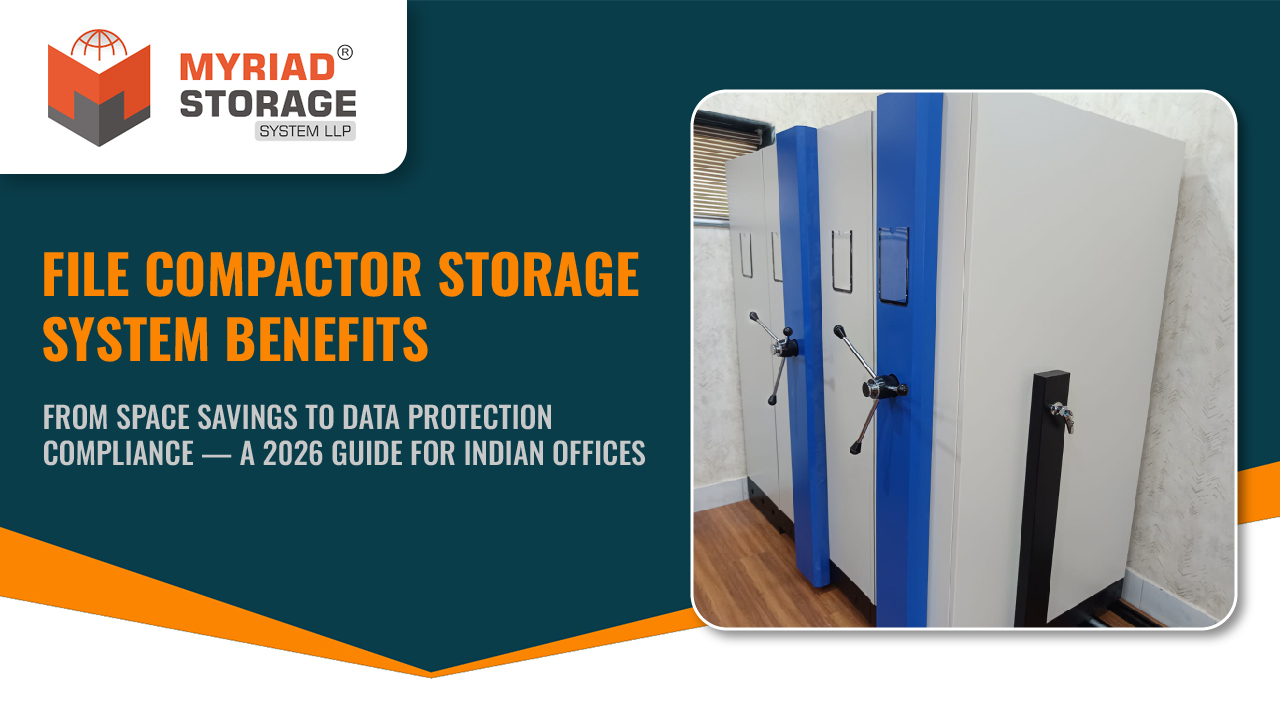
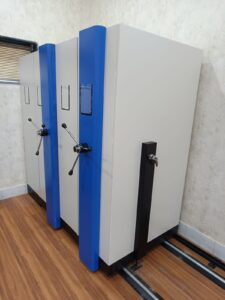
A file compactor storage system with central locking provides exactly the physical access control layer that compliance demands:
- Central locking bars secure an entire row of shelving with a single key turn — ideal for end-of-day lockdown procedures in shared environments
- Individual compartment locks allow different departments or teams to maintain segregated access within the same unit
- Access logging becomes practical when only authorised key-holders can open specific bays, creating a clear chain of custody for sensitive records
- Controlled access without electronic systems — a significant cost advantage over installing card readers, CCTV, and biometric locks on a traditional record room
The penalty for non-compliance under the DPDPA can reach up to ₹250 crore per instance. Even for organisations that consider this unlikely, the reputational damage from a data breach involving unsecured physical records is immediate and lasting.
India's Data Protection Compliance Timeline
How DPDPA and sector regulations create the need for controlled physical document storage
🔒 How File Compactors Satisfy Physical Access Control
- Central locking secures entire rows — only authorised key-holders access records
- Compartment-level locks allow department-wise segregation of personal data
- Controlled access creates auditable chain of custody for sensitive documents
- Physical security layer complements digital access controls at a fraction of the cost
Source: DPDPA 2023, DPDP Rules 2025 (MeitY), Puttaswamy v. Union of India (2017)
Explore Myriad's File Compactor Storage Systems →
Sector-Specific Compliance Benefits — Why Every Industry Needs Controlled Access
Different industries face different regulatory requirements for physical record storage. Here is how a file compactor system addresses each one.
Banking and Financial Services — RBI KYC Record Retention
Under the Reserve Bank of India’s Master Direction on KYC (Know Your Customer), banks and financial institutions must retain:
- Transaction records for a minimum of 5 years from the date of the transaction
- Customer identification and verification records for 5 years after the business relationship ends or the account is closed
- Suspicious transaction reports and related documentation for 5 years from the date of the report
RBI concurrent auditors expect file retrieval within 30 minutes during inspections. A well-organised file compactor system — with records sorted by account number range, date, or department — satisfies both the retention requirement and the rapid retrieval expectation. Central locking ensures that KYC records containing Aadhaar numbers, PAN details, and financial information are not accessible to unauthorised staff.
Healthcare — Patient Record Protection
Hospitals and clinics handle some of the most sensitive personal data in existence — patient diagnoses, treatment histories, prescription records, and clinical trial data. India’s expanding healthcare compliance framework, combined with the DPDPA’s coverage of health data that gets digitised, creates a clear requirement for controlled physical storage.
File compactors with individual compartment locks allow hospitals to segregate records by department — radiology, pathology, inpatient, outpatient — while maintaining central control. This is particularly important in multi-speciality hospitals where different teams need access to different record sets.
Corporate Offices — HR Records and Client Data
Every company processing personal data of Indian residents is now a “Data Fiduciary” under the DPDPA. Employee records (salary slips, PAN copies, medical insurance documents), client contracts containing personal information, and vendor agreements all qualify as personal data when linked to identifiable individuals.
A file compactor in the HR department with compartment-level locking ensures that sensitive salary information, disciplinary records, and personal documents are only accessible to authorised HR personnel — not the entire administrative team sharing the same office.
Government Departments — RTI and Archival Compliance
Government departments maintain vast physical archives spanning decades. Under the Right to Information Act, 2005, any citizen can request access to government records, and departments must produce the requested information within 30 days. Systematic organisation within a file compactor — sorted by year, department, and file category — reduces retrieval time from hours to minutes.
Sector-Wise Record Retention & Access Control
What each industry must store, for how long, and why controlled access matters — India 2026
One System, Every Sector
Store more, access faster, control who sees what — a file compactor delivers all three with customisation for your compliance needs.
Sources: RBI KYC Direction 2016 (amended), DPDPA 2023, RTI Act 2005, Companies Act 2013
See Myriad's File Compactor Range →
Space Savings That Directly Reduce Real Estate Costs
Beyond compliance, the most immediately visible benefit of a file compactor storage system remains space optimisation. Traditional fixed shelving with permanent aisles consumes 40 to 60 per cent of a record room’s floor area just for walkways. A file compactor eliminates all but one movable aisle — the one currently in use — recovering 50 to 70 per cent of usable floor space.
To put this in financial terms: commercial office rent in Mumbai’s business districts ranges from ₹100 to ₹250 per square foot per month depending on location. A record room that currently occupies 500 sq ft with fixed shelving can be reduced to approximately 200 sq ft with a compactor system — freeing 300 sq ft. At ₹150 per sq ft, that represents a monthly saving of ₹45,000 in rent — or ₹5.4 lakh annually — from a single room.
For organisations in premium business zones like BKC, Nariman Point, or Connaught Place, the numbers are even more dramatic. The space freed by installing compactors can be repurposed for workstations, meeting rooms, or collaborative areas that directly contribute to productivity and revenue.
The compactor system itself pays for itself within 12 to 18 months in most urban installations when measured against the rent saved on the floor area recovered.
Organisation, Retrieval Speed, and Daily Productivity
A well-configured file compactor system transforms how an office retrieves and manages documents daily:
- Systematic filing by category — records organised by department, client, date, or account number across clearly labelled bays and shelves
- Adjustable shelving — shelf heights can be configured to fit A4 files, legal-size folders, box files, registers, or oversized documents like architectural drawings
- Colour-coded labelling — visual identification of sections reduces retrieval time from minutes to seconds
- Reduced search frustration — employees spend less time hunting for misfiled documents and more time on productive work
For industries where retrieval speed directly affects operational performance — banking audits, legal case preparation, hospital patient handoffs, insurance claim processing — the difference between a 20-minute search in a cluttered record room and a 2-minute retrieval from an organised compactor is significant across hundreds of daily requests.
The workspace itself benefits too. A clean, organised record room eliminates the visual clutter of stacked files, overflowing cabinets, and boxes on the floor — creating a more professional environment for employees and visitors.
Scalability — Growing Without Moving
One of the least discussed but most valuable benefits of a file compactor system is scalability. As document volumes grow — and they always do — a modular compactor system grows with the organisation:
- Additional bays can be added to an existing track system without replacing the entire installation
- Adjustable shelf configurations allow the same unit to transition from storing thin files to heavy box files or registers as needs change
- Vertical expansion uses full ceiling height, unlike traditional cabinets that rarely exceed 6 feet
This means organisations can increase their storage capacity by 30 to 50 per cent within the same floor footprint simply by reconfiguring or extending their existing compactor system — avoiding the cost and disruption of moving to a larger office.
For growing companies — especially in sectors like banking, insurance, and healthcare where document volumes compound year over year — this scalability represents a significant long-term infrastructure advantage.
Why Compliance-Ready Storage Is an Investment, Not an Expense
The conversation around file compactors has shifted fundamentally. Five years ago, the primary buying reason was space savings. Today, the combination of DPDPA compliance requirements, sector-specific record retention obligations, and rising audit scrutiny means that a file compactor system is not an optional office improvement — it is compliance infrastructure.
Organisations that invest in controlled, lockable, systematically organised physical storage now are positioning themselves ahead of the enforcement timeline. Those that wait until auditors flag deficiencies or — worse — until a physical data breach creates legal liability, will face significantly higher costs under pressure.
Our Valued Clients
Trusted by Leading Businesses Across Industries for Reliable Storage Solutions



































Full DPDPA enforcement begins May 2027 — Is your record room ready?
Get a Free Site Survey for Your Record Room
Our team will visit your location, measure your record room, and show you how a file compactor fits your floor plan — no cost, no obligation.
500+ installations
ISO 9001:2015
ISRO, SBI, Tata, L&T
Myriad Storage System LLP · Manufacturer since 2018 · Factory in Vasai, Mumbai · Pan-India delivery & installation
FAQ
Does the DPDPA apply to physical document storage?
The DPDPA specifically covers digital personal data. However, it also applies to personal data collected in physical form that is subsequently digitised — which is the case for most Indian organisations maintaining both paper and digital copies. Additionally, sector regulators like the RBI and healthcare authorities independently require controlled access to physical records containing personal data.
How long must banks retain KYC records in India?
Under RBI’s Master Direction on KYC, banks must retain transaction records for at least 5 years from the date of the transaction and customer identification records for 5 years after the business relationship ends or the account is closed. Physical KYC documents, including identity proof copies and address verification, must be stored securely throughout the retention period.
How much space can a file compactor save compared to traditional shelving?
A file compactor storage system typically recovers 50 to 70 per cent of usable floor space compared to traditional fixed shelving. This is achieved by eliminating permanent aisles — a compactor keeps all bays compacted together and opens only one aisle at a time for access.
What security features do file compactors offer for document protection?
Modern file compactors offer central locking bars that secure entire rows with a single key, individual compartment locks for department-level access control, anti-tilt safety mechanisms, and smooth rail-guided movement. These features provide the physical access control layer that data protection compliance requires.
Can file compactors be customised for different industries?
Yes. File compactor systems are fully customisable — shelf heights, bay widths, locking configurations, and material specifications can all be configured to match specific industry requirements. Banks typically need high-density filing by account number, hospitals need department-wise segregation, and corporate offices often require a mix of file and box file storage.
How does a file compactor system help during audits?
A systematically organised file compactor allows staff to retrieve any document within minutes — meeting the rapid access requirements of RBI concurrent audits, statutory audits, and internal compliance reviews. Central locking also demonstrates to auditors that controlled access to sensitive records is maintained.