India's Textile Capital Runs on Paper — And 43°C Summers Are Turning It to Dust
Ahmedabad — the Manchester of India — is the engine of Gujarat’s textile, diamond, pharmaceutical, and chemical industries. Gujarat ranks second among Indian states in textile exports at approximately $5.75 billion annually. The city’s business districts from CG Road to SG Highway to the industrial estates of Naroda and Vatva generate millions of pages of export documentation, customs records, GST filings, quality certificates, and buyer agreements every year.
Every one of those pages is stored in a city where summer temperatures hit 43°C, humidity drops to 33 per cent for months at a time, Kutch and Rajasthan dust storms coat every surface in fine sand, and then — within weeks — the monsoon arrives and humidity spikes to 80 to 90 per cent.
This is not just a hot city. It is a city with the most extreme climate swing of any major business centre in India. And that swing — from bone-dry to saturated, from scorching to mild, and back again every year — is what destroys paper documents faster than steady heat or steady humidity alone.
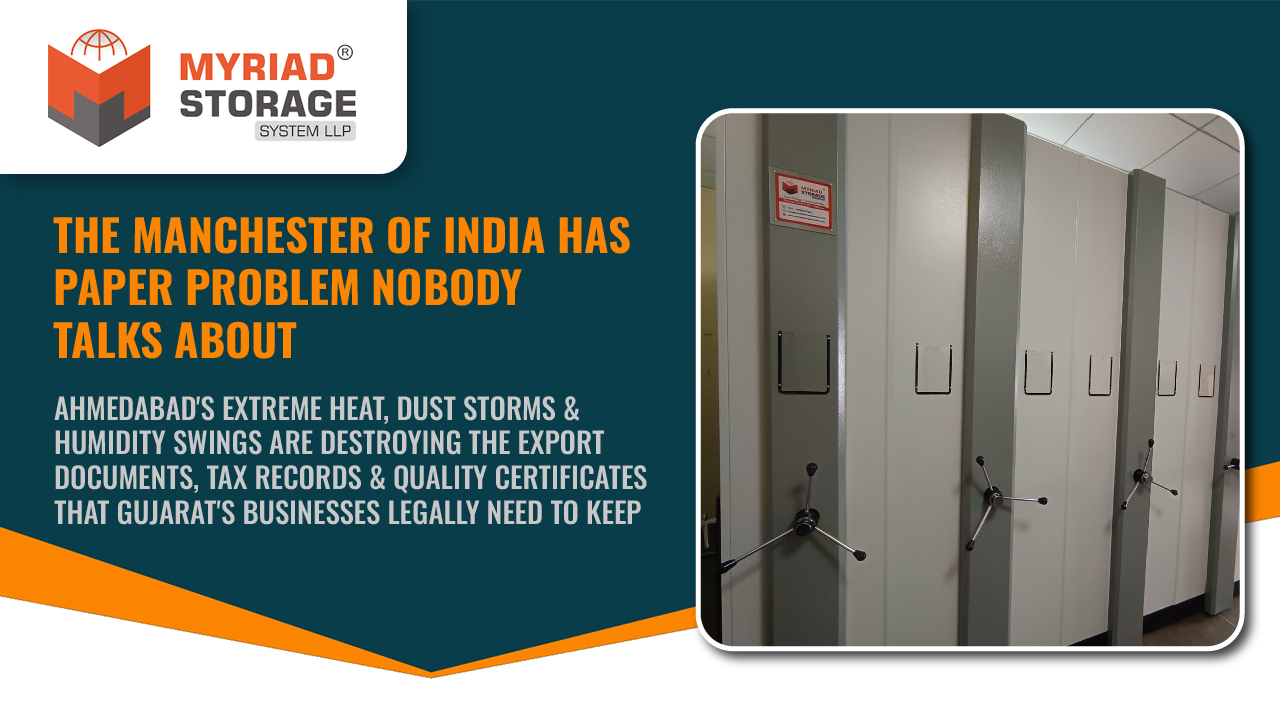
A file compactor storage system seals documents away from these swings. Bays stay compacted together when not in use, creating a semi-enclosed environment where temperature and humidity fluctuations reach the paper far less than in an open almirah or ventilated filing cabinet. In a city where the air itself changes character every few months, that isolation is the most effective protection your records can get.
Why Climate Swings Damage Documents More Than Steady Heat or Steady Humidity
Most people assume that extreme heat is the biggest threat to paper. It is not. Chennai’s humidity is a bigger threat than Delhi’s heat. But neither is as destructive as what Ahmedabad’s documents face — the constant cycling between extremes.
What happens during the dry-heat months (March to June):
Ahmedabad’s humidity drops to 33 to 34 per cent — among the lowest of any major Indian city. Temperatures reach 41 to 43°C, with peaks touching 46°C during heat waves. Paper stored in these conditions loses moisture rapidly. The cellulose fibres that give paper its flexibility dry out and become rigid. The result: brittleness, edge curling, and micro-cracking along fold lines.
A document that has been through three Ahmedabad summers becomes noticeably stiffer and more fragile than the same document stored in a climate-controlled environment. Fold lines that were flexible when the document was new become weak points where the paper will crack and tear.
What happens during the monsoon (July to September):
Within weeks, the humidity spikes from 33 per cent to 80 to 90 per cent. Paper that has spent months losing moisture now absorbs it rapidly. The dried, brittle fibres swell unevenly — some areas absorb faster than others depending on ink coverage, paper grade, and position in the file.
This uneven re-absorption causes warping, cockling (wavy distortion across the page surface), and adhesion between pages that are pressed together in files. Documents that curled at the edges during summer now flatten unevenly during monsoon, leaving permanent waves.
The destructive cycle:
The damage is not from the heat alone or the humidity alone. It is from the repeated cycling — dry-brittle, wet-swollen, dry-brittle, wet-swollen — year after year. Each cycle weakens the paper’s fibre structure further. After 3 to 5 years of this cycling in an unprotected almirah, documents that started life as crisp, legible pages become yellowed, wavy, brittle sheets that crack when handled.
This cycling effect is well documented in conservation science. Paper conservators call it “mechanical fatigue” — the same process that causes a metal wire to break if you bend it back and forth repeatedly. Each bend is harmless on its own. The accumulated cycling is what causes failure.
No other major Indian city has this extreme a swing. Chennai is consistently humid. Delhi is consistently polluted. Bangalore is consistently moderate. Ahmedabad goes from one extreme to the other — twice a year, every year.
The Dust Factor — Kutch and Rajasthan Don't Stay in the Desert
Ahmedabad sits at the eastern edge of the Kutch desert and downwind from Rajasthan’s Thar Desert. During pre-monsoon months (April to June), hot westerly winds carry fine sand and dust particles across the Kutch and deposit them across the city.
These are not ordinary urban dust particles. Desert dust is primarily silica — hard, abrasive mineral particles that scratch paper surfaces on contact. When a dusty file is pulled from a shelf, the friction between the dust layer and the paper surface creates micro-abrasion that damages the print and weakens the fibre.
The dust also carries alkaline salts from the Rann of Kutch — a salt marsh that produces fine salt-dust aerosols during the dry season. These salts deposit on paper and metal surfaces. On paper, they create localised chemical reactions that accelerate yellowing. On metal almirahs, they contribute to corrosion — especially when monsoon humidity arrives and the salt absorbs moisture.
A standard metal almirah with ventilation slats provides zero protection against this dust. The slats are designed for airflow — and in Ahmedabad’s pre-monsoon winds, that airflow carries desert dust directly onto the documents inside.
What Ahmedabad's Industries Must Store — And Why the Volume Is Staggering
Ahmedabad is not a single-industry city. It is a multi-industry powerhouse where every sector generates massive documentation requirements.
Textile and garment industry
Gujarat’s textile sector produces $5.75 billion in exports annually. Every export shipment generates a documentation trail: buyer purchase orders, proforma invoices, commercial invoices, packing lists, bills of lading, certificates of origin, GST invoices, shipping bills, bank realisation certificates, and DGFT (Directorate General of Foreign Trade) filings.
A mid-sized textile exporter shipping 50 consignments per month generates 500 to 750 pages of export documentation per month — 6,000 to 9,000 pages per year. Under GST rules, these records must be retained for 6 years from the due date of filing the annual return. Under DGFT regulations, export records must be retained for 3 to 5 years.
A textile company that has been exporting for 10 years has 60,000 to 90,000 pages of live export documentation that must remain retrievable.
Diamond and gem industry
Gujarat processes approximately 90 per cent of the world’s diamonds. Ahmedabad and nearby Surat are the global centres for diamond cutting and polishing. Every stone generates documentation: rough diamond import records, Kimberley Process certificates, grading reports, customs entries, buyer invoices, and export documentation. The documentation density per unit value is among the highest of any industry.
Pharmaceutical manufacturing
Zydus Lifesciences (headquartered in Ahmedabad), Torrent Pharmaceuticals, Intas Pharmaceuticals, and Cadila Healthcare all operate from the city. Pharmaceutical documentation requirements — batch records, stability data, regulatory filings — are as intensive as described in our Hyderabad pharma storage guide. Ahmedabad’s pharma companies face the same documentation volumes plus the added climate challenge of extreme heat and humidity swings.
Chemical manufacturing
Naroda and Vatva industrial estates host hundreds of chemical manufacturers. Each facility maintains material safety data sheets, production records, pollution control board filings, environmental compliance documentation, and hazardous material handling records. Chemical industry records must be retained for 5 to 10 years under various environmental regulations.
GIFT City — International Financial Services
Gujarat International Finance Tec-City (GIFT City) in Gandhinagar is India’s first operational international financial services centre. Financial institutions, insurance companies, and fund management firms operating here maintain documentation under both Indian and international regulatory frameworks — doubling the documentation burden compared to a standard domestic office.
Ahmedabad's Business Zones — Where the Paper Piles Up
CG Road and Navrangpura
Ahmedabad’s premier commercial corridor — corporate offices, professional services firms, banks, and administrative headquarters. Many buildings are 20 to 30 years old with record rooms that were designed for a fraction of the current document volume. These offices face the full impact of Ahmedabad’s climate swing — no basements (flooding risk during monsoon), no climate-controlled record rooms, and standard almirahs that provide zero environmental protection.
SG Highway (Sarkhej-Gandhinagar Highway)
The new corporate corridor — modern glass-facade offices housing IT companies, consulting firms, BFSI operations, and pharma corporate offices. While the buildings are newer, the record rooms are typically afterthoughts — utility rooms or converted storage spaces without climate control. The sealed bay environment of a file compactor is especially valuable here because it provides passive climate protection without requiring HVAC modifications to the record room.
Ashram Road
Ahmedabad’s traditional business spine along the Sabarmati riverfront — textile trading houses, banks, insurance companies, and government offices. Many businesses here have operated for decades, accumulating 20 to 30 years of paper records in almirahs that are themselves corroding from years of Ahmedabad’s climate cycling.
Naroda and Vatva Industrial Estates
Ahmedabad’s industrial backbone — chemical manufacturers, pharmaceutical production units, engineering workshops, and packaging companies. Industrial record rooms here face the worst conditions: factory heat adds to ambient temperatures, industrial dust adds to desert dust, and ventilation designed for factory airflow channels hot, dusty air directly into the record room.
Sanand and Changodar
The manufacturing corridor west of Ahmedabad — home to Tata Motors (previously), Ford (previously), and hundreds of auto component and consumer goods manufacturers. Production records, quality certificates, supplier documentation, and statutory compliance files are stored in factory environments where ambient temperatures routinely exceed 40°C for 4 months of the year.
How a File Compactor Protects Against Ahmedabad's Climate Swings
A file compactor storage system addresses Ahmedabad’s specific threats through passive environmental isolation — no electricity, no AC, no filters, no maintenance.
Against dry heat and humidity swings: Sealed bays create a microenvironment where temperature and humidity changes reach the documents far more slowly and with far less intensity than in the open room. When the room swings from 33 per cent to 80 per cent humidity over monsoon weeks, the documents inside compacted bays experience a much smaller, much slower swing. This reduces the expansion-contraction cycling that causes mechanical fatigue in paper fibres.
Against desert dust: Compacted bays eliminate the air gaps that allow dust particles to settle on documents. Unlike almirahs with ventilation slats that channel dusty air directly onto files, a compactor’s panel-to-panel contact blocks airborne particles when bays are closed. Documents are only exposed to room air for the brief moments when a specific bay is opened for retrieval.
Against salt-dust corrosion: The 60 to 80 micron electrostatic powder coating on CRCA steel creates a smooth, non-porous surface that does not absorb salt-dust or moisture. This coating maintains its integrity through Ahmedabad’s heat-monsoon cycling for 15+ years — unlike standard almirah paint that begins flaking within 3 to 5 years.
Against the cumulative year-over-year effect: Each year of sealed storage reduces the cumulative damage compared to each year of open storage. After 5 years, the difference between a compactor-stored document and an almirah-stored document in Ahmedabad is dramatic — the compactor-stored document remains crisp, flat, and legible while the almirah-stored document shows visible yellowing, warping, and brittleness.
Ahmedabad's Climate Swing — The Paper Destruction Cycle
How the annual swing between bone-dry heat and monsoon humidity destroys documents faster than either extreme alone
Climate data: climatestotravel.com, IMD, Nirma University · Textile data: Gujarat Textile Policy, DGFT
See Myriad's File Compactor Range → · Get a Free Site Survey in Ahmedabad →
What to Do Before Ahmedabad's Next Summer
Ahmedabad’s most damaging period — the pre-monsoon heat from March to June — is when documents lose the most moisture and become most vulnerable. Here is what to do before it arrives:
Assess your record room temperature. If the room does not have AC and faces direct afternoon sun, internal temperatures may exceed 45°C during peak summer. This is accelerated aging for every document in the room.
Move critical records off bottom shelves and away from exterior walls. Exterior walls absorb solar heat and radiate it into the room. Bottom shelves near the floor accumulate the most dust. Upper shelves on interior walls are the least-bad position in an unprotected almirah.
Install a file compactor before summer. A file compactor with raised rail installation, sealed bay construction, and corrosion-resistant powder coating provides passive protection against all of Ahmedabad’s climate threats simultaneously. Once installed, it requires zero electricity, zero maintenance, and zero ongoing cost.
Create digital backups of irreplaceable records. Export documentation, signed contracts, customs filings, and tax assessment records should have digital copies in cloud storage. The physical originals remain legally necessary — but the information survives even if the paper degrades.
Why Myriad for Ahmedabad and Gujarat Installations
Myriad Storage System has completed 500+ installations across India — including cities with extreme climatic conditions from Mumbai’s coastal humidity to Delhi’s pollution to Chennai’s cyclone flooding. Ahmedabad’s climate presents a different but equally demanding challenge, and our systems are built for it.
CRCA steel with 60 to 80 micron electrostatic powder coating. Engineered to resist both the dry-heat corrosion acceleration and the monsoon-humidity corrosion spike that Ahmedabad’s annual cycle produces.
Pan-India delivery with dedicated Gujarat project coordination. Site survey, layout design, manufacturing at our ISO 9001:2015 certified Vasai factory, and professional installation — managed as a single project with a dedicated coordinator for Ahmedabad, Surat, Vadodara, and all of Gujarat.
Enterprise clients across industries. ISRO, SBI, Tata, L&T, JSW, TVS, Bharat Electronics Limited, WAAREE, Berger, Hikvision, and HP Gas.
Ahmedabad swings from 33% to 90% humidity every year. Your documents feel every cycle.
How Many More Summers Can Your Records Survive?
Request a free site survey for your Ahmedabad office, factory, or trading house. We'll assess your record room's climate exposure and design a file compactor layout that stops the heat-dust-humidity cycle from ageing your documents prematurely.
ISRO, SBI, Tata, L&T
500+ installations
ISO 9001:2015
Myriad Storage System LLP · ISO 9001:2015 · Factory in Vasai, Mumbai · Pan-India delivery & installation