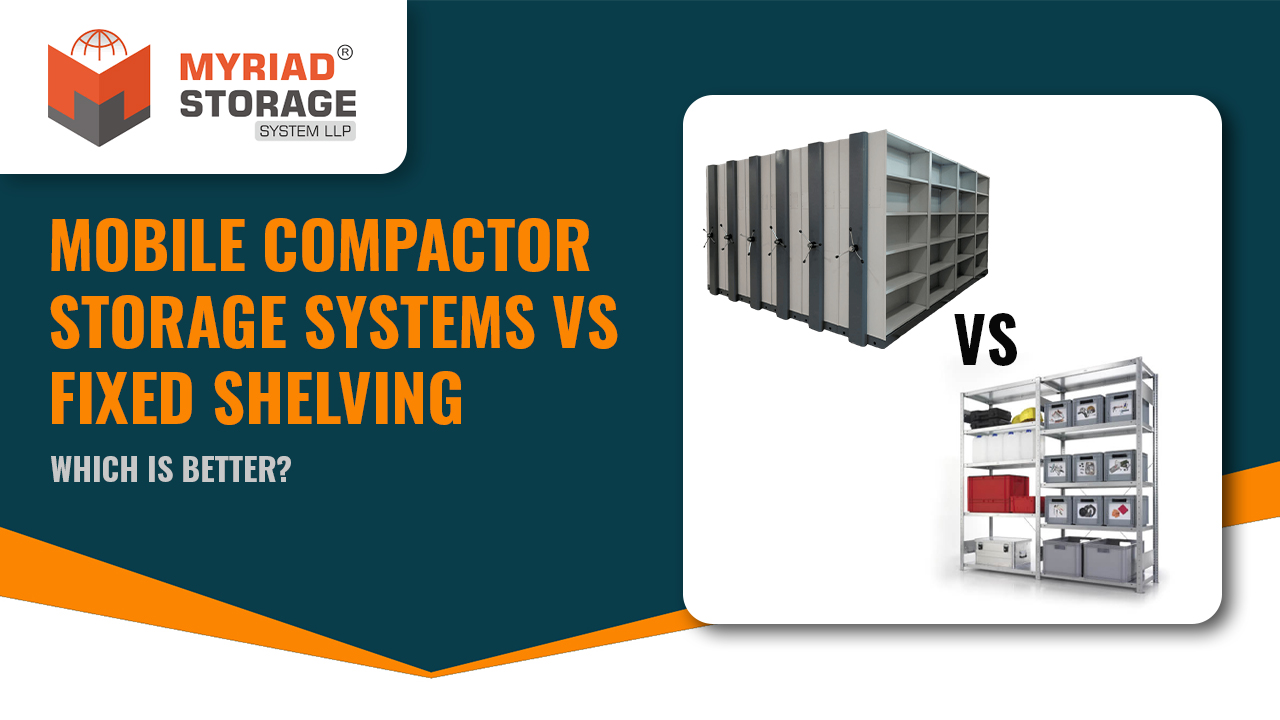
Mobile Compactor vs Fixed Shelving — Which Saves More Space?
If your office or warehouse is running out of storage space, you are probably weighing two options — add more fixed shelving racks or switch to a mobile compactor system.
On the surface, both hold files, boxes, and materials. But the way they use your floor space is fundamentally different — and in Indian cities where commercial rent ranges from ₹60 to ₹168 per sq ft, that difference directly hits your monthly costs.
This comparison breaks down exactly how both systems perform across space efficiency, storage capacity, cost, accessibility, security, and long-term ROI — with real numbers, not generic claims.
The Core Difference in 30 Seconds
Fixed shelving keeps every aisle permanently open. Even when nobody is accessing files, every row has a dedicated walkway consuming floor space.
A mobile compactor storage system mounts shelving units on floor rails. All units slide together when closed, and you open only the one aisle you need at any given time. The rest of the floor space stores materials instead of holding empty air.
That single design difference — permanent aisles versus on-demand aisles — changes everything about how much you can store per square foot.
Same Room. Two Different Layouts.
See how floor space is used in a 200 sq ft room
Side-by-Side Comparison
Here is how the two systems compare across every factor that matters:
Space utilisation — Fixed shelving uses 45–55% of the room for storage, the rest for aisles. A 200 sq ft room gives you roughly 100–110 sq ft of actual storage. Mobile compactors use 80–85% of the room for storage. The same 200 sq ft room delivers 160–170 sq ft of usable storage — 50–70% more capacity from the same room.
Storage capacity — A 200 sq ft room with fixed shelving stores approximately 4,000–5,000 standard office files. The same room with a mechanical compactor stores 8,000–10,000 files — effectively doubling your capacity without adding a single square foot.
Flexibility — Fixed shelving is rigid. Once installed, the layout is set. Adding more storage means buying more racks and finding somewhere to put them. Compactors are modular — you can add bays to an existing rail system and reconfigure shelf heights as needs change.
Accessibility — Fixed shelving gives instant access to every shelf at all times. This is its one genuine advantage. Compactors require you to open an aisle before accessing files — with a hand-wheel this takes 3–5 seconds. For most offices this delay is negligible. For warehouse environments where multiple people need simultaneous access to different rows, fixed shelving may work better.
Security — Fixed shelving offers no built-in security. Anyone who enters the room can access any shelf. Compactors can be fitted with central locking bars, individual bay locks, and electronic access control. This matters for banking compliance (RBI mandates), legal document storage, and healthcare records.
Durability — Fixed shelving lasts 8–12 years. Bolted angle racks tend to loosen over time under heavy loads. Compactors are built with heavier gauge steel and precision rail systems — they last 15–20 years with minimal maintenance.
Installation — Fixed shelving is faster — a 200 sq ft room can be fitted in half a day. Compactors require floor rail installation and alignment — typically 1–2 days. The extra time is a one-time cost that pays back over 15+ years.
Fixed Shelving vs Mobile Compactor
| FACTOR | FIXED SHELVING | MOBILE COMPACTOR |
|---|---|---|
| Space used | 45–55% | 80–85% ✓ |
| Files per 200 sq ft | 4,000–5,000 | 8,000–10,000 ✓ |
| Upfront cost | ₹40K–80K ✓ | ₹3.3L–5.4L |
| 5-year total cost | ₹10.68L (with rent) | ₹5L (one-time) ✓ |
| Instant access | All aisles open ✓ | 1 aisle at a time |
| Security | None built-in | Lockable bays ✓ |
| Lifespan | 8–12 years | 15–20 years ✓ |
| Scalability | Limited | Add bays anytime ✓ |
| Installation time | Half day ✓ | 1–2 days |
| Load capacity/shelf | 75–150 kg | 500–1,000 kg ✓ |
Cost Comparison — The Numbers That Matter
This is where most comparisons stop at “compactors cost more upfront.” That is true — but it completely ignores what happens after the purchase.
Upfront cost
A standard slotted angle rack setup for a 200 sq ft room (8–10 racks) costs approximately ₹40,000–₹80,000 depending on material quality. A 6-bay mechanical hand-wheel compactor for the same room costs ₹3,30,000–₹5,40,000 installed. The compactor is 5–7x more expensive upfront. No argument there.
But here is what fixed shelving actually costs you
Your 200 sq ft room with fixed shelving fills up after 2–3 years. Now you need more space. In Mumbai (₹168/sq ft), an additional 100 sq ft costs ₹16,800 per month — ₹2,01,600 per year. Over 5 years you spend ₹10,08,000 on rent for overflow storage alone.
The compactor that cost ₹5,00,000 would have eliminated the need for that extra space entirely — by doubling the capacity of the room you already had.
5-year total cost (Mumbai, 200 sq ft room):
Fixed shelving: ₹60,000 (racks) + ₹10,08,000 (extra rent) = ₹10,68,000
Compactor: ₹5,00,000 (one-time) + ₹0 (no extra rent) = ₹5,00,000
The compactor saves ₹5,68,000 over 5 years — and lasts another 10–15 years beyond that.
Cost per file stored
Fixed shelving: ₹60,000 ÷ 5,000 files = ₹12 per file Compactor: ₹5,00,000 ÷ 10,000 files = ₹50 per file upfront
But factor in the 20-year lifespan versus 10 years for shelving, plus rent savings, and the compactor’s effective cost per file drops below ₹10 — cheaper than fixed shelving over its lifetime.
When Fixed Shelving Is the Better Choice
Compactors are not always the answer. Fixed shelving makes more sense in these situations:
Temporary or short-term storage. If you are storing materials for less than 2 years — a project office or seasonal inventory — the compactor investment does not pay back fast enough. Fixed racks at ₹40K–80K make more sense.
Very frequent multi-user simultaneous access. If 3–4 people need to pull items from different rows at the same time, all day long, compactors create a bottleneck. Warehouse pick-and-pack operations with high daily access volume may be better served by fixed racks.
Very light storage in tiny rooms. A 50 sq ft cupboard storing 500 files that will not grow — a ₹15,000 steel almirah does the job. A compactor would be overengineering.
Budget-constrained short-term. If cash flow is tight and the priority is “get storage working this week,” fixed shelving is faster and cheaper. Just know you will likely outgrow it within 2–3 years.
When a Compactor Is Clearly the Better Choice
You are paying high rent. Any office in Mumbai, Bengaluru, Delhi-NCR, Pune, or Chennai where commercial rent exceeds ₹60/sq ft. Rent savings will pay for the compactor within 18–30 months.
You have compliance-driven storage. Banks (RBI: 7–10+ year document retention), hospitals (NABH record requirements), legal firms, and government departments all face mandatory long-term storage. These files are not going away. Compactors provide the capacity and security to handle this permanently.
For banking-specific requirements: Banking & Finance Storage Compliance Under RBI Guidelines 2026
Your storage volume is growing. If you added more than 1,000 files in the past 12 months and the trend continues, fixed shelving will run out before your lease renewal. A compactor absorbs growth within the existing room.
You need physical security. Law firms, defence establishments, financial services, and healthcare need access-controlled storage. Compactors with locking mechanisms provide this inherently.
You are storing heavy items. Spare parts, tooling, metal components — heavy-duty compactors handle 500–1,000 kg per shelf. Standard slotted angle racks are rated for 75–150 kg and sag under sustained loads.
Should You Get a Compactor or Stick with Shelving?
Answer honestly — we will tell you straight
QUESTION 1 OF 4
Is your current storage room already full or nearly full?
QUESTION 2 OF 4
Are you paying more than ₹60/sq ft in commercial rent?
QUESTION 3 OF 4
Will you need this storage for more than 3 years?
QUESTION 4 OF 4
Do you need lockable, secure storage?
Industry-Specific Recommendations
Banking and finance — Compactor. No question. RBI compliance requires long-term retention, and branch record rooms are 150–300 sq ft. File compactor systems double the capacity and provide locking security that audits require.
Corporate offices — Compactor for the central record room. Fixed shelving (or almirahs) for individual department storage with light needs.
Warehouses and factories — Depends on the zone. Compactors for spare parts stores, maintenance inventory, and sample archives. Fixed racking for active pick-and-pack zones with forklifts.
Hospitals and clinics — Compactor for medical records. Patient files, billing, and insurance paperwork accumulate rapidly. NABH accreditation requires defined retention periods.
Libraries — Compactor. Library systems are designed for book weight and high-density shelving. 50–70% space recovery is significant for institutions.
Government offices — Compactor. Paper-heavy workflows, chronic space shortages, and DPDPA 2025 retention requirements make it the practical long-term solution.
Frequently Asked Questions
Can I convert my existing fixed shelving room to compactors?
Yes. The existing racks are removed, floor rails are installed, and compactor bays are fitted. Myriad handles the full conversion including removal of old racks, floor preparation, and rail installation.
Do compactors work on upper floors?
Yes, with a structural check. A fully loaded 6-bay office compactor weighs 3,000–5,000 kg. Most RCC floors handle this comfortably, but older buildings should be assessed.
How long does installation take?
For a standard 4–8 bay office compactor, 1–2 days. Larger warehouse installations take 3–5 days.
What maintenance do compactors need?
Minimal. Rail cleaning every 6 months, wheel lubrication once a year, periodic bracket tightening. No specialist technician needed.
Can I add more bays later?
Yes — if the rail system is designed with expansion in mind. Myriad recommends extending rails 1–2 bays beyond your current need for easy bolt-on expansion later.
The Bottom Line
Fixed shelving is cheaper upfront, faster to install, and gives instant access to every shelf. If your storage needs are small, temporary, and unlikely to grow, it works fine.
But for any Indian business paying commercial rent and dealing with growing storage volumes — which is most offices, banks, hospitals, and warehouses — a mobile compactor system pays for itself within 18–30 months and then saves money every month for the next 15+ years.
The question is not “can I afford a compactor?” The question is “can I afford to keep paying rent on empty aisles?”
What You Actually Pay Over 5 Years
Mumbai rates (₹168/sq ft) — 200 sq ft room that runs out of space in year 2
Still Paying Rent on Empty Aisles?
A free site survey shows exactly how much space a compactor recovers from your existing room — and whether it makes financial sense for your setup. No pressure. Just numbers.
500+ installations across India since 2018 · Trusted by ISRO, SBI, Tata & L&T