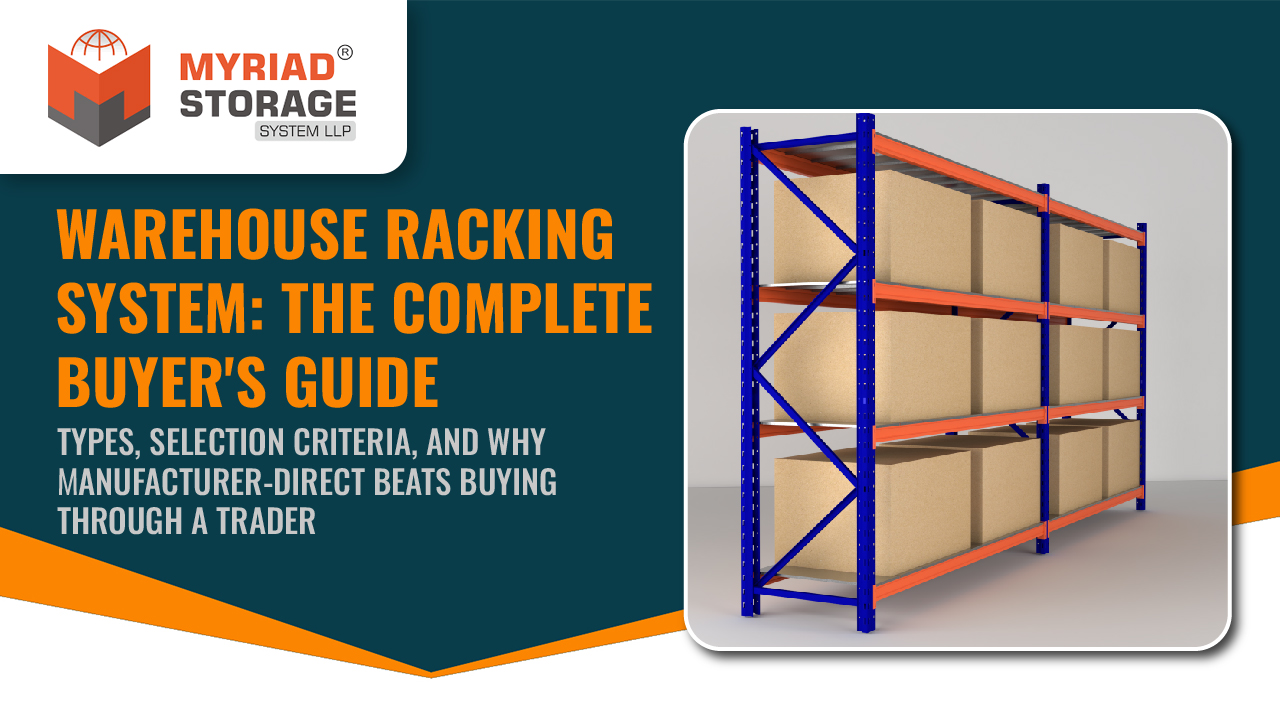
Warehouse Racking System: The Complete Guide to Types, Selection, and Choosing the Right Manufacturer
A warehouse that runs out of floor space doesn’t actually need a bigger building — it usually needs a better warehouse racking system. Whether you’re storing raw material, finished goods, or spare parts, the right racking setup changes how much you can hold, how fast your team can move, and how safely your inventory sits on the shelf.
This guide covers what a warehouse racking system actually is, the main types used across Indian warehouses today, how to choose the right one for your operation, and — something most guides skip — why it matters whether you buy from a manufacturer or a trader.
What Is a Warehouse Racking System?
A warehouse racking system is a structured framework of vertical uprights and horizontal beams designed to store palletized or boxed goods above floor level, in an organized, retrievable layout. Instead of stacking goods directly on the floor — which wastes vertical space and makes stock hard to access safely — a racking system lets a warehouse use its full height, keep inventory organized by SKU or batch, and move goods in and out with a forklift or manual trolley without disturbing the rest of the stock.
A good racking system does three things at once: it multiplies usable storage space, it protects the goods sitting on it, and it keeps the people working around it safe.
Types of Warehouse Racking Systems
Not every warehouse needs the same kind of racking. The right type depends on how heavy your goods are, how often you need to access them, and how your floor space is shaped. Here are the four types most Indian warehouses choose between;
Heavy Duty Racking
Built for the heaviest loads — raw material, machinery parts, bulk packaged goods — heavy duty racking uses thicker-gauge steel uprights and beams designed to carry significantly more weight per shelf than standard shelving. It’s the default choice for manufacturing units, large distribution centers, and anywhere goods are stored in bulk rather than individual small cartons.
Pallet Racking
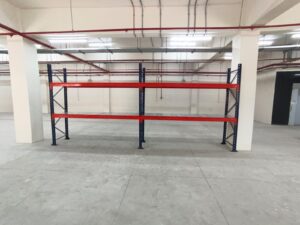
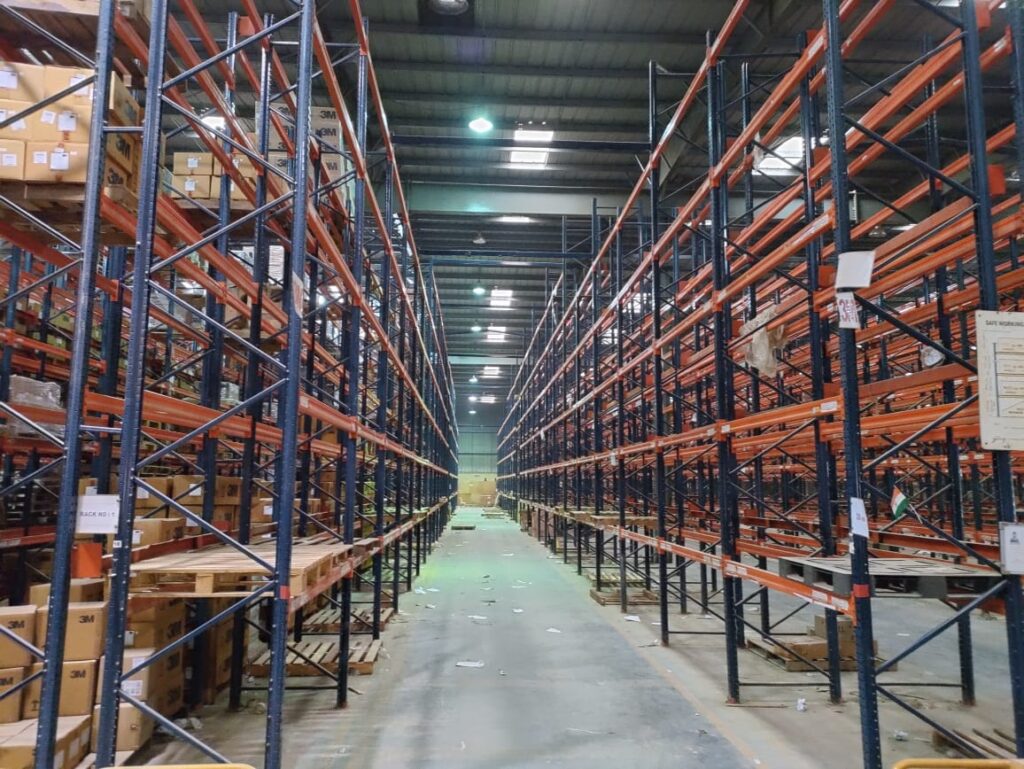
Pallet racking systems are the most common racking format in Indian warehouses, built specifically to hold palletized loads and give forklifts direct access to every pallet position. Selective pallet racking (where every pallet is individually accessible) is the standard configuration; drive-in variants trade some accessibility for higher storage density when you’re storing large quantities of the same SKU.
Mezzanine Floor Racking
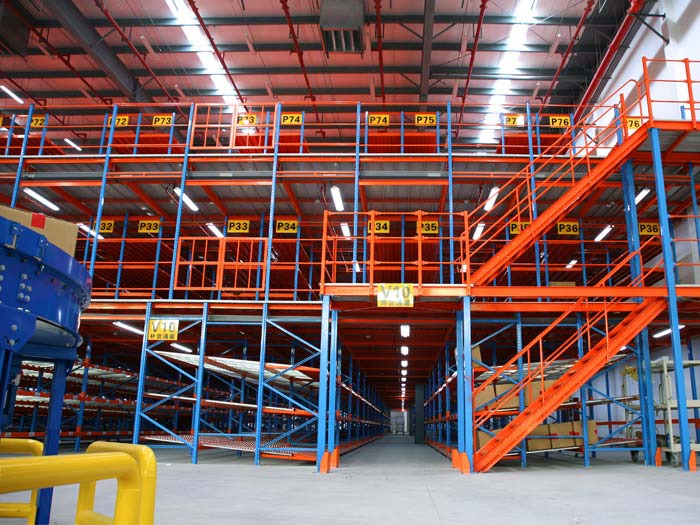
When a warehouse can’t expand outward, mezzanine storage systems let it expand upward instead — adding an intermediate structural floor within the existing building height to effectively double usable floor area without new construction. It’s one of the fastest ways to add capacity in warehouses where land or lease costs make expansion expensive, and it pairs naturally with racking installed both above and below the new floor.
Cantilever Racking
For long, awkward, or irregularly shaped items — pipes, timber, steel sections, furniture — cantilever racking uses arms extending from a single vertical column instead of enclosed bays, so long items can be loaded and unloaded from the side without obstruction.
4 Types of Warehouse Racking, At a Glance
Picking the right one depends on load, access frequency, and floor layout
Heavy Duty Racking
Thicker-gauge steel for bulk raw material and heavy packaged goods
Pallet Racking
Selective or drive-in formats built for forklift-accessed pallets
Mezzanine Floor
Adds a structural floor to double usable space without new construction
Cantilever Racking
Open-arm design for long, irregular items like pipes and timber
Buying From a Trader
- Custom requests routed back through their supplier
- Load-rating accountability gets unclear
- Reseller margin baked into price
- After-sales support depends on someone else
Buying From a Manufacturer
- Bay sizes and load ratings adjusted in-house
- Direct accountability for structural rating
- No reseller margin — direct pricing
- Same team handles after-sales support
ISRO. SBI. Tata. 8 Sectors. 1 Manufacturer.
How to Choose the Right Racking System for Your Warehouse
Picking a racking system isn’t just about picking a type — it’s about matching the system to how your warehouse actually operates. Four factors decide the right fit:
Warehouse layout and space. Measure your available floor area, ceiling height, and aisle width before choosing a system. A low-ceiling warehouse gets more value from a wider footprint of selective racking; a tall one gets more value from vertical density or a mezzanine floor.
Load capacity. Know the actual weight of what you’re storing — per unit and per shelf — before finalizing a design. Undersizing a racking system’s load rating is one of the most common (and most dangerous) mistakes warehouses make.
Nature of your inventory. Fast-moving SKUs that need constant individual access suit selective pallet racking; slow-moving bulk stock of the same item suits drive-in or high-density formats instead.
Equipment compatibility. Your racking’s aisle width and bay depth need to match the forklifts or material handling equipment you actually run — not the equipment on a spec sheet.
Safety and compliance. Racking is a structural installation, not furniture. It should be designed to safely carry its rated load with a margin of safety, installed level and properly anchored, and inspected periodically for damage or overloading. Indian warehouse racking installations are also expected to meet general factory and workplace safety norms overseen by bodies like the Directorate General Factory Advice Service & Labour Institutes (DGFASLI), alongside relevant structural design standards. A racking supplier that can speak to this — not just sell you steel — is worth the extra question in your evaluation.
Manufacturer vs. Trader: Why It Matters
Here’s a distinction most racking guides skip entirely, and it’s one of the most consequential decisions you’ll make: are you buying from the company that actually fabricates the racking, or from a trader reselling someone else’s product?
It changes more than you’d expect:
- Customization speed. A manufacturer can adjust bay sizes, beam lengths, or load ratings in-house. A trader has to route every custom request back through their own supplier, adding time and margin at every step.
- Load testing and accountability. A manufacturer stands behind the structural rating of what it fabricates. With a trader, accountability for a load-bearing failure can get murky fast — exactly when you don’t want ambiguity.
- Pricing. Buying direct removes a reseller’s margin from the equation.
- After-sales support. If a beam needs replacing or a bay needs modifying six months after installation, a manufacturer with its own fabrication facility can respond directly. A trader depends on whoever they originally sourced from.
- Direct engineering conversation. You’re talking to the people who actually design and build the system, not a sales layer repeating specs from a catalogue.
This is a genuinely useful question to ask any racking supplier before you sign off: do you manufacture this yourself, or are you reselling it?
Trusted by Industry Leaders
Myriad Storage System is a Mumbai-based manufacturer — not a trader — with racking and storage installations across sectors that don’t usually appear on the same client list: space research, banking, automotive, infrastructure, steel, defence electronics, and renewable energy. Organizations including ISRO, SBI, Tata, L&T, Bharat Electronics Limited, JSW, TVS, and WAAREE have installed Myriad storage and racking systems, backed by 500+ installations across India and a Make in India manufacturing base.
Get Your Racking Designed by the People Who Actually Build It
Skip the reseller layer. Talk directly to the manufacturer behind 500+ warehouse racking installations across India — and get a system engineered for your exact space, load, and access needs.
Manufacturer Direct
Pan-India Delivery & Installation
Direct After-Sales Support
Installation & After-Sales Support
A racking system is only as good as its installation. Myriad handles design, fabrication, delivery, and on-site installation as one connected process — with pan-India delivery and installation support, so the team that engineers the racking is also accountable for how it goes up on your floor. Post-installation, periodic inspection and support for reconfiguration (as your storage needs change) stay with the same manufacturer, not a reseller who’s since moved on to the next order.
Frequently Asked Questions
What is a warehouse racking system?
A warehouse racking system is a structural framework of vertical uprights and horizontal beams used to store goods above floor level in an organized, easily retrievable layout, making full use of a warehouse’s vertical space instead of stacking goods directly on the floor.
What are the main types of warehouse racking systems?
The most common types used in Indian warehouses are heavy duty racking, pallet racking (selective and drive-in), mezzanine floor racking, and cantilever racking — each suited to different load weights, access needs, and floor layouts.
How do I choose the right racking system for my warehouse?
Match the system to your warehouse layout and ceiling height, the actual load weight of your inventory, how often each SKU needs to be accessed, and the forklift or material handling equipment you already run. Safety and compliance with factory and structural standards should also factor into the decision.
What's the difference between buying racking from a manufacturer versus a trader?
A manufacturer fabricates the racking in-house, which typically means faster customization, direct accountability for load ratings, better pricing (no reseller margin), and faster after-sales support. A trader resells racking sourced from someone else, adding a layer between you and the people who actually built it.
How long does a warehouse racking system last?
A well-designed racking system, properly installed and not overloaded beyond its rated capacity, is built to last for many years of continuous industrial use — periodic inspection and correct load management are the biggest factors in long-term durability.
Who are the leading warehouse racking manufacturers in India?
India has a mix of large trading-led suppliers and dedicated manufacturers. When evaluating one, the most useful question to ask is whether they manufacture the racking themselves or resell it — manufacturers like Myriad Storage System, which fabricate in-house and deliver pan-India, offer more direct accountability and customization than resellers.