The Hidden Cost of Kochi's Humidity: Why Ordinary File Storage Fails in Kerala
Walk into almost any record room in Kochi that’s more than five years old, and you’ll see it before anyone tells you: rust blooming along the bottom edges of steel shelving, drawer runners that stick or grind, hinges gone orange and stiff. It’s not poor maintenance. It’s Kerala’s climate doing exactly what humid coastal air does to ordinary mild steel — slowly, relentlessly, and far faster than most facility managers expect.
Kochi sits on the Arabian Sea coast with year-round humidity routinely above 75%, heavy monsoon rainfall from June through September, and salt-laden air that travels further inland than most people assume. For IT offices in Kakkanad, PSU regional headquarters in Ernakulam, hospitals, and manufacturing plants across the state, this isn’t a minor inconvenience — it’s a structural threat to every physical record, file, and piece of inventory sitting in standard steel storage.
Why Ordinary Steel Storage Fails Faster in Kerala Than Almost Anywhere Else in India
Most filing cabinets, open shelving units, and budget storage racks are built from standard mild steel with a basic painted finish. That finish is usually adequate in drier parts of India. In Kochi’s climate, it isn’t.
Humidity above 70% accelerates oxidation on exposed steel edges — and Kochi sits above that threshold for most of the year, spiking further during monsoon months when moisture in the air is constant. Add salt particles carried inland from the coast, and you have two corrosion accelerants working together instead of one. The result: hinges seize, drawer rails warp, and paint finishes bubble and flake within a few years — sometimes faster in ground-floor archive rooms or storage areas without proper climate control.
This matters more than it might seem. A rusted shelf isn’t just an aesthetic problem. Corrosion weakens structural load-bearing points over time, drawer mechanisms that grind and stick slow down staff trying to retrieve records quickly, and — most seriously — poorly sealed, corroding cabinets let humidity reach the paper and documents stored inside them, leading to mold, warping, and permanent damage to records that may be legally required to be preserved for years.
Kerala's Humidity vs. Standard Steel Storage
What happens to ordinary filing cabinets in Kochi's coastal climate — and what doesn't
What Kerala Businesses Actually Need From Their Storage
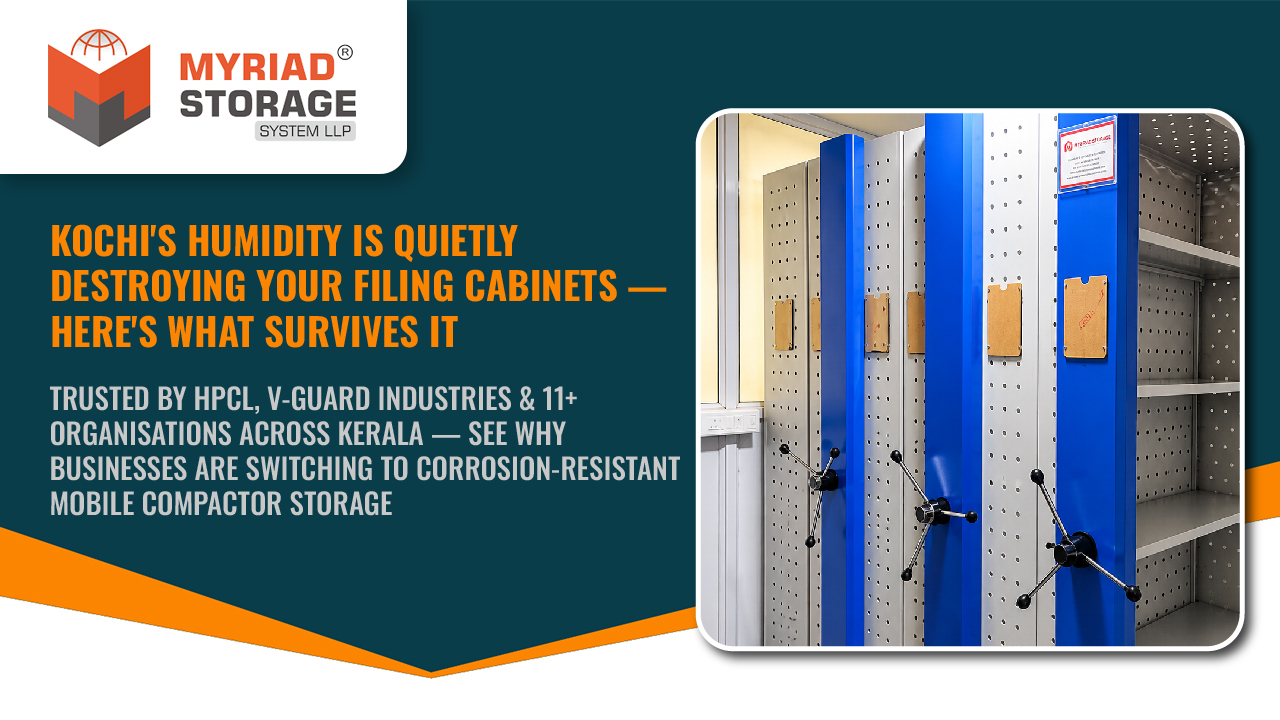
The fix isn’t complicated, but it does require moving away from generic storage furniture toward systems specifically engineered to resist this environment. Mobile compactor storage systems — high-density storage where shelving units are mounted on floor-fitted rails and slide together to eliminate fixed aisles — solve two problems at once for Kochi businesses: they reclaim significant floor space in a city where commercial rents run high, and when built correctly, they hold up against the exact conditions that destroy ordinary steel shelving.
The difference comes down to construction. Myriad’s compactor systems are built from high-grade CRCA (Cold Rolled Close Annealed) steel — a denser, more consistent steel than the mild steel used in most budget storage — finished with a corrosion-resistant powder coating rather than standard paint. Powder coating creates a much thicker, more durable barrier against moisture than liquid paint, which is precisely why it holds up in coastal and high-humidity environments where standard finishes fail within a few years.
Already Proven Across Kerala
These aren't theoretical applications. Myriad storage systems are already supporting organisations across Kerala, from Kochi to Trivandrum, Kozhikode, Kollam, Idukki and Pathanamthitta.
From PSU documentation and corporate records to patient files and engineering documents, the same space-saving storage approach is being used across very different working environments.
The Space Problem Kochi Businesses Are Also Solving
Corrosion resistance solves a durability problem. Space efficiency solves a cost problem — and in Kochi, that cost is real and rising. Commercial rents in business districts like Kakkanad (Infopark), Palarivattom, Edappally, and Vyttila range from ₹40 to ₹85 per square foot per month, and Kochi’s growing IT sector — centered around Infopark — has made competition for good commercial space tighter every year.
A mobile compactor system reclaims up to 70% of the floor space that static shelving would otherwise require, because there’s no need for a permanent aisle beside every single row of storage. Instead, shelves slide together on rails, and only the aisle actually being accessed opens up. For a business paying ₹60-70 per square foot for office space in Kakkanad, every square foot returned from a record room is square footage that doesn’t need to be leased, expanded into, or paid for at all.
Built for Kerala's Specific Storage Needs
Beyond the core structural advantages, several features matter specifically for Kerala’s institutional and corporate storage needs:
Central locking with tiered security — a single key secures all bays simultaneously, with optional individual aisle locks and digital access control available for sensitive records. This matters directly for PSU regional offices managing regulatory documentation, hospitals maintaining confidential patient files, and banks and financial institutions across the state handling records that require restricted access.
Modular, expandable design — bays can be added to an existing rail system as storage needs grow, without replacing the entire installation. For a growing IT company in Kakkanad or a bank branch adding new compliance requirements, this means the system scales with the business rather than needing full replacement every few years.
Portability across office moves — Kochi’s commercial real estate market moves fast, and businesses relocate. Myriad’s modular compactor design allows disassembly and reinstallation at a new site, protecting the investment even if the office itself changes address.
What This Means for Banks, Hospitals, and PSUs Specifically
Kerala’s storage-heavy sectors each have their own version of this problem. Banking and financial institutions — including major players like SBI, Canara Bank, Federal Bank (headquartered in the state), and South Indian Bank — retain years of physical compliance and transaction records that must remain both secure and legible; humidity damage to paper records isn’t just an inconvenience, it can become a genuine compliance and audit problem. Hospitals and healthcare institutions face the same issue with patient records that may need to be produced years later. PSU regional offices managing central government documentation face similar retention requirements with zero tolerance for document degradation.
For all three, the calculation is the same: a storage system that fails to resist Kerala’s climate isn’t a facilities inconvenience — it’s a risk to records the organization is legally or operationally required to keep intact.
Kochi's IT Boom Is Making This Problem More Urgent, Not Less
Kochi’s commercial identity has shifted substantially over the past decade. What was once primarily a port and PSU hub is now Kerala’s fastest-growing IT and technology corridor, centered on Infopark in Kakkanad. That growth has pulled in a wider mix of companies — IT services firms, fintech operations, consulting practices, and corporate back-offices — many of which are leasing space in newer commercial buildings without necessarily thinking through how that space will handle physical records over a five or ten year horizon.
This creates a specific blind spot. A company moving into a modern glass-fronted office in Kakkanad might reasonably assume the building’s climate control solves the humidity problem. In practice, climate control keeps occupied office space comfortable — it does very little for a back-room record archive, a basement storage area, or a ground-floor filing room that isn’t part of the primary HVAC zone. Corrosion doesn’t care how modern the building looks from the outside; it responds to the actual humidity and airflow conditions wherever the steel is sitting.
This is precisely why compactor systems built for the climate matter more in Kochi’s current growth phase than they might have a decade ago. More businesses are storing more physical documentation — contracts, compliance records, HR files, client documentation — in buildings that weren’t necessarily designed with long-term archival conditions in mind.
How to Tell If Your Existing Storage Is Already Failing
Corrosion damage is gradual, which is exactly why it’s easy to miss until it’s already compromised documents. A few practical signs worth checking in any Kochi or Kerala facility:
Look at the base and rear panels of existing steel cabinets first — corrosion typically starts where moisture pools or where airflow is weakest, often at floor level or against exterior-facing walls. Check whether drawer runners move smoothly or require extra force; grinding or sticking mechanisms are frequently an early sign of rust forming on the rail surfaces before it’s visible elsewhere. Look for any bubbling, flaking, or discoloration in the paint finish, particularly around welded joints and corners, since these are typically the first points of failure. And check the documents themselves — any curling, staining, or musty odor in stored paper is a sign that humidity is already reaching the contents, not just the exterior of the cabinet.
If any of these are present, the storage system isn’t simply cosmetically aged — it’s actively in the process of failing, and the rate of failure typically accelerates once corrosion breaches the surface finish and reaches bare steel underneath.
Why Retrofitting Beats Waiting for a Full Failure
Facility managers often delay replacing storage until a cabinet is visibly unusable — drawers that won’t open, shelving that’s structurally unsound. In Kerala’s climate, this is a more expensive way to handle the problem than planning a proactive upgrade, for two reasons.
First, the documents stored inside degrading cabinets are typically damaged well before the cabinet itself becomes unusable, since moisture reaches the contents long before structural failure occurs. Second, an emergency replacement — done reactively after a failure — rarely allows time to plan an efficient layout, meaning the replacement often ends up being another like-for-like static shelving purchase rather than a space-saving upgrade. Planning a compactor system upgrade proactively allows the layout, bay count, and access points to be designed around actual retrieval patterns, rather than rushed into place.
A Practical Starting Point
For any Kochi or Kerala business currently storing records in standard steel shelving or filing cabinets more than a few years old, the questions worth asking are straightforward: is there visible rust or corrosion on existing storage? Are drawer mechanisms sticking or grinding? Is there any sign of moisture reaching stored documents? If any of these are true, the storage system is actively degrading — and the records inside it along with it.
Myriad Storage System LLP, an ISO 9001:2015 certified manufacturer, designs and manufactures every mobile compactor storage system at its Vasai, Maharashtra facility, with each installation custom-built to the client’s floor plan and shipped with professional installation and after-sales support across Kochi, Trivandrum, Kozhikode, Kollam, Pathanamthitta, and Idukki.
Kerala’s climate isn’t going to change. The storage systems built to withstand it are the only long-term fix.
How Many More Monsoons Can Your Records Survive?
Request a free site survey for your Kochi office, warehouse, or record room. We'll assess your storage area's humidity exposure and design a compactor layout built to stop corrosion before it starts.
Corrosion-resistant build
CRCA steel with powder-coat finish, engineered for coastal humidity
Central locking & security
One key secures all bays, with optional tiered access control
Free layout design
Custom bay layout and quotation at no cost